
H.266 / VVC codec approved for 4K and 8K video compression
H.266 / VVC codec approved for 4K and 8K video compression
The Fraunhofer Institute for Telecommunications has announced the approval of a new video codec.

H.266 / VVC was developed with the need for ultra-high definition content in mind and is intended to be the successor to the popular H.264 / AVC and H.265 / HEVC standards, used by more than 10 billion devices. to handle more than 90% of the global video volume.
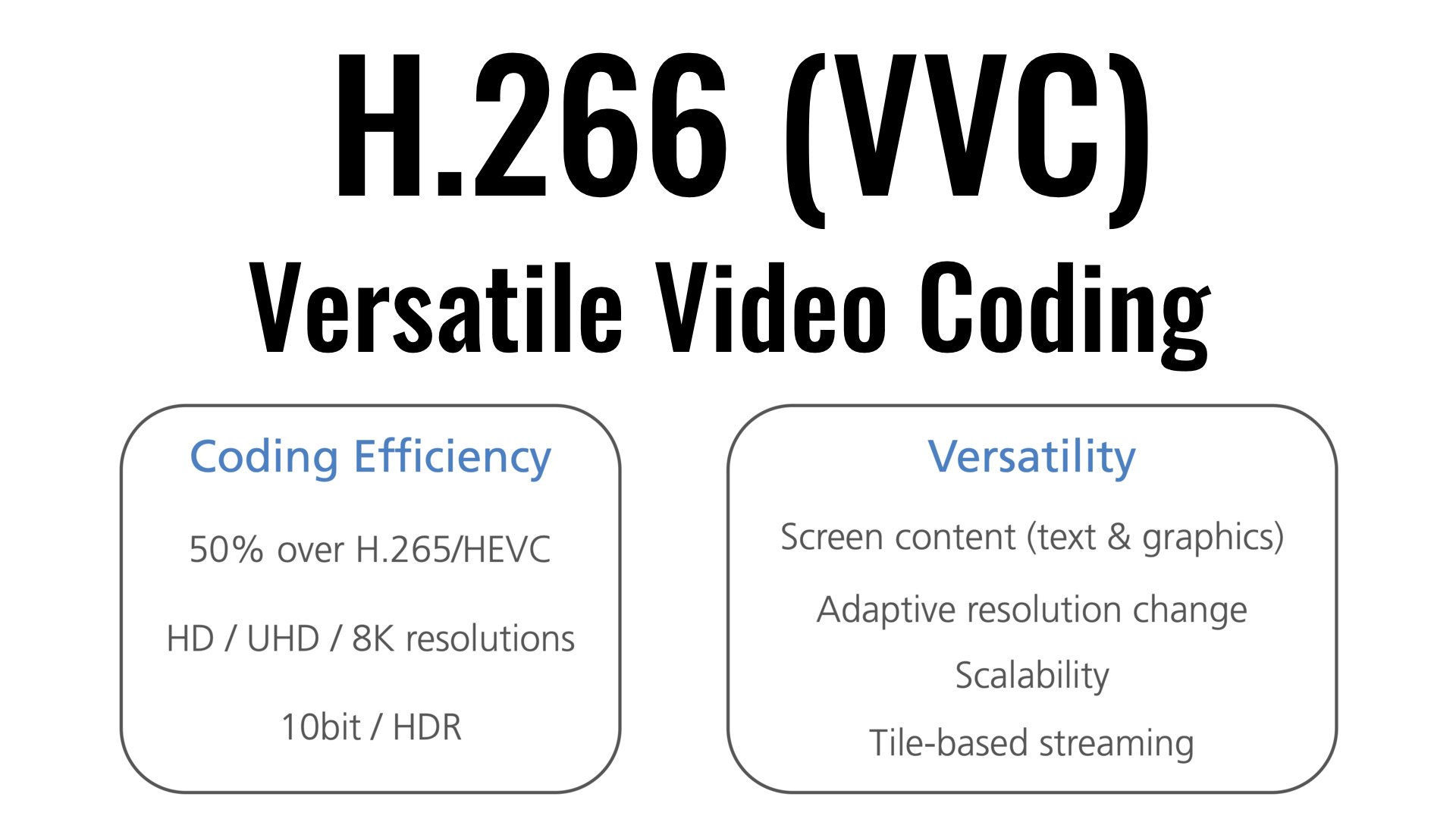
H.266 / VVC (Versatile Video Coding) provides highly efficient transmission and storage of all screen resolutions (from SD and HD to 4K and 8K), supports High Dynamic Range (HDR) video and video 360 degree panoramic … Supports YCbCr color space with 4: 4: 4 and 4: 2: 2 color conversions, color depth from 8 to 16 bpc, and auxiliary channels for data such as depth and transparency.
It is claimed that compared to H.265 (HEVC), the new standard will demonstrate a significant increase in compression ratio and allow a 50% lower bit rate to be used for streaming video with the same quality. For example, if a 90 minute video in UHD quality in H.265 required 10 GB of data transfer, then H.266 will fit in 5 GB while maintaining the same quality level. In comparison, the AV1 format in terms of compression efficiency outperforms HEVC by an average of 17% (at a high bit rate by 30-43%).
The standard has been created for 5 years by the MPEG (ISO / IEC JTC 1) and VCEG (ITU-T) working groups with the participation of Apple, Ericsson, Intel, Huawei, Microsoft, Qualcomm and Sony. The MC-IF (Media Encoding Industry Forum) was established to license overlapping patents, with more than 30 companies and organizations owning the intellectual property used in H.266 / VVC.
The cost of increasing compression efficiency is a significant complication of algorithms, leading to increased computational resource requirements (up to 10 times for encoding and up to 2 times for decoding compared to H.265). Unlike the AV1 video encoding format, the use of H.266 / VVC in your products requires a royalty fee. A reference implementation of an encoder and decoder for H.266 / VVC is expected to be released in the fall.


