H.266 / VVC codec approved for 4K and 8K video compression


Free Download Mp4Gain
picture

H.266 / VVC codec approved for 4K and 8K video compression
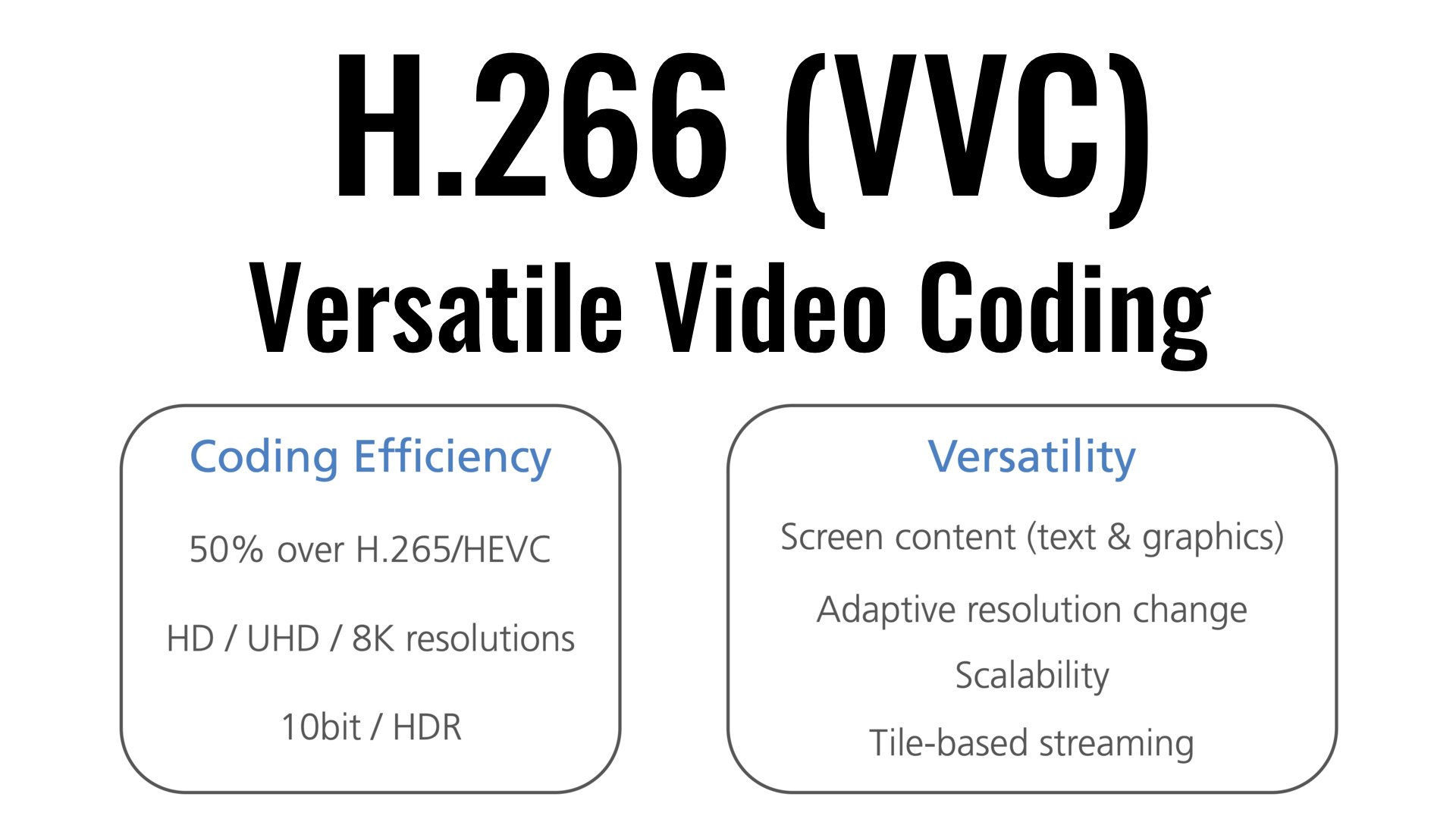
H.266 (VVC)

H.266 / VVC codec approved for 4K and 8K video compression
The Fraunhofer Institute for Telecommunications has announced the approval of a new video codec.

H.266 (VVC)

H.266 / VVC was developed with the need for ultra-high definition content in mind and is intended to be the successor to the popular H.264 / AVC and H.265 / HEVC standards, used by more than 10 billion devices. to handle more than 90% of the global video volume.

H.266 / VVC (Versatile Video Coding) provides highly efficient transmission and storage of all screen resolutions (from SD and HD to 4K and 8K), supports High Dynamic Range (HDR) video and video 360 degree panoramic … Supports YCbCr color space with 4: 4: 4 and 4: 2: 2 color conversions, color depth from 8 to 16 bpc, and auxiliary channels for data such as depth and transparency.

It is claimed that compared to H.265 (HEVC), the new standard will demonstrate a significant increase in compression ratio and allow a 50% lower bit rate to be used for streaming video with the same quality. For example, if a 90 minute video in UHD quality in H.265 required 10 GB of data transfer, then H.266 will fit in 5 GB while maintaining the same quality level. In comparison, the AV1 format in terms of compression efficiency outperforms HEVC by an average of 17% (at a high bit rate by 30-43%).

The standard has been created for 5 years by the MPEG (ISO / IEC JTC 1) and VCEG (ITU-T) working groups with the participation of Apple, Ericsson, Intel, Huawei, Microsoft, Qualcomm and Sony. The MC-IF (Media Encoding Industry Forum) was established to license overlapping patents, with more than 30 companies and organizations owning the intellectual property used in H.266 / VVC.

The cost of increasing compression efficiency is a significant complication of algorithms, leading to increased computational resource requirements (up to 10 times for encoding and up to 2 times for decoding compared to H.265). Unlike the AV1 video encoding format, the use of H.266 / VVC in your products requires a royalty fee. A reference implementation of an encoder and decoder for H.266 / VVC is expected to be released in the fall.


Free Download Mp4Gain
picture


Mp4Gain Main Window
picture


Mp4Gain Features
picture


Free Download Mp4Gain
picture

New standard for digital video compression twice as efficient as HEVC

New standard for digital video compression twice as efficient as HEVC

H.266/VVC Video Compression

German engineers who once developed the popular MPEG-3 audio coding format, as well as AVC and HEVC, which allowed video to be compressed to fit on a smartphone, announced a new standard for VVC compression, which could become a critical element in the era of ultra high definition video.

H.266

Compressed video today represents 80% of global Internet traffic. New standard presented by the Institute of Telecommunications. Fraunhofer, provides improved compression that will reduce file size by 50% compared to the older H.265 / High Efficiency Video Coding (HEVC) format. In other words, the H.266 / VVC standard will provide faster file transfers with the same quality. It supports all video resolutions from SD and HD to 4K and 8K, high dynamic range video, and 360-degree video.

“Today it is increasingly difficult to distinguish a voice robot from a human”
By reducing data requirements, VVC is making video streaming over mobile networks more efficient, according to the Institute’s website.

For example, if HEVC required approximately 10GB of data for 90 minutes of UHD recording, then with VVC you only need 5GB while maintaining the same quality. The new format is especially suitable for 4K and 8K broadcasts on flat screen televisions.
As with each of the previous protocols, VVC will require new encoding chips that are already in development. Apparently this is being done by the Institute’s partners: Apple, Ericsson, Intel, Huawei, Microsoft, Qualcomm and Sony.

To avoid previous licensing problems, the developers will authorize the use of the new standard on FRAND principles (fair, reasonable and non-discriminatory use), which will be enforced by the Media Coding Industry Forum (MC-IF). The first VVC-compliant encoding program will be released this fall.

H.266 / VVC (video compression standard)

H.266 / VVC (video compression standard)

VVC (H.266) CODEC

A new standard for video compression without quality loss appeared
On July 7, 2020, the Fraunhofer Heinrich Hertz Institute research organization introduced a new video compression standard: H.266 / VVC. The codec created will reduce the size of video files in half, while ensuring fast data transfer between devices.

H.266 CODEC

Fraunhofer HHI explained that the new solution focuses on efficient data compression while maintaining original quality. The codec is capable of performing tasks twice as efficiently as the HEVC solution, which was introduced in 2013. The codec does an excellent job of handling ultra high definition video (4K, 8K, 360 degree video) as well as with more common formats (480p, HD (720p) and FullHD (1080p)).

A new video compression standard has been released. The size is reduced by half without loss of quality.
For example, the HEVC codec above would require 10GB for 90-minute long UHD video. The VVC codec will compress video down to just 5GB. H.266 / VVC is also well suited for text, graphics encoding, the solution supports adaptive resolution switching, 10-bit and HDR. H.266 / VVC was developed in partnership with Apple, Intel, Huawei, Ericsson, Qualcomm, Sony, and Microsoft.

Fraunhofer HHI intends to create a uniform licensing model for patents related to basic codecs, adhering to the FRAND principle (“fair, reasonable and non-discriminatory”). Fraunhofer HHI will present a list of the first applications that support encoding and decoding using the H.266 / VVC standard in Autumn 2020. It is assumed that before 2021-2022, hardware solutions that support the new standard, although chip development aimed at accelerating H.266 at the hardware level is actively underway by July 2020.