There are several types such as WAV, MP3 and FLAC, but what is the difference?


Free Download Mp4Gain
picture

There are several types such as WAV, MP3 and FLAC, but what is the difference?

Music File Formats

Comprehensive research on file formats
Do they like music to all?

audio file formats

I think many people enjoy music by downloading or playing streaming instead of CD these days, but what kind of format music is stored as data?

I researched the differences, advantages and disadvantages of each format.

Types of audio compression

There are three types of music file formats: “Not compressed”, “compressed with loss” and “compressed without loss”.

File-based compression can reduce the size of the file and reduce the download time and storage capacity.

“Uncompressed format”
As its name indicates it, it is an uncompressed file. The point are the original data.

The advantage is the accuracy of the data. However, it also has the disadvantage of a large file, which uses about 10 MB for a 1-minute audio file.

The most used are “WAV” and “AIFF”. It is common to use “WAV” for Windows and “AIFF” for Macintosh.

“Compression format with loss”
This compression format is probably the one that most uses.

Although there are individual differences, it is said that the human audible range is 20 Hz to 20000 Hz. This file format has the advantage that the file size can be deleted while maintaining a certain level of sound quality when it is removed and compressed Other parts difficult to identify.

Even so, the disadvantage is that the sound quality is lower than the original data. It is not exaggerated to say that “MP3” is the best-known file format. As successors, “AAC” is often used, which was created to achieve higher sound quality. In addition, “WMA”, “Vorbis”, etc. They are also in this format.

“Format of compression without loss”
This format compresses the original data while preserves them.

During playback, you can decompress and return to the original uncompressed format, so the sound quality is the same as that of the original data. Although the file size can be reduced compared to the uncompressed format, it is still about half, so the size of the file is greater than that of the compressed format with loss and takes more time coding and decoding.

In addition, it is currently not handled by the main music distribution sites, and the number of devices that can be reproduced is less than that of uncompressed formats. The most common of these formats is “FLAC”, and Apple uses a single format called “ALAC”.


Free Download Mp4Gain
picture


Mp4Gain Main Window
picture


Mp4Gain Features
picture


Free Download Mp4Gain
picture

What is the difference between MP3 and AAC? Part 3

What is the difference between MP3 and AAC? Part 3

aac vs mp3

Finally, let’s review the important MP3 and AAC compatible devices.


MP3 o AAC

MP3s are compatible with almost all music-playing devices, such as personal computers, smartphones, and audio devices. Therefore, it is generally better to save the file in MP3 format.

As for AAC, it is a recommended storage format for iPad / iPhone users and those who use iTunes, Apple’s official music player, because it is compatible with Apple devices. Even if you import the sound source from a CD with iTunes or purchase paid music content from iTunes, it will be saved in AAC format.

Which is better, MP3 or AAC?

Unsplash logo Photo by marksolarski
In this article, I explained about MP3 and AAC music file storage formats. Finally, if you do not know what is the storage format that I should use, to leave and save the music files in MP3 format, it can be said that it is the best. MP3s have many playable devices and the sound quality is not that different from AAC.

Also, files saved in MP3 format can be easily converted to AAC files using iTunesw. When saving as MP3, it can also support post file conversion, so if you have problems with the save format, it is better to select the MP3 format. Also, if you’re targeting Apple devices, try saving music by choosing an AAC format that doesn’t need to be converted.

What is the difference between MP3 and AAC? Part 2

What is the difference between MP3 and AAC? Part 2

AAC Vs. MP3

The disadvantage of the “lossy compression format” used by MP3 / AAC is that the compressed data file cannot be restored to its original size (the original sound quality of music content).

aac vs mp3

There is a music content compression format called “lossless compression format”, which has a relatively large data size and can restore the original sound quality when playing music files.

There is not much difference between the two compression formats, but if you want better sound quality, you should use the “lossless compression format”. In the next chapter, we will further compare the differences between MP3 and AAC formats.

Comparison of MP3 and AAC

Unsplash Logo Photo by duck58cth
We will compare MP3 and AAC in terms of sound quality and compression rate (bit rate).

Sound quality

As mentioned above, MP3 and AAC are compression methods that use the “lossy compression format”, so there is not a big difference in sound quality between the two formats. The sound quality of MP3 and AAC differs depending on the compression rate (bit rate) of the music content file. So what exactly is the compression rate (bitrate)? The next section describes (compression bit rate).

Compression rate (bit rate)

format Compression rate (bit rate)
64kbbp 96kbbp 128 kbbp 160 kbp 192 kbbp 256 kbbp 320kbbp

MP3 Upper Limit Frequency 8.3 kHz 11.7 kHz 15.2 kHz 18.6 kHz 21.3 kHz 22.0 kHz 22.0 kHz

MP3 size 123kB 184kB 245kB 308kB 372kB 494kB 616kB

AAC upper limit frequency 13.5 kHz 15.2 kHz 18.7 kHz 19.1 kHz 19.6 kHz 20.0 kHz 20.0 kHz

AAC size 127kB 188kB 249 KB 310kB 368kB 490kB 613kB

The comparison table above shows the compression rate (bit rate) of MP3 and AAC, and the upper limit of frequency and data size (capacity). The higher the value of the compression rate (bit rate), the higher the upper limit for frequency and data size (capacity), and the better the sound quality.

Although the compression rate (bit rate) of MP3 and AAC is the same, the data size (capacity) and the upper limit frequency are different, so please compare the sound quality using the table above as a guide.

Proper use of MP3 and AAC

In this chapter at the end of this article, we will introduce how to use MP3 and AAC correctly. Even if you read the comparative explanation of MP3 and AAC presented so far, many people may not get it right. How to use MP3 and AAC correctly should be judged by the compression rate (bit rate).

Bit rate

As discussed in the previous chapter, the higher the value expressed in “kbbs” called the compression rate (bit rate), the better the sound quality. However, MP3 and AAC have the same compression rate (bit rate) but different upper limit frequencies.

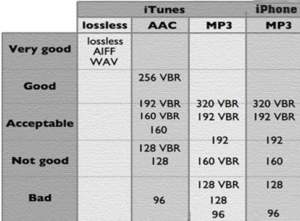
128 kbps to 160 kbps is adopted for general MP3 / AAC music files. This is because you can watch various music genres like J-POP and Jazz with high sound quality. You can fully enjoy music with your PC speakers and audio equipment.

Then I will explain the characteristics of the compression rate (bit rate) of 128 kbps or less and the compression rate (bit rate) of 160 kbps or more, and which file format should be used, MP3 or AAC.

Less than 128 kbps

A compression rate (bit rate) of less than 128 kbps does not improve the sound quality of music, etc., and is not suitable for the music content storage file format. Suitable as a conversation-focused radio sound source. Also, if it is less than 128 kbps, the AAC format has a higher frequency upper limit, so the sound quality is said to be better than MP3.

192 kbps or higher

The compression rate (bit rate) of 192 kbps or higher reproduces even delicate sounds like classical music. If you have a good ear, you can clearly tell the difference in sound quality.

When the compression rate (bit rate) is 192 kbps or higher, the MP3 format has a higher upper limit frequency and is said to have a higher sound quality. The data size (capacity) is almost the same as that of AAC, so it is recommended to save it in MP3 format.

What is the difference between MP3 and AAC?

What is the difference between MP3 and AAC?

MP3 o AAC

It also explains the benefits of compressing file size and sound quality!

AAC Vs. MP3

This article introduces the compressed music file storage formats called MP3 and AAC. If you don’t know which compression storage format to choose, MP3 or AAC, check the characteristics and merits of each MP3 and AAC presented in this article and select the most suitable storage format.

What MP3 and AAC have in common
・ The MP3 / AAC compression format is “lossy compression format”
3Comparison of MP3 and AAC
·Sound quality
・ Compression rate (bit rate)
Four Proper use of MP3 and AAC
·Bit rate
・ Compatible equipment
Five Which is better, MP3 or AAC?

Difference between MP3 and AAC

Unsplash logo Photo by alicemoore
In this chapter at the beginning of this article, we will explain the characteristics and differences between the MP3 file format and the AAC file format. Many people generally recognize that both MP3 and AAC are file compression formats dedicated to music and audio, but not many people clearly understand the difference between MP3 and AAC.

A solid understanding of the differences between MP3 and AAC will help you choose the correct file format, so it is important to remember each file format first.

MP3

MP3 is the oldest music file storage format for smartphones and computers. MP3 is a format that compresses music files and is characterized by a large number of compatible devices. MP3 is a music compression format, but there is a video compression format called MP4.

The names of both formats are similar, but watch out for mistakes as they are completely different formats. MP4 is also a well-known video compression storage format, so it’s a good idea to keep that in mind.

AAC

AAC is also known as alias “M4A”, “M4P”, which was established as the music compression format for the upcoming MP3, the standard compression format for Apple products such as the iPhone and iPad. When you purchase paid music content from iTunes, all purchased music files are saved as “AAC” files in iTunes.

Files saved in AAC format apply to copyrighted music content.

What MP3 and AAC have in common

Unsplash logo Photo by cgower
I will present the common points between MP3 and AAC. Both are compression methods for digital music content, but I will introduce the compression format and the advantages of compression.

The MP3 / AAC compression format is “lossy compression format”

The MP3 / AAC music content compression format is called “lossy compression format” and they both have the same compression format. Digital music data is usually a 1 minute music / audio file with a large size (capacity) of 10 MB, but since it is compressed with the MP3 / AAC “lossy compression format”, the download speed is fast and the storage capacity is increased. It does not squeeze.

Data file compression (capacity) of music content makes sound quality worse than live audio, but falls within the range of sound quality that can be heard by the human ear, so there is no problems such as interruptions in sound.

Is AAC absolutely better than mp3?

Is AAC absolutely better than mp3?

AAC Vs. MP3

I know that the lossless sound source is of the highest quality, but the file size is too large.

MP3 o AAC

I want to hear it in the smallest possible size with the best possible sound quality!

I think there are many such people. I am the same.

This time, I would like to roughly examine the differences between mp3 and AAC.
I don’t know because it’s just a little bit snooty for a hobbyist.

Effect
Since this is a compressed sound source, casual listening is an important premise.

First, let’s abandon the stereotype that “AAC is better.”

Looking at the net, there are people who write that “AAC is better because it came out later” or “AAC is better because it is an improved version of mp3”, but the compression efficiency is good and the sound that you can really hear in particular, not I think it is always the same to improve.

This study then only confirms the “objectively understandable difference” for each format, and does not determine the superiority or inferiority of sound quality.

Personally, assuming 320 kbps, even if it is a compressed sound source, be it mp3 or AAC, the audible range is perfectly suppressed, so I think the sound you hear is the same, and I only listen casually. I don’t even have to hear the slightest difference.

Honestly, 128 kbps is fine for portable use (although the audible range changes significantly compared to 320 kbps), but if you’re looking for a premium music experience with home audio, you should use a compressed sound source first. use time.

Frequency analysis
There are many other people who do the same, but I’ll check it out myself.
Note that the vertical and horizontal widths differ for each graphic.
All encoding to mp3 / AAC is done with iTunes.

First, I prepared a FLAC sound source sample. The genre is rock.
The characteristics of 4608 kbps bit rate / 96 kHz sampling rate / 24 bit bit depth of
frequency are as follows. This is the original way.

Generally, the human audible range is said to be around 20Hz to 20kHz *, but with FLAC, you can see that information is also included in the ultra-high range above 20kHz.

* Actually, it seems that most people have a hard time distinguishing between 15 kHz and higher.

Then AAC / 320 kbps
* Sampling frequency 44.1 kHz / Bit depth 16 bit

There is information above 20 kHz, and it seems that the sound around 22 kHz is cut off by gradually attenuating. Looking only at the frequency, there is not a big change from FLAC. Is the sound pressure so low that you can’t feel it? That is all.

Then mp3 / 320 kbps
* Sampling frequency 44.1 kHz / bit depth 16 bit

It is characteristic that it cuts from around 20 kHz.

When mp3 and AAC waveforms overlap, it becomes as follows.
Purple is mp3 and pink is AAC.

There is a considerable difference in the amount of information above 18 kHz. Also, you can see that the other parts are exactly the same (there is a difference in the level of points when zoomed in, but it is considered a negligible difference).

Let’s listen and compare
It is out of the question to mention the difference in sound quality, but there is a huge difference when you look at the waveform above, so experience how it feels when you listen to it.

320kbps mp3 and 320kbps AAC were carefully compared to listen to over and over again.

As a result … well …

I did not understand anything.

There were some parts that said, “Oh … I feel something different …”, but when I did a blind test with the hidden extension, I had no confidence at all, so I decided to be a placebo.

When you play the same song randomly while walking down the street, you are unlikely to know “Oh, this is the mp3!” Or “This sharp glow … AAC!” . In my ears.

conclusion
You can convert it as you like (appropriate).

It seems certain that AAC has better compression technology, but I think it is almost impossible to distinguish the quality of the sound that is actually heard in a casual environment.

After all, what is the difference between “high resolution”?

After all, what is the difference between “high resolution”?

Hi-Res Audio

What are the advantages and disadvantages?

High-Res Audio

The keyword “high resolution” that suddenly increases its presence due to the diffusion of downloaded sound sources.
Even if you know that “high resolution” = “high sound quality”, not many people really understand what is different from conventional.

In this article, I will introduce how to listen to high resolution based on the difference between “high resolution” and conventional sound.

What is high resolution?
High Resolution is an abbreviation for “High Resolution Audio” and means a high resolution sound source.
Here, high resolution is used to refer to “a digital sound source with an amount of information that exceeds the sound quality of a CD.”

So what does “a digital sound source that exceeds the sound quality of a CD” mean?

High resolution sound source definition
The sound quality of a digital sound source is determined by the precision with which it is converted into a digital signal. The more information there is, the better the sound quality.

A sound source that can be called high resolution requires that the “sample rate” and “bit depth” exceed the level of a CD. I think it is an unfamiliar word, so I will explain this point briefly.

The CD sound source has a “sampling rate of 44.1 kHz / s” and a “bit depth of 16 bits”.

“Sample rate” refers to “the number of pieces of information divided per second”, and the higher the number, the softer the sound.
On the other hand, “bit depth” refers to “the amount of data per information divided”, and the higher the number, the greater the expressiveness of the sound.

Also, there is a unit called “bit rate (kbps)” when importing a CD or selecting the sound quality with a streaming service.
This is the product of “sample rate”, “bit depth” and “number of channels (monaural = 1 / stereo = 2)”, and is a unit that expresses good sound quality. Similarly, the higher the number, the higher the sound quality.

If the sound quality of the CD is the Famicom pixel art Mario, is it easy to imagine that the high resolution sound quality is as accurate as the Super Nintendo pixel art Mario?

The sound is good! That is why the downsides of “high resolution”
High sound quality has the downsides of data.
Since this is digital data, the greater the amount of information, the greater the data capacity. Therefore, the amount of data from the high-resolution sound source is also quite large.

The capacity of each sound source per song for 5 minutes is as follows.

“Mp3 (normal sound quality)” = ”
7.2 MB ”
“CD” = “52.9 MB” “High resolution (96 kHz / 24 bit)” = “168.6 MB”

A 16GB SD card can only support about 10 albums. It costs money.

How to get and listen to a high resolution sound source?
Due to the large capacity of high-resolution audio sources, they cannot fit on existing CDs, so you must purchase them through a music distribution site that handles high-resolution music.
Currently, Hi-Res Audio sources can be purchased from music distribution sites such as “e-onkyo music”, “mora” and “HDtracks”.
If the demand for high resolution increases in the future, it can be handled by “iTunes” etc.

Also, even if you get a sound source, you basically cannot enjoy high-quality sound unless you use a “high-resolution compatible” playback device, so be careful.

At present, the impression that the obstacles are a bit high cannot be erased, but it is an opportunity to listen to the songs of your favorite artists with better sound quality, and it will surely be a new musical experience.

There are also retail electronics stores where you can listen to them, so why not look for a viewer when you pass by?

What exactly is “EDM”?

What exactly is “EDM”?

EDM

The word EDM, which has become popular in recent years. In this article, I will explain EDM in an easy to understand way.

EDM

Meaning of EDM
EDM is an acronym for Electronic Dance Music in English.

EDM is one of the musical genres and is a general term for dance music created with synthesizers (such as keyboards for making electronic music). It is a very rough explanation, but by nature, the word EDM does not have a more rigorous definition.

Therefore, this EDM is a very broad concept, and techno, house, and trance can be called EDM.

Also, although the word itself has been around for a long time, it is often used in nuances that refer to electronic music, dubstep, and subgenres derived from it, which have been mainstream since the early 2000s.

Popular EDM
Here are some of the most popular EDMs in the world. I think a lot of people have heard it at one time or another.

Rihanna “We found love with Calvin Harris”
In collaboration with Rihanna and Calvin Harris, the song, released in 2011, topped the US and UK charts and was the first EDM song to be certified as a diamond disc.

Nicky Romero – Toulouse ”
This song from Nicky Romero, which has a distinctive deep bass. Since its launch in 2011, MV has surpassed 390 million views as of 2018.

Avicii – Wake me up ”
This song by Avicii quickly gained first place in the UK when it was released in 2013. When she died young in April 2018, fans around the world heard the song and paid tribute to her.

Zedd, Alessia Cara “Stay”
Released in 2017 by Zedd and Alessia Cara, this song was nominated for Best Pop Duo / Group Performance at the 60th Grammy Awards.

Marshmello “Solo”
A flagship song released in 2016 by the mysterious masked DJ Marshmello. Marshmello was exposed at the music awards ceremony hosted by the Canadian music channel in August 2018, but popular Canadian singer Shawn Mendes came out of the headdress. It looks like it was a one night replacement ball operation to surprise both fans.

Music distribution services like Apple Music, Spotify, and AWA have plenty of EDM playlists too. If you want to listen to EDM, it is a good idea to first search for playlists for these services.

What does the word “vinyl” mean that DJs and record enthusiasts often use?

What does the word “vinyl” mean that DJs and record enthusiasts often use?

Vynil Record

People who are familiar with DJs and record lovers may have heard the word “vinyl” coming from their mouths.

Vinyl records

However, there are many people who do not know the meaning of honesty.

For you, I will introduce you to the meaning of “vinyl” and how to use it correctly.

In short, it is a record
A “vinyl” is simply a record. Some people may be surprised, “What!”, But that’s correct. It is a record.

The reason I came to say that is that “vinyl” actually comes from the material on the record.

The point is vinyl
“Vinal” is vinyl. Yes, it is vinyl. Some people may be surprised again, “What!” …

As everyone knows, vinyl is a resin material that is used for various purposes such as shopping bags, boots, and handbags. The popularity of vinyl records is believed to have led to the widespread use of records as “vinyl.”

In other words, it may be easier to think of jeans as the same as calling them denim.

But it’s not “record = vinyl”!
Now that you know the origin, there is one thing to keep in mind. Because, as I said before, “a vinyl is a record”, in no way is it a record = vinyl. Let me explain step by step.

The ancestor of records is a machine that records and reproduces the “phonograph” sound invented by the inventor Edison. At the time, he was still using a brass cylinder instead of a disk, but when the disk was later invented, he was once settled with a material called “shellac” that passed through resin like rubber.

However, this shellac is very brittle and wears easily and breaks immediately when dropped, and vinyl records have been used as a substitute. Yes, it is a “vinyl”.

In other words, there are records that are not made of vinyl! Even if it is called by convention, it may be wrong in its original meaning.

It is said that this name began to be used in the neighborhood of young listeners such as hip-hop reggae who are active as DJs, rather than among old record fans.

It is not a venerable phrase, so if you want to avoid mistakes, call it “registry” and you may be right for the moment.

What are MP3 and AAC? Which one should I choose to use?

What are MP3 and AAC? Which one should I choose to use?

aac VS mp3

Music has passed through discs and CDs, and now more and more people listen to it by putting data on their smartphones or streaming it over the Internet.

AAC vs. MP3

One of the things that comes to mind are the words MP3 and AAC that are attached to music files. What the hell is this? In this article, I will explain these two words!

Lossy compression for MP3 and AAC
Generally speaking, MP3 and AAC are the forms of music converted into digital files. The MP3 and AAC forms have their own characteristics, but what they can say in common is that they are both lossy compressed sound sources.

Lossy compression, that is, a method that reduces the amount of data but is irreversible due to data loss. However, this missing part is mostly a super treble part that is difficult for humans to hear, so it doesn’t mean there is no vocal voice. Are you sure.

MP3 with many compatible devices
MP3 is the official name of MPEG1 Audio / Layer3, and it was born in 1992! It is quite an old format.

At that time, the Internet was completely different. If you say that it was natural to exchange at low speed which is incomparable with the speed at which “communication with smartphone slowed down due to speed limitation”, you can understand the horror.

In such circumstances, how to reduce the file size is important, and thus the compression format called MP3 was born. It can be said that the format sacrifices sound quality in order to reduce file size.

However, even in MP3, if the bit rate (the unit is bps), which is the amount of data per second, is set to 320 kbps, the sound quality will improve a bit. This is the same for AAC, which will be explained later.

MP3 is an old format, but on the contrary, it is a format with a fairly high penetration rate. Almost all compatible devices have the advantage that they can be used in any terminal without any problem.

AAC, the successor to MP3
The official name of AAC is Advanced Audio Coding. Born in 1997 as a successor to MP3. Improvements have been made since then, and the AAC currently in use is the 2006 AAC-HE V2.

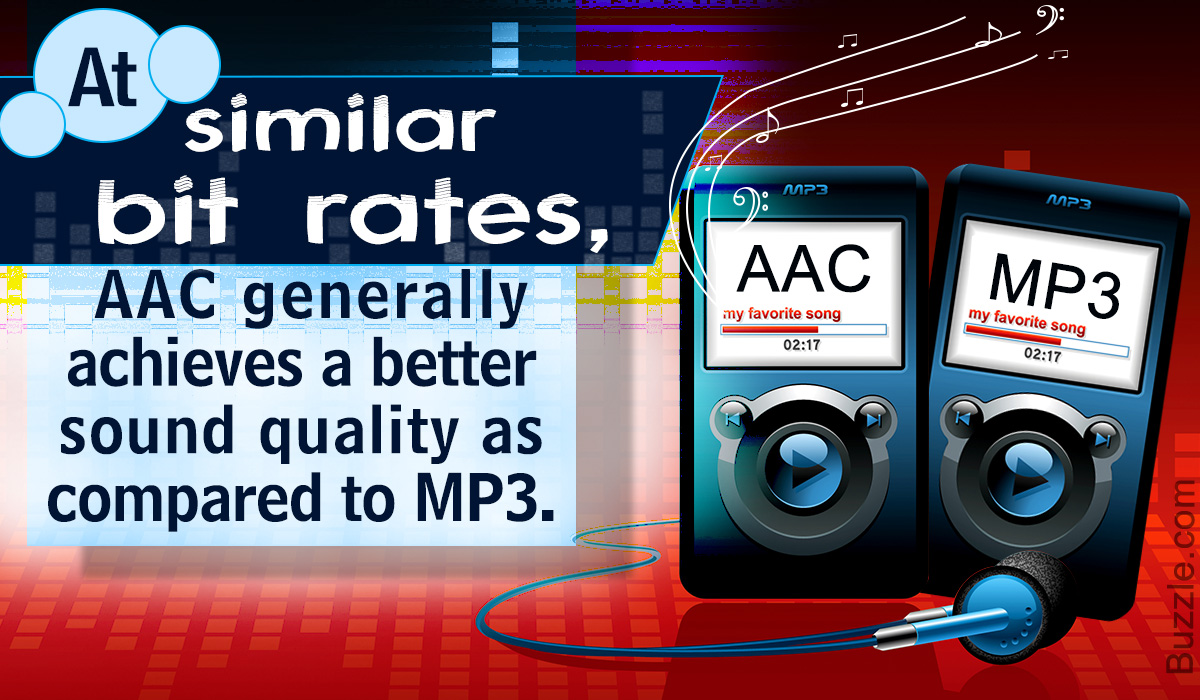
Generally, AAC is said to have superior sound quality than MP3 if the compression ratio is the same, and it is a format that is also used for digital terrestrial broadcasting on TV.

Apple, which makes iPhones, is active in using AAC. ITunes Store download sales are AAC / 256kbps, which is the standard when importing a CD with iTunes.
Compared to MP3s, the number of compatible devices is reduced, but it can still be played on most terminals.

Other music file formats
There are also other music file formats. Lossless compressed and Apple Lossless FLACs, and uncompressed AIFF and WAVs are well known. Lossless compression is the opposite of lossy compression and is a format that can be undone. Therefore, the sound does not deteriorate, but the compression ratio is lower than lossy compression. Uncompressed is a format that has the same sound and capacity.

Which is better, MP3 or AAC?
Now that the speed of Internet communication is increasing, it seems unlikely that MP3 and AAC will come into play at first glance. However, there are restrictions on the amount of data communication from mobile phone companies, so you cannot listen to large music files over the Internet.

So I think I should save it to the terminal, but this time the data area of ​​the terminal will be bloated. Due to such circumstances, the MP3 and AAC formats are still active. So which of these two should you choose?

There are various theories, but this is still AAC. Since it is a newcomer, the sound quality is better than lossy compression, and the data capacity can be suppressed. MP3 is an option only if you are using a device that does not support AAC.

What is the difference between AAC and mp3? Introducing a music file format comparison!

What is the difference between AAC and mp3? Introducing a music file format comparison!

AAC Vs. MP3

One of the music files is “AAC”, but do you know the difference between the two files, the AAC file and the popular mp3 file? This article provides a comparison of the formats and the differences between the two music files, AAC and mp3.

AAC or MP3

What is AAC?
What is the difference between AAC and mp3?

What is AAC?

There are various music file formats, but do you know what kind of file is “AAC”, what is one of the file formats? AAC is an abbreviation for “Advanced Audio Coding” and is one of the irreversible digital audio compression formats. The extensions are “.m4a” and “.m4p”.

This is a standardized file format for higher sound quality and higher compression than MPEG-1 Audio, including mp3. AAC is also used in MPEG-2 and MPEG-4 and is responsible for the audio part of video files in those formats. AAC can have 48 channels of full-bandwidth audio in one stream and can contain 16 channels of low-frequency sound effects, 16 interactive channels, and 16 data streams.

What is the difference between AAC and mp3?

You may be curious to know the difference between AAC files and mp3 files. As mentioned above, AAC files are a standard intended for higher sound quality and higher compression than mp3 files, which is why they are basically positioned as the successor format to mp3. AAC is the new generation and mp3 is the old generation.

Both are lossy compression, that is, data compression is done using a compression method that produces data that is truncated, even though the data compression rate is high. Therefore, if you rip from a music CD and create these files, the sound quality will inevitably deteriorate compared to the original music CD. (Since the audible range that humans cannot hear is cut off, it is difficult to notice if you are not very particular to

respect). The data compression rate for both AAC and mp3 is about 1/10 of the original data, and AAC is slightly better. It feels like the compression rate is high. AAC is the default file format used by Mac products, such as the iPhone, and mp3 is more common on Android smartphones. Also, there are many music players that support mp3 because it has a long history and AAC tends to be less than mp3.

Regarding sound quality, the maximum bit rate for both is “320 kbps”. Although 320 kbps is well below the 1142 kbps for music CDs, the sound quality is high enough considering the human audible range. And if both AAC and mp3 are encoded at 320 kbps, AAC is said to have better sound quality.