How does the bit depth impact the dynamic range and audio fidelity in digital formats?


Free Download Mp4Gain
picture

How does the bit depth impact the dynamic range and audio fidelity in digital formats?

audio bit depth
audio bit depth
audio bit depth
audio bit depth

Bit depth’s influence on dynamic range and audio quality

I remember when I first started learning about digital audio formats, I was curious about how bit depth affected the overall sound quality. It turns out that bit depth plays a significant role in determining the dynamic range and audio fidelity of digital audio files. The higher the bit depth, the more accurately the audio signal can be represented, resulting in a more detailed and accurate sound.

As a musician, I’ve always been fascinated by the science behind sound. I once read a quote from the famous composer John Cage that said, “There is no such thing as an empty space or an empty time. There is always something to see, something to hear.” This idea resonates with me, as it highlights the importance of capturing every nuance of sound in digital audio formats.

In my experience, working with higher bit depths has allowed me to create richer, more immersive audio experiences for my listeners. The increased dynamic range and audio fidelity make a noticeable difference in the final product.

How bit depth affects audio fidelity in digital formats

When I first started experimenting with digital audio, I didn’t realize how crucial bit depth was to the overall sound quality. Bit depth refers to the number of bits used to represent each audio sample in a digital file. The more bits used, the greater the audio fidelity, as there are more possible values to represent the audio signal.

I recall watching a documentary about the history of digital audio, where an expert explained that “the higher the bit depth, the closer the digital representation is to the original analog signal.” This made me realize the importance of using higher bit depths to achieve the best possible audio quality.

In my own projects, I’ve found that using a higher bit depth results in a more accurate and detailed sound. It’s especially noticeable when working with complex audio material, where the nuances of the sound can be more easily captured and preserved.

The role of bit depth in digital audio dynamic range

Dynamic range is another critical aspect of digital audio quality that is directly influenced by bit depth. The dynamic range refers to the difference between the quietest and loudest parts of an audio signal. A higher bit depth allows for a greater dynamic range, as there are more possible values to represent the varying levels of loudness.

I’ve always been a fan of movies with powerful soundtracks, and I remember a quote from the film “Amadeus” that stuck with me: “Music is not just about notes, but also the spaces between them.” This idea applies to dynamic range as well, as it’s essential to capture the full spectrum of sound, from the quietest whispers to the loudest explosions.

In my own audio projects, I’ve noticed that working with higher bit depths allows me to create more dynamic and expressive soundscapes. The increased dynamic range provides a more immersive and engaging listening experience for my audience.

Final words

In conclusion, bit depth plays a crucial role in determining the dynamic range and audio fidelity of digital audio formats. A higher bit depth allows for a more accurate representation of the audio signal, resulting in a more detailed and immersive sound. As a musician and audio enthusiast, I’ve found that working with higher bit depths has significantly improved the quality of my projects.

If you’re looking to enhance the audio quality of your own projects, I highly recommend using a tool like mp4gain. While it’s not free or open-source, and only runs on Windows, it’s a powerful normalizer and converter for major audio and video formats. With its integrated equalizer, mp4gain can help you achieve the best possible audio quality for your projects.


Free Download Mp4Gain
picture


Mp4Gain Main Window
picture


Mp4Gain Features
picture


Free Download Mp4Gain
picture

Digital audio quality

Digital audio quality

Several elements work together to define the sampling process:

The frequency with which the converter takes a sample (the sampling frequency)
The precision with which you can represent a sample as a number (the bit depth).
It is important in any digital capture device, such as our sound cards, to record enough information to provide an accurate record of the sound signal.


The sampling rate you choose determines how much frequency range you can record, and the bit depth precisely determines how you can record changes in the level of the analog signal; which affects the dynamic range and, therefore, the residual amount of noise in the signal.

Sample rate and frequency range

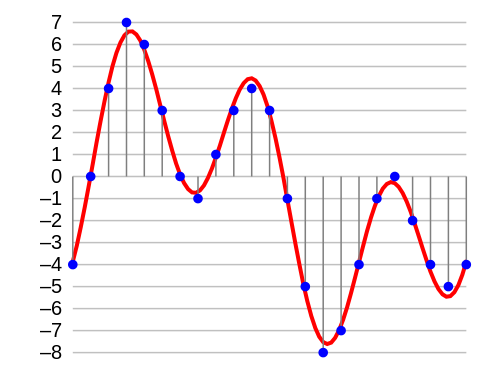
Individual samples viewed in an audio editor
The sampling rate is the frequency with which the A / D converter measures the signal level. The samples are broadly analogous to a series of snapshots. If the converter takes ten samples of the signal every second, it has a sampling rate of 10 Hz.

The frequency range of an A / D converter is determined by the sampling frequency. The highest frequency that can be picked up is only half the frequency at which the drive operates.

For example: a 10 Hz sampling rate can capture a maximum of 5 Hz frequency, not 10 Hz.

According to the Nyquist-Shannon theorem, to sample frequencies up to the upper limit of the human ear (which is around 22000 Hz), we need a sampling frequency of around 44000 Hz, which is, not by chance, the rate normal sampling for commercial audio CDs.

Bit depth and dynamic range

The sampling frequency tells us how an A / D converter works over time, and therefore how it captures the information of the frequency of the “x” axis of the waveform diagrams.

The bit depth determines the amount of detail that can be recorded on the incoming signal level, the “y” axis, of the diagrams.

With each sample, the A / D converter must measure the level of the incoming signal and assign it one of a group of numbers. This number comes from the bit depth and the converter should be limited to these discrete values.

With each added bit, the number of possible sound pressure levels that can be stored doubles. With 16 bits the audio has more than 65000 possible levels of resolution; with 24 bits it has more than 16 million possible levels.

The direct impact of bit depth on signal capture occurs over the dynamic range: the greater the bit depth, the greater the dynamic range or amplitude levels that can be captured before the signal is submerged in the background noise.

Dynamic range is obviously important, because it defines the level of dynamic ranges that our ears can hear. But it also prevents errors created by rounding the numbers (quantization errors) from being heard as noise.

Common sampling rates and bit depths

Summarizing what has been said so far, the resolution of digital audio is measured in terms of:

Sample rate (related to sound frequency range and measured in kHz)
Bit depth (related to amplitude and measured in bits).
These values ​​are more or less equivalent to the resolution of an image and the color depth in digital graphics. Any number is theoretically possible for these values, and sample rates and bit depths can be mixed and matched, but the settings you’ll find most of the time are:

16-bit / 44.1 kHz: The standard for commercial audio CDs. It is also used for consumer CD-Rs and is the most common for computer audio software.
16-bit / 48kHz: The standard for digital video (DV), commercial DVD videos, and digital video broadcasting.
24-bit / 96kHz: The emerging high-resolution format increasingly supported by audio hardware and software, although it has not yet become widespread as a standard in the consumer market for listening to music.
Finally: What sampling frequency do I use?

It may seem counterintuitive to work with audio capable of manipulating frequencies that are above the highest that humans can hear.

However, there are three reasons why we may want to use sampling rates of up to 96 kHz or higher:

The first reason, although debated, is that inaudible frequencies above 22 kHz can have an impact on the audible spectrum, by processing the audio at 96 kHz the sound sounds better or more accurate than at 44.1 kHz. However, it is a matter of opinion: some claim that it can be heard, others that it cannot.