What you need to know about MP3

What is MP3?

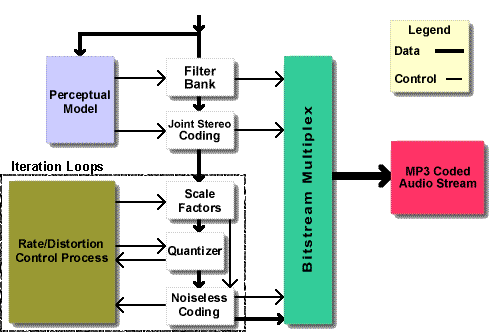
MP3 is short for MPEG Layer3. It is one of the transmission formats for storing and transmitting audio in digital form, developed by Fraunhofer IIS and THOMSON, and later approved as part of the MPEG1 and MPEG2 compressed video and audio standards. This scheme is the most complex scheme in the MPEG Layer 1/2/3 family. It requires the most amount of machine time to encode compared to the other two and provides higher encoding quality. It is mainly used for audio CD encoding.
The high degree of compactness of MP3 compared to other formats such as PCM (i.e. normal WAV- file) and similar formats while maintaining similar sound quality (considered 16-bit stereo at 44.1 kHz) is achieved using additional quantization according to a certain scheme, which minimizes the loss of quality. This is achieved by taking into account the peculiarities of human hearing, including the masking effect of a weak signal from one frequency range with a stronger signal from an adjacent range, when it occurs, or a strong signal from the previous frame, which causes a temporary decrease in the ear’s sensitivity to the current frame signal (simply, background sounds are eliminated, which are not heard by the human ear due to the presence at a given / previous moment of another – louder). It also takes into account the inability of most people to distinguish between signals that are below a certain power level,
This is called adaptive coding, and it allows you to save on the less perceptually significant sound details. The compression ratio (and therefore quality) is not determined by the format, but by the width of the data stream when encoded in MP3. The bit rate when encoding a signal similar to an audio CD (44.1 kHz 16 bit stereo) varies from the largest, 320 kbs (320 kilobits per second, also kbs, kbps or kb / s), up to 96 kbs and less.
Why MP3?
MP3 has two huge advantages over other formats available today. It is true that MicroSoft is trying to squeeze MP3 with its new WMA format, and there are also alternative VQF and AAC formats, but they have not yet received proper distribution and the quality is often a little worse. However, WMA is still, in fact, closed for free use, so you have problems with various encoding / listening / maintenance programs (although, who doubts MicroSoft’s mobilization capabilities :-).
The first advantage of MP3 is that none of the existing similar formats can yet be said to fully guarantee the stable preservation of sound quality at sufficiently high bit rates, except MP3, which has stood the test of time with dignity.
The second, no less important advantage: over the next few years, and perhaps the entire decade, MP3 has become the de facto standard, as the parties that use it (eg me 😉 have made a lot of investments in him, including digital radio stations. There are also many easy-to-use software programs written for MP3. Now the production of hardware MP3 players has been launched, both pocket and car. Thus, MP3 became the first massively recognized audio storage format after Audio CD (although it is often illegal).
The most famous encoders
Today there are 3 main sources that have created programs to encode MP3 music. These are Fraunhofer-IIS, Xing Technologies, and ISO itself, which adhere to the ISO MPEG standard developed by it.
Most of the encoders created to date use modified code from one of these organizations. Fraunhofer-IIS based encoders are not very fast, but very high quality, quality optimized for low bit rates.
128 kbps (11: 1)
The most popular bit rate today. The 11: 1 compression ratio is of course an argument, especially for the internet, where every kilobyte counts. However, the high frequencies are not very well preserved and there is some distortion in the sound. At the same time, I can safely say that on an ordinary computer, for example, using an ordinary sound card, computer speakers, albeit of good quality, or output through a simple recorder to your speakers (using the input for a External CD, like me), the difference will not be noticeable unless you are a sound expert.
However, in normal speakers (at least large and expensive), the lack of high frequencies is quite noticeable.