Fundamentals of digital audio

Digital audio is based on the mathematical representation of the sound wave.
The digital world is evolving very rapidly and it is no wonder that many people find digital technology complex. The purpose of this article is to explain what digital audio is without going into complicated mathematical details. To understand what digital sound is, you must first understand that there are no sounds inside a computer and there is only one math.
What is sound
Sound is the vibration of molecules. Mathematically, sound can be accurately described as a “wave.” It has a maximum peak value (wave hump) and a minimum value (deflection). If you have ever seen a graphical representation of a sound wave, you will notice that sound is always represented by a curve that constantly crosses the X-axis. This means that the nature of sound is “periodic”. Any sound has a crest and deflection, a positive and a negative period. This is called a loop. So the basic concept is that all sounds have at least one cycle.
The next important idea is that any periodic function can be represented mathematically as a series of sinusoids. In other words, even the most complex sound is just a collection of sine waves. A voice can constantly change its volume and pitch, but anytime it sounds, the voice is just a set of sine waves.
And finally, third: people do not hear sounds with a frequency higher than 22 kHz. Therefore, it is not necessary to record everything above 22 kHz.
So once again, the fundamentals of sound are as follows:
Sound waves are periodic and therefore can be described as a collection of sine waves.
We are not interested in waves with a frequency higher than 22 kHz, because we cannot physically hear them.
Analog to digital transition
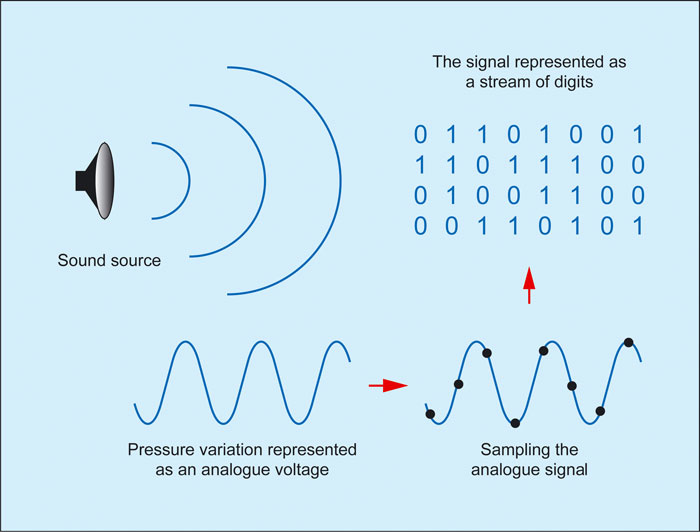
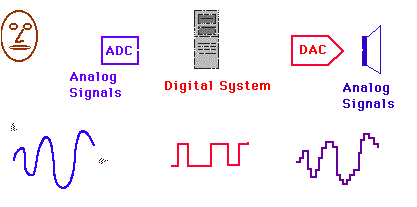
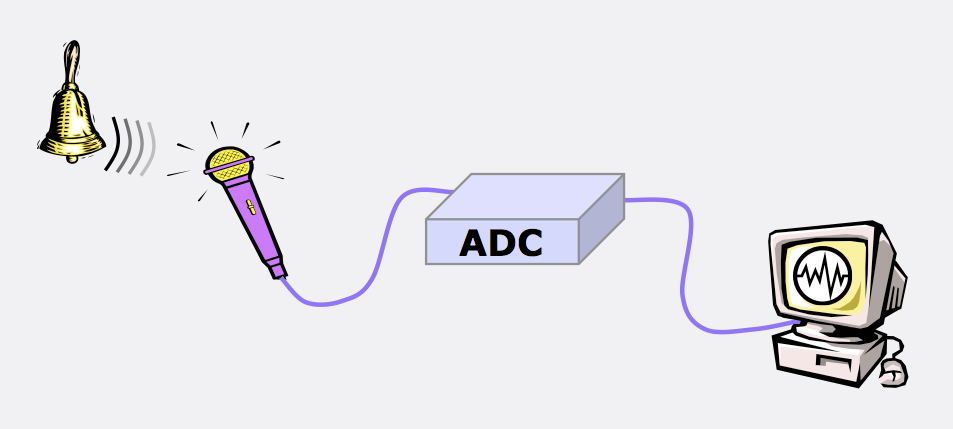
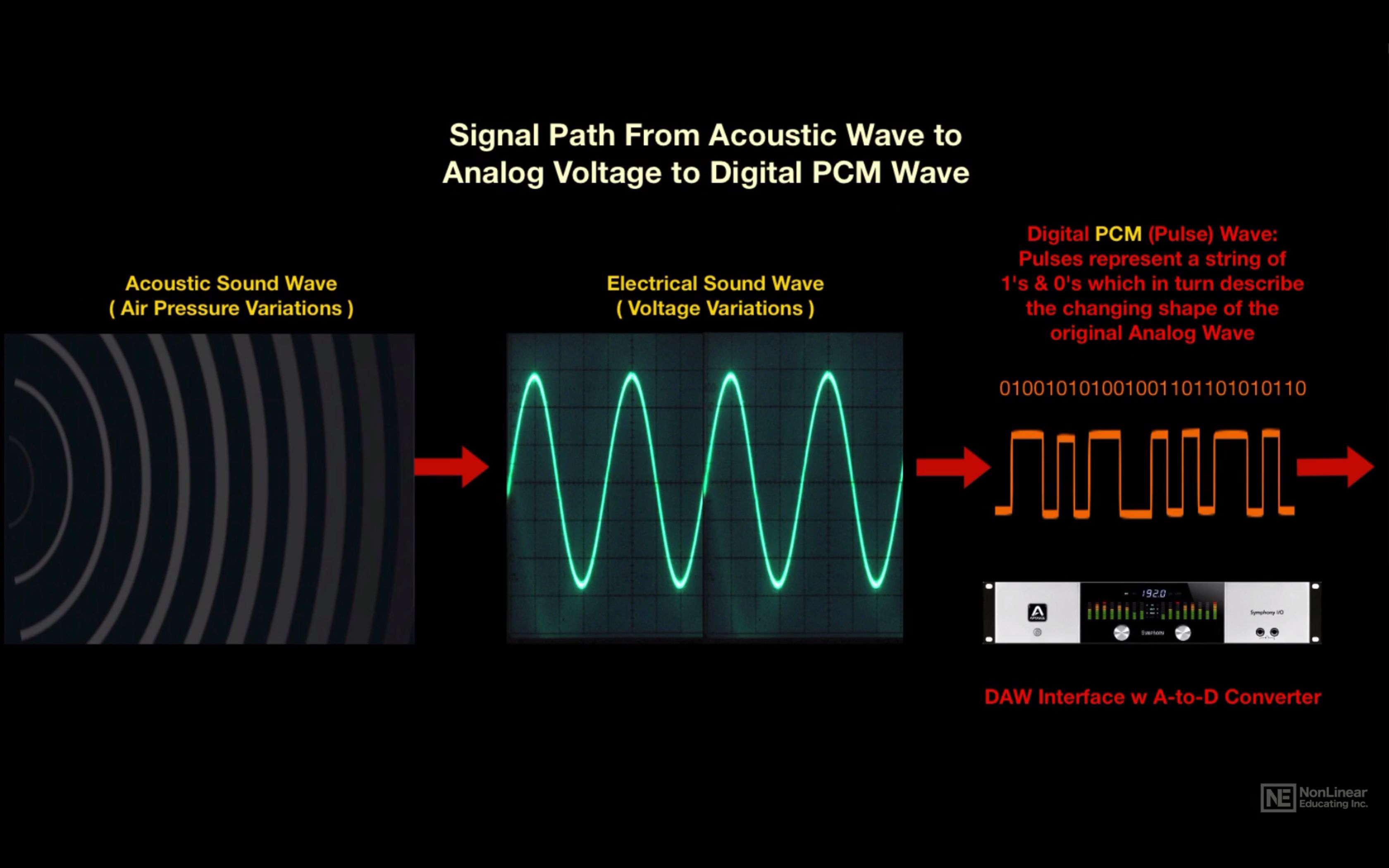
Let’s say I’m speaking into a microphone. The microphone turns my voice into a continuous electrical current. This electrical current passes through a wire through an amplifier of some kind and eventually enters an analog-digital converter (ADC). Remember that the computer does not store sounds, but mathematical values, so we need something that converts the analog stream into a sequence of ones and zeros. This is what the ADC is doing. In simple terms, the converter takes quick snapshots of the sound wave, called samples, and assigns an amplitude value to each sample. And here we come to two basic concepts that will help explain the nature of digital sound. These concepts are time and breadth.
Sound bitness
Sound bitness
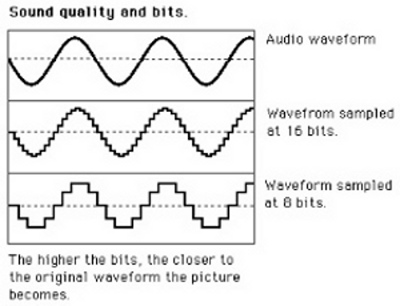
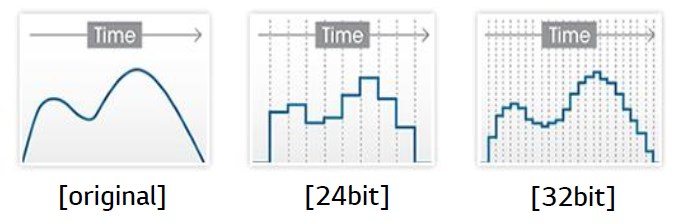
In the digital world, nothing is continuous, everything has a certain mathematical meaning. In the analog world, the sound wave will reach its peak and all values from 0 dB to the peak will exist. And in a digital signal, there are a limited number of possible amplitude values. Think of analog audio as someone who gently walks up an escalator, while digital audio is someone who walks up a staircase and, over time, is on one rung or the other. Or let’s say there are values 50 and 51. So in analog sound there may be some intermediate value of 50.46, but in digital sound this value will be rounded to 50. This means that in fact the sound wave is distorted as it passes through the ADC … And since the analog signal is continuous, then this rounding of values occurs constantly during the conversion process. This is called a quantization error and it sounds like a strange noise. But imagine a ladder with more steps that are less high. Now we have the values 50, followed by 50.2, followed by 50.4, and then 50.6, etc. An analog signal with an amplitude value of 50.46 will now be rounded to 50.4 instead of 50. This is a major improvement that does not completely eliminate quantization errors, but significantly reduces their impact. An increase in bitness is essentially an increase in the number of steps on a stair with a decrease in their height. As the quantization error decreases, the noise level decreases. Now we have the values 50, followed by 50.2, followed by 50.4, and then 50.6, etc. An analog signal with an amplitude value of 50.46 will now be rounded to 50.4 instead of 50. This is a major improvement that does not completely eliminate quantization errors, but significantly reduces their impact. An increase in bitness is essentially an increase in the number of steps on a stair with a decrease in their height. As the quantization error decreases, the noise level decreases.