What are “bit depth” and “sample rate”? Part 2
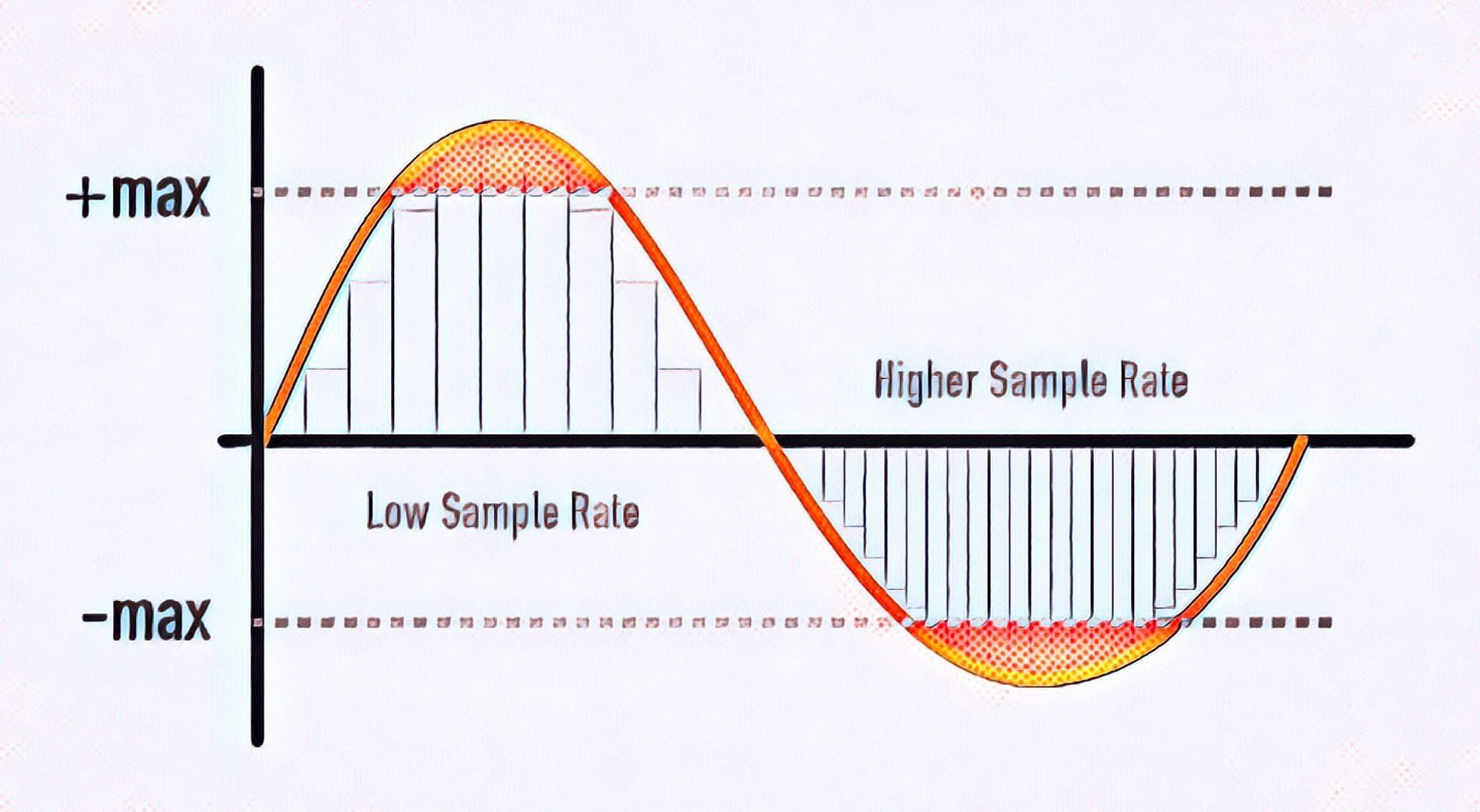
What is the sample rate?
Next, I will explain the sample rate.
The sample rate is like the “resolution” of the audio.
The higher the sample rate, the more samples per second = you can hear better.
Requires double sample rate
One thing to keep in mind here is that you need twice the sample rate to hear sound at that frequency.
For example, if you want to hear a 1000 Hz (1 kHz) sound accurately and clearly, the sampling frequency must be at least 2000 Hz (2 kHz).
If the sample rate is less than twice the value you want to hear, “aliases” will occur and you will not be able to process the sound accurately, such as crackle or noise.
Nyquist frequency
By the way, to use a little technical word, it also means not to exceed the “Nyquist Frequency”.
The Nyquist rate is exactly half the supported sample rate.
For example, if the sampling frequency is 44.1 kHz, the Nyquist frequency will be 22.05 kHz.
If you try to handle this high-pitched sound that exceeds 22.05 kHz, the above-mentioned “aliasing” will occur and you will not be able to reproduce the sound correctly.
Range recognizable by the human ear
The loudest sound that can be recognized by the human ear is said to be 20 kHz, so to hear a 20 kHz sound, you only need to have a sample rate of at least 40 kHz.
After that, to avoid aliasing, apply an anti-aliasing filter until the Nyquist (Transition Band) frequency is reached.
For 44.1 kHz, 2050 samples x 2 are required.
In other words, a sample rate of 44.1 kHz is all that is needed to minimize the limit of sound (20 kHz) that the human ear can hear.
When the sampling frequency is high (96 kHz, 192 kHz)
Recently, it can be set to a high sample rate, such as 96 kHz or 192 kHz.
Unfortunately, even with such a high sample rate, it’s hard to tell the difference.
As shown in the image above, non-human animals can hear higher frequency sounds.
However, it is a level that we do not have to worry about because it is a completely inaudible zone for the human ear.
By the way, many audio interfaces cover up to 192 kHz.
Controversy over sampling rate
In fact, in the 1970s, many media outlets were controversial about sample rates.
At the time, 48 kHz was the audio standard used in radio, television, and video work.
However, broadcasting stations have decided to use 44.1 kHz as a standard to prevent data from being copied to consumers (viewers) by intentionally breaking compatibility (or making conversion difficult) …
It’s difficult to change data from 44.8 kHz to 44.1 kHz, so it prevented the average viewer from converting it to the sample rate used for home devices.
By the way, the article “Comparison of professional versus cheaper audio interface” is summarized here, which is also explained from the point of view of bit rate and sample rate.