
Role of predictive coding in H.265 and AAC compression

Let’s talk about the role of predictive coding in H.265 and AAC compression
Predictive coding is fundamental to modern compression technologies like H.265 and AAC, enabling efficient encoding without compromising quality. At its core, predictive coding reduces redundant data by predicting the values of future data based on previous patterns. For instance, in a video, if one frame is nearly identical to the next, predictive coding eliminates the need to encode the entire frame again. It’s like predicting what the next puzzle piece looks like when assembling a jigsaw puzzle. This technique allows for smaller file sizes while preserving visual and audio quality.
In my work, I’ve seen predictive coding excel in handling complex audio and video sequences. With H.265, this process identifies similarities between frames and encodes only the differences, dramatically cutting down data requirements. Similarly, AAC uses predictive coding to analyze and predict audio waveforms, ensuring that only the necessary changes are encoded. Picture a friend trying to describe a simple drawing over the phone—they only need to tell you what changes to make to complete the image, saving time and effort.
How predictive coding optimizes H.265 compression
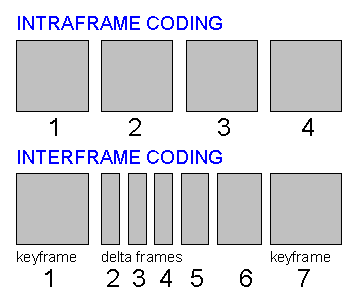
H.265, or HEVC, relies heavily on predictive coding to enhance video compression efficiency. By using intra-frame and inter-frame prediction, it minimizes redundant information. Intra-frame prediction looks within a single frame for patterns, while inter-frame prediction focuses on similarities between consecutive frames. For example, a static background in a video scene doesn’t need to be encoded repeatedly if predictive coding captures its unchanged nature.
The efficiency of H.265 comes from its ability to divide frames into smaller blocks and predict their content more accurately. I’ve often explained this using a mosaic analogy: instead of recreating each tile individually, H.265 identifies repeating patterns and predicts their placement, reducing the data load. This approach not only saves bandwidth but also improves streaming quality for high-definition content, even on limited internet connections.
How predictive coding works in AAC compression
In AAC, predictive coding ensures efficient audio compression by analyzing and predicting sound waveforms. It removes redundant frequencies and encodes only the essential changes. Think of it like adjusting the temperature in a room: once you set the thermostat, only small tweaks are needed to maintain comfort. Predictive coding in AAC eliminates unnecessary adjustments, focusing solely on what’s required to preserve audio fidelity.
This technique is particularly valuable for music and speech. By predicting and encoding only the differences between successive sound samples, AAC achieves high-quality audio with lower file sizes. I’ve personally worked with AAC files that maintain studio-level sound quality while being small enough to fit on older devices with limited storage. Predictive coding is the unsung hero behind this balance of quality and efficiency.
Latest words on the role of predictive coding in H.265 and AAC compression
Predictive coding is the cornerstone of H.265 and AAC compression, ensuring smaller file sizes without sacrificing quality. By predicting and encoding only the essential changes in video frames and audio waveforms, this technology maximizes efficiency. It’s like packing smarter for a trip—bringing only what you truly need while leaving unnecessary items behind.
If you’re looking to optimize your media files further, Mp4Gain offers tools that can help improve audio and video quality while leveraging these advanced compression techniques. It’s the ideal choice for those who want to enhance their media without compromising efficiency.
FAQs about the role of predictive coding in H.265 and AAC compression
What is predictive coding in H.265?
Predictive coding in H.265 reduces redundant data by predicting similarities within and between video frames, optimizing compression efficiency.
How does predictive coding work in AAC?
Predictive coding in AAC analyzes sound waveforms, encodes only changes between samples, and removes redundant frequencies to ensure high audio quality.
Why is predictive coding important in compression?
Predictive coding reduces file sizes while maintaining quality, making it essential for efficient video and audio streaming and storage.
What is inter-frame prediction in H.265?
Inter-frame prediction in H.265 analyzes similarities between consecutive frames to encode only the changes, reducing redundancy.
How does predictive coding affect video quality?
Predictive coding ensures that video compression retains high quality by focusing on encoding essential details and eliminating redundancies.
What is the role of intra-frame prediction in H.265?
Intra-frame prediction in H.265 analyzes patterns within a single frame to encode data more efficiently.
Does predictive coding improve streaming performance?
Yes, predictive coding reduces file sizes, enabling smoother streaming even on limited bandwidth connections.
Is predictive coding exclusive to H.265 and AAC?
No, predictive coding is used in other codecs as well, but it plays a critical role in H.265 and AAC for advanced compression.
How does predictive coding balance quality and compression?
By predicting and encoding only changes, predictive coding reduces data usage without compromising perceived quality.
What devices benefit from predictive coding?
Devices like smartphones, streaming platforms, and storage-constrained gadgets benefit from predictive coding’s efficiency.





Comments:
I didn’t know predictive coding worked this way! It’s amazing how it keeps file sizes so small without losing quality.
Good read, but I would have liked more examples of real-life applications of predictive coding. Still, solid info!
Wow, this article answered a lot of my questions about H.265. I’m going to bookmark this for future reference!
What a great explanation! I always wondered how AAC could be so efficient. This really cleared it up for me.
Pretty detailed article, but maybe a bit too technical in some spots. Would be nice to have even simpler analogies.
Can predictive coding be applied to older codecs too? Curious about how far back this technology goes.
I’ve been searching for an easy way to explain H.265 to a client, and this article nailed it. Thanks a ton!
Didn’t know predictive coding was the reason why my streaming is so smooth. Learned a lot from this post!
The way this was broken down into examples made it so easy to follow. Great job simplifying complex ideas!