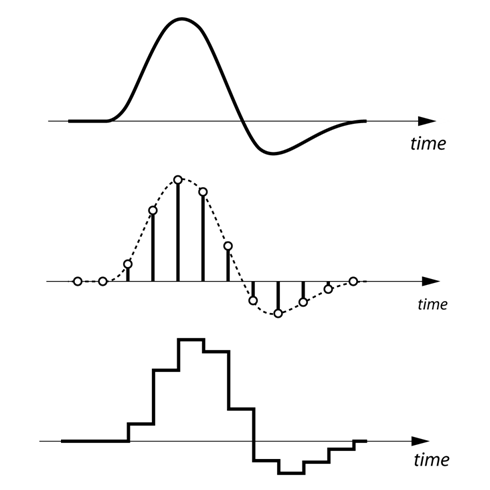
Digital audio formats on the network:
WAV: Waveform files (or simply wave) are the most common sound formats on Windows platforms. WAV files can also be played on Mac and other systems with player software.
MPEG (MP3): The Motion Pictures Experts Group (MPEG) format is a standard format with significant compression capability. MPEG level 3 or MP3 files are frequently used for web music distribution. However, due to their size, MPEG files must be downloaded completely before playing them.
RealAudio (.rm): Real Audio is the technology that currently predominates on the Web. You need a proprietary player, but the basic versions of the player are available for free.
MIDI: The Musical Instrument Digital Interface format is not a digital audio format. It represents notes and other information so that music can be synthesized. MIDI has good support and its files are very small, but it is only useful for certain applications because of the quality of its sound when played on PC hardware.
AU: The u-law format is one of the oldest sound formats on the Internet. Players are available for almost all platforms.
RMF: The Rich Music Format supported by Beatnik (www.beatnik.com) is a high quality audio format, primarily for “download-and-play”, which is becoming increasingly popular.
AIFF: The Audio Interchange File Format is very common on Macs. It is widely used in multimedia applications, but it is not very common on the Web.
Flac: Free Lossless Audio Codec (FLAC) (Lossless audio compression codec) Ogg project format without loss. The initial file can be completely recomposed with the disadvantage that the file occupies much more space than would be obtained when applying lossy compression or Lossy.
Digital audio on the network:
The digital sound is measured by the sampling frequency, or how many times the sound is digitized over a certain period of time. The sampling frequencies are indicated in kilohertz (kHz), which indicate the number of times the sound is sampled per second. The CD sound quality is obtained with 44.1 kHz, or 44,100 samples per second. For stereo sound, two channels are required, each 8 bits; At 16 bits per sample, this results in 705,600 bits of data on a CD, producing high quality sound, at the request of the end user. In reality, the transmission of this amount of data would occupy almost half the bandwidth of the T1 network. As the average user of the Web does not have this bandwidth, another solution is necessary. One possible solution is to decrease the sampling rate when digital sound is created for sending through the Web. A sampling frequency of 8 kHz, in mono, would produce acceptable results for simple applications, such as language, especially if we consider that the playback hardware generally consists of a combination of a simple sound card and a small speaker. Low quality audio does not require more than 64,000 bits of data per second, but the end user still has to wait to download the sound. Modern users need several seconds to receive, even in the best conditions, a single second of low quality sound, making continuous sound impossible.