What are codecs?


Free Download Mp4Gain
picture

First, it is useful to know the technical definition of codecs. They are programs that encode and decodify multimedia files, which favor compression for storage and unpacking for viewing.

Multimedia files

When using a media file, a codec is used, even without knowing it. Each file with an MP3 or AVI extension, for example, was created with a codec. Currently, to play music or watch a movie, you need a codec to read these media files. But why?

Codec

Listening to and viewing multimedia files At the beginning of personal computing, the main multimedia files used were WAV and MIDI audio. The WAVs recorded the ambient sound and made short clips. MIDIs were sound synthesizers because they used the computer’s sound card to replicate music. The big problem with these formats was that the MIDI files weren’t music, just any computer playback (currently, MIDI sound technology is used in the polyphonic tones of cell phones) and the WAVs were extremely large.

codec

The problem with WAV

But why are WAV files (and still are) so large? To understand this, it is enough to know that the human ear perceives only one sound track and does not listen as much as possible. However, the WAV can perceive and record these inaudible sounds and transform them into information along with the perceivable ones. In this way, WAV sound files have a lot of information, from unnecessary to what we need.

The way to deal with excess information was to develop a program that would take only the useful parts of the WAV files. In this way the MP3 was created, that is, it is a compressed sound file with only the necessary information.

Starting with the video files

Viewing video files It all started in the late 1980s, with the MPEG project, the Motion Picture Expert Group, or the Animated Picture (or Movie) Expert Group. This group developed a system to compress movie files for storage and playback on computers, without excess size or weight. Imagine that in an 800×600 movie, full screen in high resolution, there are 30 different images per second and each image is made on average with about 500,000 dots. Each point is one byte of information, so each second of film would have approximately 15 MB of information. That way, a CD with a capacity of 700 MB would only fit 50 seconds of film!

This group developed a way to encode these images from the film so they didn’t take up as much space. Despite having lost some of its quality, the film was playable on any computer, in addition to providing detailed observation. These files were either MPEG or MPG. MP3 would actually be the third layer of MPEG, the sound layer (that’s why it’s called MP3). The MP4 format would be a fourth layer of MPEG, with videos in high definition.

Understand how it works

The codec is a small program to encode and decode information from a multimedia file. It encodes the original format in a smaller size for storage and then decodes it, converting it back into an image and / or sound for all to see.

Therefore, you must have the codec installed on your computer to view certain multimedia files. A video in AVI format, for example, can be compressed with different codecs, such as XVID or DIVX. And for your computer to read that information, you need to have that code to decode the movie and watch it.

Existing core codecs

Currently, a primary audio codec, MP3, is used. In addition to some different video codecs, such as XVID, DIVX, RMVB, M4V, among many others. Fortunately, there is the K-Lite Codec Pack, a great package with all of these core codecs and many others, all of which are playable with Media Player Classic. The important thing is that with the K-Lite Codec Pack installed, you will hardly find a file format that requires a codec that is not on your computer.

There are different versions of K-Lite. They are:

K-Lite Mega Codec Package: With this package you offer the vast majority of necessary codecs and also the advantage of having the Media Player Classic ready.

K-Lite Codec Pack Full: Bring all the codecs you will need, without Media Player Classic.

Other possible packages

If you are not satisfied with the K-Lite Codec Pack packages, there are other download options in Baixaki. Some are:

Windows Essentials Codec Pack: allows decoding of other file formats, such as APE audio and FLV video.

Real alternative: a package with codecs for viewing files in Real Media, such as RMA audio and RMVB and RMVB video.


Free Download Mp4Gain
picture


Mp4Gain Main Window
picture


Mp4Gain Features
picture


Free Download Mp4Gain
picture

Codecs and bit rates, how much do they influence the quality of MP3s?


The importance of codecs

Everything that has been written about the bit rate is valid
“with the same codec”, ie with the same algorithm
Coding, but the quality of the algorithms is very variable,
since the perception model, fundamental control of the levels of
compression.

codec

Those who are best able to mimic natural perception will get it
the best results since the cutoff frequencies will be
least audible and significant, while a codec with a perceptual model
Unrealistic creates flat and empty passages of important frequencies.

video container

In addition, a bad codec easily introduces “artifacts”; or
Sounds that are not available in the original originate from poor quantization
of some frequencies, especially if the original is not perfect.

Like most things in the computer world, codecs are evolving
In addition to the codec type, it is important that it is current and updated
for increasingly powerful algorithms.

Codecs fall into two categories: “fast”
and slow “. The most important fast codecs include blade,
QDesign and Xing, fast compression, but low to medium quality,
among the slow but high quality Fraunhofer and Lame are these
latest free and especially valid for high bit rates.

You can achieve good results with Fraunhofer coding
Most listeners cannot do this even at 128 Kbit / s and 320 Kbit / s
Distinguish MP3 from the original while compressing with Xing
o Blade with 128 Kbit / s can detect obvious artifacts and only with 256 Kbit / s
Audio reaches the quality of an MP3 compressed with 128 Kbit / s
Fraunhofer.

The just released Xing algorithm had the advantage of lower costs
Rights compared to Fraunhofer and faster coding speed
(It was also the first to implement variable bit rate VBR coding), but
Today’s processor performance is like that. for this
Factor is less important.

The lame algorithm has the advantage that no fees have to be paid
and of remarkable quality, especially at high bit rates – an MP3 from
128 Kbit / s encoded with Lame are less than one compressed with Fraunhofer.
but significantly better than Xing, and 256 Kbit / s Lame has the same quality
Fraunhofer.

At the moment, Lame is the best option for those who
You can afford larger files, while those that need to be careful
about the size, maybe because they have to offer files on an amateur website
or because they have an MP3 player with limited memory, they can pay well
Get a Fraunhofer encoder.

Xing, Blade, and other faster algorithms are not recommended, though
Pay attention to quality.

General quality and bit rate considerations
So that most listeners are of acceptable quality,
using a quality codec like Fraunhofer the bit rate that is normally used
(128 kbps, 1 MB per minute) is usually sufficient, especially if
Songs have a limited frequency range.

For some traces or for more sensitive ears a
highest bit rate, e.g. B. 256 Kbit / s (2 MB per minute, 1/5 of
Corresponding WAV).

64 kbit / s bit rates are always insufficient and with low quality codecs
like Xing or Blade are practically unknown.

Finally, we have to dispel a false myth: it is not possible to point it out
Music genres that need a higher bit rate, classical music too
Sometimes it can be made acceptable at 128 kbps because
Use restricted frequencies, while some rock or pop songs can
suffer because synthesizer tones and human voices are
easily exposed to the “artifact” effect.

Only lyrical music that has always been the most difficult
play and jazz (with cymbals,
Artifacts easy to suffer) certainly not suitable for MP3 and require bit rates
higher.

However, the results vary from song to song and are not
possible to give a general rule. It must be remembered that the audiophile,
The hi-fi musician or hobbyist can almost always
Distinguish an MP3 file with 320 Kbit / s from the original on the audio CD.
So if you have storage space, WAV files or codecs without loss of information
like WMA9 Lossless or FLAC (Free Lossless Audio Codec) always have a quality
Consider MP3, even if they are two to four times larger than
an MP3 with 320 Kbit / s.

What are codecs and why do I have to use them?

It seems incredible, but even today there are many people who still have the so-called codecs, as something virtually unknown. It is not very well known how they work and many people do not even know what they are for. In a basic way, the word codecs can be translated into a compressor – decompressor, and it is used to describe anything that converts data into another form of storage or transmission, and can convert it into something that can be used.

codec

In broadcasted or broadcasting technologies, a codec is a physical device that converts analog video and audio data, into a digital form so that it can be sent over the air. It is also capable of converting the digital information received back to an analog format. In the world of computers, codecs are used as a means of compressing video, images and audio to more manageable size. Most codecs use a lossy compression method, but there are some without losses.

Lossless codecs, such as MSU and Huffyuv, reproduce the original video exactly, without subsequent losses if the video is re-encoded. The most common loss codecs lose several parts of the information, but can save large amounts of space. A codec with losses can act in different ways, such as cutting the original image or sound, and readjusting it in a much more efficient space, then coding it. Another method is to compare a piece of data known to other adjacent data and eliminate excess information to save space. The truth is that there are a lot of codecs available, each of them trying to find the perfect balance between the lost information and the file size. Other factors such as process power also have to be taken into account.

How the video codecs works

The MPEG-1 codec is used in VCDs, and contains the MP3 standard, one of the most used audio codecs. The support for this type of codec is very high, especially among computers, and consumers of devices for watching movies. The quality is very high, although it is not as high as MPEG-2, and the sizes of the files that contain the video are quite large. The MP3 audio standard has good compression through a number of codecs, and is one of the most popular for listening to music online.

The MPEG-2 codec is an incredible high quality standard used primarily for DVDs. While the MPEG-1 codec only allows progressive scanning, MPEG-2 also supports interlacing, allowing greater control over size. Although it is not one of the most advanced codecs, it is widely used for its continued use as a standard for commercial DVDs.

The MPEG-4 goes one step beyond the MPEG-2. It has a number of significant technical advances and better compression methods. It is also widely used, and supports progressive scanning and interlacing. There are a good number of online codecs derived from this format, which includes DivX, 3ivx and Xvid. Each of these codecs has small differences from the original MPEG-4, to give better compression and functionality in certain situations. In fact, there are literally hundreds of codecs on the network, and everyone has their own tastes regarding the application they will use. Many programs, especially players, have their own functionalities to automatically search and download codecs that you may need for a movie or sound file. This eliminates the need for the user to have to search for them on their own. There are so-called codec packages, which bring a good selection of the best and those that are guaranteed to work. Some of the most popular are the ELISOFT Codec Pack 14. 0 and the K-Lite Codec Pack 3.7.0, which usually make almost any multimedia file work.

What is a Codec? Why we need codecs so much?

Nowadays, with so much multimedia information that we consume, whether in the form of video, audio or images, it is impossible to think of a simpler way to enjoy all these contents without the use of a codec. However, this small piece of software, so valuable for digital media playback, goes almost unnoticed for most users.

So important is the function of the codec in our system, that without them it would be impossible, for example, to watch a movie or listen to a song, since they fulfill the function of converting digital data to a way in which we humans can understand it. There are dozens of different codecs for each type of multimedia file, and each of them has been developed for a specific task.

codecs

If you want to know more about the fascinating technology of codecs, don’t hesitate to continue reading the rest of the article.

Most common types of codecs

Uncompressed audio or video take up a lot of storage space, and that is why codecs are one of the most viable alternatives when reducing their size for easy handling and storage.

However, the task is not so simple, since most codecs, when reducing the size of a file lose some of the original quality, and it is very important to know what codecs to use when compressing to avoid that problem.

codec

One of the most famous codecs today is the MP3, which allows us a great capacity to reduce the size of a music file, but that offers a considerable loss of quality, even at the lowest compression rates.

In this sense, another codec that allows us to compress a music file in a good way is FLAC, which is considered a lossless codec, but with a compression rate lower than MP3, that is, the files in FLAC are larger, but also the quality that can be obtained from the original source. Other codecs widely used for compression in the musical field are Ogg Theora and Ogg Vorbis, just to name a couple.

In the field of video files, exactly the same happens with audio codecs, there are codecs that allow a high compression rate but that lose a lot of quality in the process, and lossless codecs such as MSU or Huffyuv, but which are practically unmanageable due to the resulting size of the video.

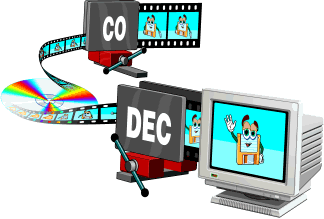
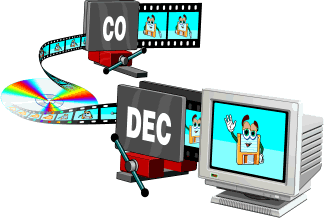
The codec name comes from the contraction of CO-code and DE-code.

And as we said before, we encode and decode to reduce the size, losing the minimum possible quality. Today we want everything to happen without cuts, without interruptions. Watching a movie without taking hours to download or load, or listen to a song equally without interruptions … that means that the video or audio (increasingly high quality and therefore of greater weight in the discussion and that would take longer time to be transmitted over the internet) should be reduced as much as possible by convincing as much as possible the same quality.

It was already understood that without codeces we would be lost and this audiovisual era of streaming we would not be possible?

Jua many audio and video formats, each one was made with a series of specifications in mind. They compete against each other and it is good that we know them and know that it is better to listen to quality music … an mp3, a FLAC, ogg, etc. The same for videos … a webp, mp4, avi, wmv, etc. is better.

That’s why codecs shouldn’t seem strange things to us, just weird names. But we must understand that without its ability to reduce the size of the files, we would not have been able to live this multimedia revolution that we are living today.