
It seems incredible, but even today there are many people who still have the so-called codecs, as something virtually unknown. It is not very well known how they work and many people do not even know what they are for. In a basic way, the word codecs can be translated into a compressor – decompressor, and it is used to describe anything that converts data into another form of storage or transmission, and can convert it into something that can be used.
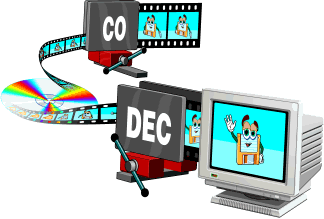
In broadcasted or broadcasting technologies, a codec is a physical device that converts analog video and audio data, into a digital form so that it can be sent over the air. It is also capable of converting the digital information received back to an analog format. In the world of computers, codecs are used as a means of compressing video, images and audio to more manageable size. Most codecs use a lossy compression method, but there are some without losses.
Lossless codecs, such as MSU and Huffyuv, reproduce the original video exactly, without subsequent losses if the video is re-encoded. The most common loss codecs lose several parts of the information, but can save large amounts of space. A codec with losses can act in different ways, such as cutting the original image or sound, and readjusting it in a much more efficient space, then coding it. Another method is to compare a piece of data known to other adjacent data and eliminate excess information to save space. The truth is that there are a lot of codecs available, each of them trying to find the perfect balance between the lost information and the file size. Other factors such as process power also have to be taken into account.

The MPEG-1 codec is used in VCDs, and contains the MP3 standard, one of the most used audio codecs. The support for this type of codec is very high, especially among computers, and consumers of devices for watching movies. The quality is very high, although it is not as high as MPEG-2, and the sizes of the files that contain the video are quite large. The MP3 audio standard has good compression through a number of codecs, and is one of the most popular for listening to music online.
The MPEG-2 codec is an incredible high quality standard used primarily for DVDs. While the MPEG-1 codec only allows progressive scanning, MPEG-2 also supports interlacing, allowing greater control over size. Although it is not one of the most advanced codecs, it is widely used for its continued use as a standard for commercial DVDs.
The MPEG-4 goes one step beyond the MPEG-2. It has a number of significant technical advances and better compression methods. It is also widely used, and supports progressive scanning and interlacing. There are a good number of online codecs derived from this format, which includes DivX, 3ivx and Xvid. Each of these codecs has small differences from the original MPEG-4, to give better compression and functionality in certain situations. In fact, there are literally hundreds of codecs on the network, and everyone has their own tastes regarding the application they will use. Many programs, especially players, have their own functionalities to automatically search and download codecs that you may need for a movie or sound file. This eliminates the need for the user to have to search for them on their own. There are so-called codec packages, which bring a good selection of the best and those that are guaranteed to work. Some of the most popular are the ELISOFT Codec Pack 14. 0 and the K-Lite Codec Pack 3.7.0, which usually make almost any multimedia file work.


