
What are video formats?


Free Download Mp4Gain
picture

Video Formats

The term explains how video data is or has been recorded on a data carrier. The type of video data recording is basically defined by four different reference points. These are:

the movie format (image resolution and aspect ratio). Check out Part 1 of this article series titled Film Formats
the refresh rate (also called the refresh rate). The frame rate is specified in hertz (Hz) or as fps (frames per second, German = images per second)
color depth, which describes the ability to differentiate between color values ​​and brightness values
the soundtrack
Regardless of the purpose for which you want to create a video, the video format determines its quality and usability.

video formats

The data formats are NOT the same as the video formats. The data format establishes how video data is presented in a purely technically structured manner and is read (interpreted) by software on a computer system for processing.

Data formats have nothing to do with video format, movie formats, frame rates, color depths, and sound. Normal users rarely come into contact with data formats when communicating with movies and videos. The situation is different with data and video formats.

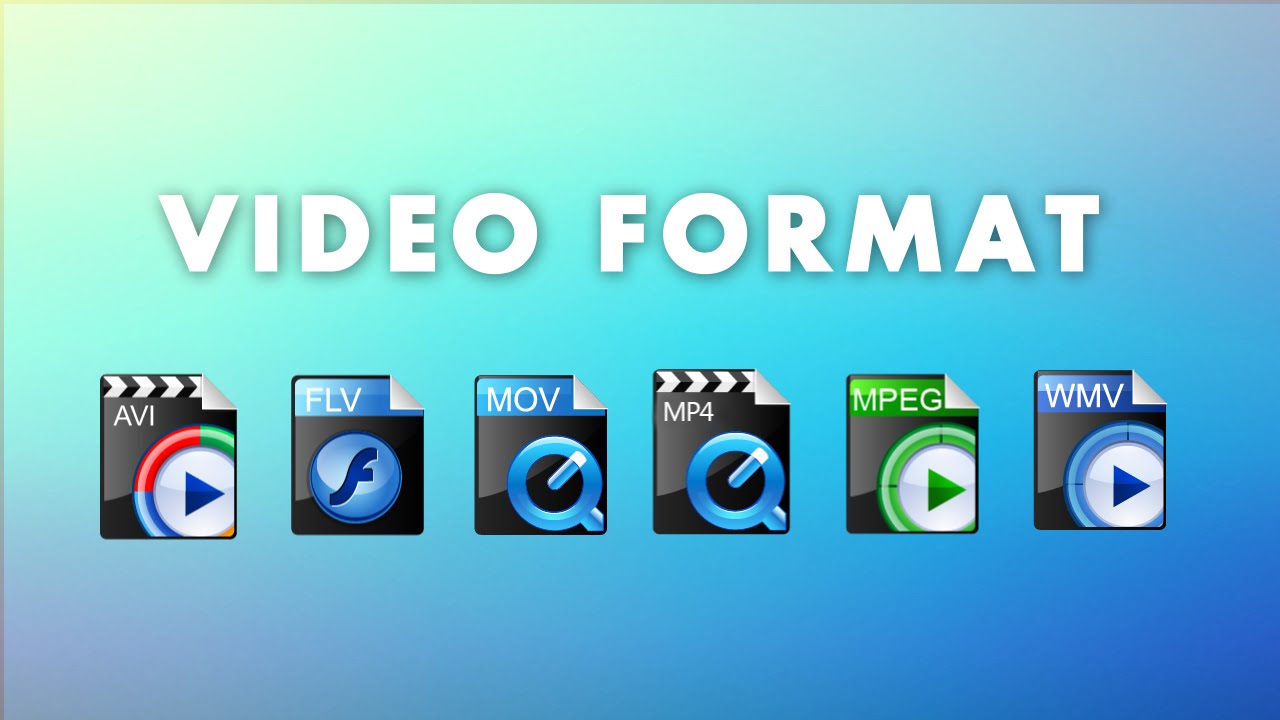
Video formats (“formatted videos”) can be identified by their file extensions (for example, * .mp4 or * .mov or * .mpg). Video formats can be classified according to different criteria, depending on the subject: for example, according to the size and quality of the file (compression) or according to the content type of a file (container formats).

Movie format / aspect ratio difference

Just as data formats represent different things, the terms movie format and video format are NOT identical. In film format in which the question is understood thereafter for film and video, size and in what aspect ratio a film or video is on a recorded disc. Movie format and rotation formats are synonymous, while recording format, image format, image size, and projection format as subgroups further specify the term movie format.

Why is the video format important?

The video format is not important. But only if you watch your videos directly on your smartphone or upload your own videos directly to the Internet. But anyone who wants to communicate professionally with videos will want to edit their movies and will quickly have to deal with not only the content, but the technical quality as well.

Even those who “only” want their movies to be accessible to the public via YouTube or Vimeo or who want to embed their social video on their website via one of these video platforms will notice at the latest that there is something like a technical framework if the video file is not sent to upload is accepted. YouTube, for example, succinctly reports in this case: Before you can upload these types of files, you need to convert them to YouTube-compatible video formats. (The next chapter on conversion provides information on what this means and means.)


Free Download Mp4Gain
picture


Mp4Gain Main Window
picture


Mp4Gain Features
picture


Free Download Mp4Gain
picture

Technical factors in video formats

In each video file format, each factor performs a function: each video has a frame rate and a color depth, a format, and a soundtrack. Depending on these four factors, the video takes on a certain aspect and size. For example, the higher the resolution of the film format and the higher the frame rate, the more information should be included. Therefore, such a file will also take up more space on your hard drive. By compressing the file, its size can be reduced, but this generally comes at the expense of quality.

Video formats

advice

Different video formats not only determine the quality and size of the file, but also determine which devices can play it. That is why video formats are generally chosen based on the media that will be used to play the video file.

Video Formats

Common video formats on different platforms

The most widely used video platform on the net is obviously YouTube. However, the social network Facebook also has wide coverage. On both websites you can upload multiple videos and share them with a large audience. Therefore, common video formats must be actively supported on both platforms. The same is true if you want to upload the different video formats to the platforms. Among other things, both providers accept the following video formats:

  • MOV
  • MP4
  • AVI
  • WMF
  • FLV
  • WebM

However, the time it takes for the platform to make the video and convert it depends on both the file size and the chosen video format, so you should choose the appropriate video format. This also applies to embedding video formats on your website.

The different video formats: advantages and disadvantages
Basically, we need to distinguish containers (container formats) from codecs. When we talk about video formats, we generally mean the container format, which contains video, audio, and metadata. The container ensures that all the information within a file can be retrieved. Instead, the so-called codec is used to encode the video, which mainly refers to the type and strength of compression. The most popular codecs are H.264, H.265, VP8 and VP9. To encode a video, you need a video editing program.

The MP4 file format

The MP4 file format has long been one of the most popular video formats on the web. Thanks to good compression coupled with good video file quality, excellent compromises can be achieved. The codecs used for MP4 are mainly H.264 or H.265.

Advantage

The format offers a good compromise between image quality and compression and is particularly compelling due to the simple ability to bundle multiple audio tracks and additional elements into a single format.

Disadvantages

MP4 files are often heavily compressed using standard codecs, making processing and creation difficult.

The AVI file format

The abbreviation AVI stands for Audio Video Interleave and means that in this format the video and audio tracks are directly linked to each other. The format is widespread, but technically obsolete.

Advantage

This format is mainly characterized by a very high level of acceptance. There is hardly any player and hardly any browser that does not support AVI files.

Disadvantages

The technical limitations of the file format and, above all, the lack of ability to use multiple audio tracks mean that fewer and fewer users are using the AVI file format.

The MKV file format

The MKV format is currently one of the most popular video formats on the net. It is a powerful container format that can integrate not only video files but also audio tracks, menus, and many other functions.

Advantage

The MKV format is particularly compelling due to the high quality of video files and the wide range of functions in which the format can be used. The format can only be used with the appropriate codec, but it is freely available on the net.

Disadvantages

The disadvantages of the format are mainly the low compression properties, so it is not possible to create very compact files.

The MOV file format

This video format was developed by Apple and is designed primarily for use with Quicktime. However, the format is no longer up to date and is therefore rarely used for network applications.

Advantage

The advantages of the format are mainly the ease of use in the Apple environment and the very high compression, which allows to obtain small files.

Disadvantages

Due to the very high compression of video files, a consequent loss of images and information occurs.

VIDEO FORMATS: A BRIEF REVIEW OF THE MOST KNOWN

When facing the world of video, you have to take into account a series of concepts. Thus, we must be clear about the differences between the container format, the video codec, the video specification and the audio codec:

Video formats

 video formats

Container format

This type of file contains several elements and, at least, video and audio.

The video codec

codec

It is often confused with the video format, but it really is not the same. It is not a mandatory element, since if no codec is specified, the video will be uncompressed, that is, in RAW format. Therefore, a codec is generally chosen to compress the video. And depending on which codec we choose, a better or worse quality will be achieved and, in turn, a larger or smaller size.

The video specification

Each video codec is usually based on a specific video specification (H262, H263, H264, H265), which is nothing more than a set of standards that define how they should behave.

The audio codec

As with the video, we can have several audio channels included in the file. In addition, they are usually also compressed with a certain codec, in order to save space: MP3, WMA, etc.

Video formats

Types of container formats

AVI format

It is probably one of the best known container formats. Corresponds to the English acronym of Audio video interleave. It was developed by Microsoft in 1992 and is one of the most popular formats, perhaps due to its wide use on Windows platforms. Being one of the most basic, it only allows audio and video channels.

Among the codecs that we can find are the DivX codec and the XViD.

MKV format (Matroska)

It is an open source container format, created in 2002.

Among the most common codecs that we can find are H264.

WebM format

It is a project that is based in Matroska. Initially, it was developed by the company On2 Technologies, but in 2010 it became part of Google, which released the source code, guiding it to use with HTML5 as a free standard.

As for the codec used by WebM we find the VP8, which has evolved to the current VP9, ​​giving great performance.

MPG format

Rather than being a format, it is a specification, standardized by the Moving Picture Experts Group (MPEG). MPG files are used to create movies that are distributed on the Internet and, depending on their compression, we find the versions MPG-1 or MPG-2.

MP4 format

The MPEG-3 specification was discontinued and never developed, the MPEG-4 standard later being defined.

The commonly used codecs are x264.

HEVC format

The MPEG-H / HEVC (High Efficiency Video Coding) specification is considered H.265, and doubles the performance of its predecessor, supporting resolutions that could reach 8K (UHDTV).