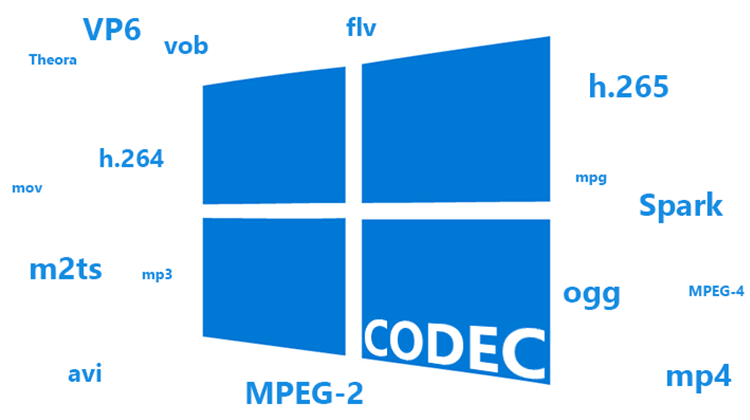
Video codecs for 4K


Free Download Mp4Gain
picture

Video codecs for 4K

4K codecs

If you are experienced in streaming or recording video signals, you probably know what video codecs are.
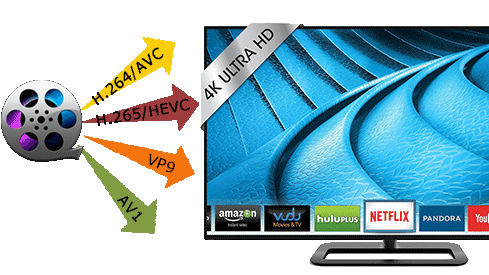
4K Codecs


Video codec – a device or program that allows you to compress (encode) large video files for viewing or editing; the name is formed at the same time as these words in English: «co the mpressor / dec ompressor» (to mpres-sor / December ohm-pres-sor) and «co de / dec ode» (to di-ro-vat / december hate-ro-vat).

In the context of the characteristics of professional environments or for live-pi-si codecs, reduce the size (or bit rate) of the data stream, allowing the transfer of data to a wide audience. For example, a compressed 1080p30 signal typically takes 4-8 Mbps, while an uncompressed version of the signal would require 1.5 Gbps – that’s 250 times longer! Given current network bandwidth limitations, it would be nearly impossible to stream at such a high bit rate without using video codecs.

Live streaming in 4K?
Streaming or recording in 4K resolution, if possible, definitely has its advantages. This is, first of all, the quality and clarity of the video, as well as ample opportunities for further processing.

In terms of formats and codecs, 4K resolution (3840×2160 pixels) contains four times as many pixels as the most popular modern Full HD resolution (1920 × 1080), meaning in one go, you can stream much more data to your audience.

Fortunately, new codecs have already appeared that allow you to work with 4K and higher resolutions.

H.265 codec: the best choice for 4K
H.265, also known as HEVC, is the successor to the modern generation H.264 codec (known as AVC), which is capable of encoding / decoding 4K video. HEVC is installed on most 4K televisions and computer monitors. When encoded, H.265 consumes up to 8-10 times more processing power than H.264, making HEVC unsuitable for transmitting small to medium-sized data using the latest technologies. Video-on-demand resources like Netflix generally encrypt their video content before making it available to users. In addition, these resources can be allowed as additional computing power,

Note that older formats and codecs (AVC / H.264) are still capable of handling 4K video, but the difference is that newer ones like HEVC do it more efficiently. At the same time, the video quality with the increased compression ratio improved and this did not affect the bit rate. Capable of supporting resolutions up to 8K (8192 × 4320), HEVC is the video format of the future.

At the same time, there are no end-user costs associated with HEVC / H.265, while equipment manufacturers, providers of paid programs and streaming services must pay royalties for using HEVC technology in their products and / or services. A good example would be modern 4K televisions or monitors, in which the H.265 codec is integrated during production and users get it for free with the purchase of the corresponding device.

Free video streaming services (such as YouTube) have traditionally been exempt from royalty payments, but this has not affected HEVC. This exclusion has generated a series of interesting collaborations between renowned high-tech companies in the creation of new open source video formats.

Alliance for Open Media
Dissatisfied with the licensing rules and patent royalties associated with HEVC, tech giants like Microsoft, Google, Mozilla, Cisco, Intel, Netflix, and Amazon have formed a new consortium: the Alliance for Open Media (AOM). It is a non-profit organization dedicated to the development of the next generation of video codecs, video encoding formats, and related technologies. For 2016-2017, AOM plans to introduce new technology that enables more efficient compression of video data, which in turn will significantly reduce the load on the Internet connection and significantly increase the capabilities of modern web networks that transmit video to personal computers, smart phones. , game consoles, streaming consoles, televisions, etc. Also, when using the new format, no royalties will be paid. It follows that any company can create software that can convert,

Many of the group’s members have already contributed to the development of the next generation of 4K codecs; Cisco created Thor, Mozilla worked with Daala and Google with VP9. AMD, ARM, Intel, and Nvidia have recently joined the Alliance.

VP9 is the most popular of the 4K codecs
The VP9 codec is open source and royalty free. It owes its popularity to its use in web applications during the gradual transition from Flash to HTML5 technology.


Free Download Mp4Gain
picture


Mp4Gain Main Window
picture


Mp4Gain Features
picture


Free Download Mp4Gain
picture

How is the video format different from the codec?

How is the video format different from the codec?

Video format and codec

What is the video format?

Codec Video Format

Although there are many video formats, from analog recording methods (VHS, for example) to digital (Betamax, DV and others), in everyday life we ​​often talk about file formats that contain digital video. In fact, these files are containers that contain not only video, but also various audio tracks and / or subtitles. Each file format has its own characteristics: some allow streaming, some do not. Some may contain multiple audio and video tracks, while others may contain only one. The container only provides one header – “instruction”, which describes how and how to open the tracks stored in it. All information is contained in compressed form, and each object packed in a container is processed in a specific way, characteristic of the selected container type.
The most common container formats are:
1. AVI (Audio and Video Interleaved) developed by Microsoft for Windows. In theory, it can store various audio and video streams, in practice it is rarely used.
2. FLV (Flash Video) is optimized for streaming video over the Internet; Advantages: quality preservation even at low bitrate, the ability to view from anywhere, regardless of the operating system.
3. 3GP focuses on mobile devices that provide the ability to record / view audio and video.
Most of the listed formats are commercial, but there are projects based on completely open standards. The most popular among them is MKV (Matroska).
Although it is more correct to use the term “media container”, in colloquial speech the word “format” has become more popular. There is no crime in this, so in the communication process you can safely operate with the data, leaving the “containers” for professional discussions.
It is sufficient that the player program understands how to correctly identify the type of container to correctly reproduce the data stored in it. Consequently, the user must know which formats the player supports and install the necessary set of several on the computer (if one cannot play all of them).
Generally, a splitter program is involved in unpacking file and media containers (it can also be part of a player). Your task is to extract the content and only then transfer each audio / video stream for decoding using codecs.

What is a video codec?
To decrypt the contents of a media container and convert it into a video stream, you will need codecs, programs of formula similar in principle to filing cabinets. Having the required codec will allow you to correctly decompress the compressed image, so it is important to have as complete a set as possible of these algorithms so as not to find a message about an unsupported video format. From an academic point of view, it is more correct to speak of decoders, but, as in the previous case, it is easier to operate with the concept of “codec”, it is universal for both digitization and video playback.

What are the codecs?
The most popular video codecs used for home use are Xvid and DivX. Movies distributed on DVD are encoded with the MPEG-2 codec.
In general, DivX is the most common proprietary MPEG-4 codec. And the Xvid codec is based on one of the versions of DivX, but open source. There is also x264 (a codec for compression in the H.264 standard) and TrueMotion VP6 (used as one of the main encoding options in the Flash Video format). The rest of the codecs, and there are many, you may not need them in practice, but it is better to have them all the same. As a general rule of thumb, the full set can be obtained by installing the K-Lite Mega Codec Pack, but some of them may have to be added manually later.

Conclusions
The video format is determined by the extension of the container file, but it is not always known which codec was used to compress the information it contains. And if to play the required format it is only important to know if the media player supports it, then to determine the codec you will have to use a third-party utility (for example, AVIcodec or GSpot), and only then add the missing codec to the system.

Everything you need to know about video codecs, containers, and compression.

Explaining the difference between codecs and containers is relatively simple, but the difficult part is trying to understand each format. The lines begin to blur when you realize that the most common codecs are not exclusive and can use various compression technologies to get the job done. The blurred line is almost invisible when you start talking about formats like MPEG-4, which can be classified as container and codec, but it is a complicated classification that is better to leave for another time.

codecs

So how is the difference between dozens of codec and container options taught? Don’t do it.There are only a handful of technologies used for online video, and most of your effort will be devoted to understanding how they work, as well as understanding the trade-offs you face in deciding what to use. .

Lossless vs Lossy

You can spend weeks studying technologies that are only used for a relatively small number of applications. Therefore, we will focus our attention on the technologies that you will use for most video encoding and playback needs.

What is a codec?

A codec, or encoder / decoder, is an encoding tool that processes video and stores it in a sequence of bytes. Codecs use algorithms to effectively reduce the size of the audio or video file and then unzip it when necessary. There are dozens of different types of codecs, and each uses different technology to encode and reduce your video file for the intended application.

Depending on the codec, this encoding occurs in two ways: Lossy or lossless compression How does file compression work? How does file compression work? One can argue that file compression is at the heart of how the modern Web works, as it allows us to share files that would otherwise take a long time to transfer. but how does it work? See more information.

Lossy compression

When looking for manageable file sizes, lossy compression is the most viable method available. Although it certainly loses quality in audio, video or both, compression is a necessary evil (currently) in a world dominated by the need to share and store what would otherwise be equivalent to impractical file sizes. Your average Blu-ray, for example, can top 40 gigabytes, and that kind of storage space would not only be expensive, but would make digital downloads and purchases inconvenient, if not a waste of time. The key when using lossy compression is to set the highest quality compression format for its intended use, so that it follows the fine line between quality loss and file size.

Lossless compression

Lossless compression works much the same as a ZIP or RAR archive, because after compressing and decompressing, the archive is essentially the same. By using smart algorithms, the file does not lose a lot of quality, but it is not an efficient way to store large files because there is not much compression that actually occurs. Also, streaming large video files online uses a lot of bandwidth (although H.265 encoding can change that) to make it a viable compression option.

Unless you work in the film or video editing industry, you are unlikely to share video files in a lossless format (if you do). To put this in perspective, even a 4K TV does not contain the resolution necessary to display a movie shot on a modern camera and is delivered without compression. In fact, it’s not even close (yet). While 4k video is beautiful, 8 Ultra HD videos to watch on your new 4K TV [things to see] 8 Ultra HD videos to watch on your new 4K TV [things to see] We have tracked high and low and found some 4K videos that take full advantage of the ridiculous amount of pixels at your disposal, for free. Read more, it is not the size of an uncompressed video format.

Although a Blu-ray movie is less than 50 gigabytes (if required on disc), the first downloadable 4K movie (available to consumers – trailer below) is 160 gigabytes! The uncompressed 1080p video is mind-blowing 410 gigabytes per hour, and that doesn’t include the audio file, which can add an additional 7 gigabytes per hour, depending on how it was recorded.

What are the most used video formats?

Choosing audio and video codecs and containers affects video quality and file size. Here we show you how to find the format that best suits your needs.

formats

Decades and decades of developments in the audiovisual field have led to a result that, in some way, can be considered curious. While in other sectors, continuous development has led to a very marked standardization (think of the .doc or .pdf format), in multimedia the situation is at least compound.

An example is the world of audio formats, animated by strong “competition” and a multitude of available options. It is no less than that of video formats, in fact. In this case, in fact, we have to deal with a division between codecs and containers (we will see in a moment what they are and what function they perform) that ends up complicating things even more. Therefore, in case you want to convert a movie, you have to be careful to choose the correct codec and the correct video format, to avoid creating files that are too large or simply unreadable. In short, the error is just around the corner.

audio formats

Differences between containers and codecs

Before analyzing the situation and seeing what are the most used video formats, it is necessary to clarify some fundamental concepts: first, what is the difference between the codec and the container. If in the audio world, the codec used to digitize the audio track matches the “final” file format, in the video, on the other hand, the codecs used are different from the file format that the video file will assume at the end of the digitization process. The reason is soon explained and lies in the multimedia nature of a video.

A movie, in fact, contains video and audio data: the conversion or playback software must be able to analyze both multimedia streams, and therefore will need different algorithms that work in one or another type of data stream. Codecs do exactly this: as the name, code, and decoding of data (audio and video) are made from movies, so you can convert them to another video format or play them back with a media player. Even with regard to containers, it is enough to resort to the literal meaning of the word: these are files that contain both the video and audio sequences within them and “make them available” to codecs for reading and playback.

What are the most used codecs?

A codec, as mentioned, is in charge of compressing and decompressing the video files and determines how they are played on the screen of the PC or smart TV. Each operating system provides the user with dozens and dozens of different codecs, each useful for encoding and decoding a specific type of file, even if a new one can be installed by downloading special software or packages from the web. Among the most used codecs we find the FFmpeg, Divx, Xvid, H.264 and its evolution H.265, VP9 and VP 10 (also known as the name of the Google codec).

-Divx and Xvid. As the name also suggests, these are two “mirror” codecs, created in the late 20th and early 21st centuries to meet the initial demand for online multimedia content. Since bandwidth and browsing speed were very limited, these are codecs that can guarantee good video quality even at high levels of image compression. In this way, it was possible to obtain files of contained dimensions even with very long movies (such as full movies)

-264 and H.265. Created by the Motion Picture Expert Group, they can be considered as industry standards. Among the most popular and used in all areas (you can find H.264 encoded movies on Blu-ray discs, for example, but also movies downloaded from the network) thanks to its versatility and ability to guarantee an excellent quality ratio / File size. The H.265 codec, in particular, can guarantee, with the same quality, a compression factor twice as high as that of its predecessor: files “treated” with this codec will therefore weigh half compared to their counterparts processed with H.264 codec

-VP9 and VP10. Also known as “Google Codec”, they are the codecs used by the giant Moutnain View to compress and decompress the movies uploaded to YouTube. These are algorithms optimized for online video playback, capable of offering excellent resolution and high quality even with small files. The VP10 in particular is the all’H.265 answer and is designed for resolutions up to 4K
Mpeg-H.