The benefits of digital audio
The basics of “numbers”
Each of the multimedia devices on sale today, be it a CD player, a voice recorder or a flash memory player, uses many different types of presentation of data streams, which are then converted into sound. And even more sound formats used for professional purposes have been invented. An inexperienced buyer is forced to gather information on designations on boxes and devices from a variety of sources, often receiving incorrect information or even more confusion.
Almost all devices in the “Portable Audio” section of the ZOOM.CNews.ru catalog support multiple sound formats at the same time, and many devices that do not belong in this category are also tagged with support for playing sound files. To help our reader, we decided to create a short glossary of abbreviations and talk about the most common formats. We plan to leave it open for updates and modifications, adding new formats and describing in more detail the advantages and disadvantages of the already common or forgotten ones.
A little theory
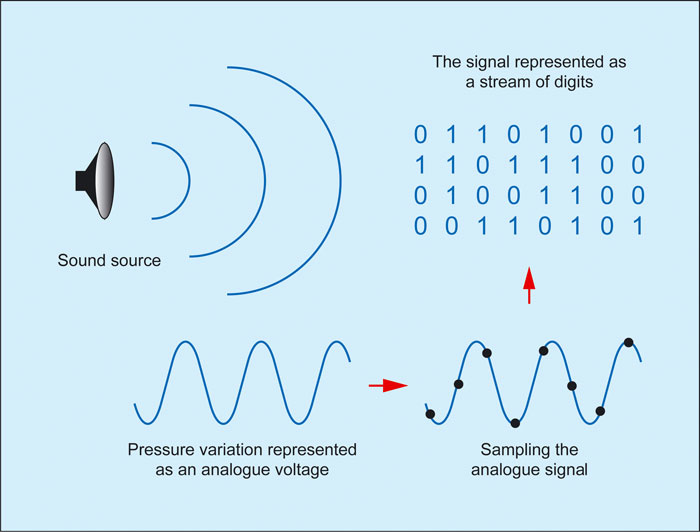
To begin with, remember that digital sound is nothing more than a collection of numbers. The determining factor is the system by which sound as air pressure is converted into data streams and encoded for further processing and reproduction. Consequently, digital sound is usually included in computer files with various extensions, which more often (but not always) can determine their format. And the same concept of format can have, paradoxically, two meanings. First, the format may exist as a general characteristic, including both the type and the physical characteristics of the medium (disc or cassette), method of recording, principles of encoding, and protection against errors. Second, the format can only be understood as the method of encoding and compressing sound, as standard means are used for transfer, for example a computer.
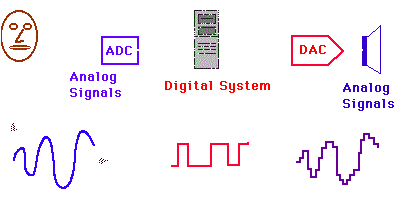
Analog sound, unlike digital, is reproduced on analog devices and has several significant differences. While not a data stream, analog sound is represented as a continuous electrical signal that represents the change in sound wave. To translate it into digital format, the sound is “digitized”, that is, it is divided into certain segments, in which the numerical value of the amplitude is fixed at that moment. We will not delve into the principles of digital sound creation, but it is absolutely necessary to note that the more often a sound segment is divided and its characteristics described, the clearer and more complete the sound image itself is created.
This process generates an enormous flow of data that describes the sound, and it is clear that each digital audio format is nothing more than a compromise between the need to present the sound as loud as possible and the limitations of the memory of the computer or device. Of reproduction.
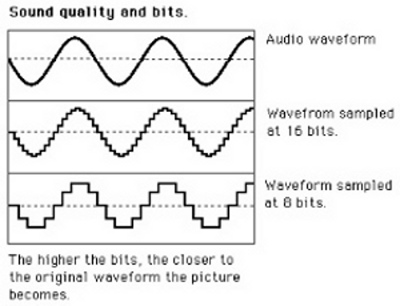
A little more theory. In most cases, the human ear perceives sound with a frequency no higher than 22,000 Hz and, to describe it fully in digital form, a sampling frequency of at least 44.1 kHz is required. Since it is absolutely impossible to determine the value of the signal at any given time, during digitization quantization occurs, that is, the replacement of the actual values of the signal by approximate values. The more levels of audio quantization, the more accurately the signal level is described. As a result, each standard CD carries an audio signal with a sampling frequency of the same 44.1 kHz and a 16-bit quantization level,