Everything you need to know about video codecs and containers


Free Download Mp4Gain
picture

Everything you need to know about video codecs and containers
Video Formats, Codecs and Containers

Sometimes it is quite difficult to figure out which codec and container are the best to create your video masterpiece.
Video Container,  Video Codec

Today, everyone seems to be striving to become filmmakers. People use a wide variety of devices and devices for filming, including mobile phones, digital cameras, portable and professional video cameras. And the latest generation of digital SLR cameras can record high definition video.

Making a good video takes a bit of effort, but it becomes even more difficult when you want to show your masterpiece to other people in all its glory. Maybe you need to upload it to YouTube, maybe you are going to burn your own Blu-ray or DVD, maybe you want to download the video to your mobile phone or tablet.

Sometimes it is difficult to figure out which codec and container is best for creating your video masterpiece. The material below can help you solve this problem.

What is the difference between a codec and a container?

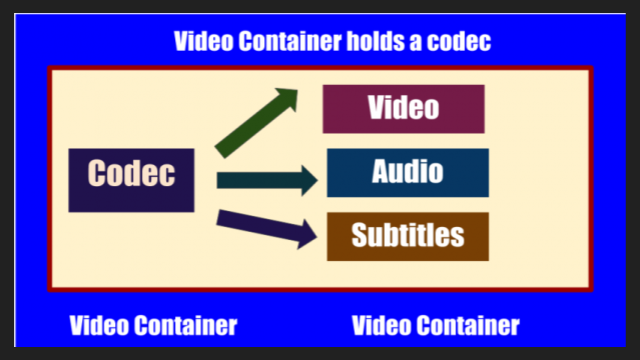
Novice users are often confused when trying to figure out the difference between codecs and containers. Now the word Codec has become commonplace, and initially the term was an abbreviation for the concept of KOMPRESSOR-DEKOMPRESSOR. What do codecs do?

They take data from digital media and compress it (for transmission and storage) or decompress it for viewing and transcoding. Each codec uses a specific method to encode and decode digital data.

Uncompressed video and audio (raw means unprocessed, or often “raw”) require a lot of storage space. Uncompressed 1080i HD video recorded at 50 frames per second consumes up to 410 gigabytes per hour. Audio on CDs, quite out of date by modern standards, plays for around 74 minutes with a 680 megabyte disk capacity. However, eight-channel audio encoded with a 24-bit resolution will require 16 megabits per second, or several gigabytes per hour. Even broadband internet connectivity is sometimes not enough to listen to music in full audio resolution. This is the reason why digital video and audio recordings must be compressed for transmission and storage.

Once the media is compressed within reasonable limits, it must be packaged for shipping and later viewing. For this, container formats are used that act as a “black box” filled with various multimedia formats. Good container formats can accommodate files compressed with different codecs.

Let’s take a look at the types of codecs.

General concept of codecs

If you chat with people who are into video processing or visit the relevant web forums, one way or another, you will find yourself involved in the sometimes heated debate about which codec is better. In fact, the effectiveness of any codec is highly dependent on the compression mode used and the type of video material being processed. Therefore, it is worth considering various codecs and taking into account their specific use and the characteristics of the compressed material. Video codecs are mainly covered below, but the section on format containers also mentions the use of audio codecs.

Capture and archive videos

Most modern consumer electronic devices receive content in some kind of already compressed format. Usually only professional videographers work with uncompressed HD video. Of course, ideally, if possible, in the presence of a large-capacity storage system, the video files should be stored in the original recording format, because this ensures the highest quality. Transcoding a video from one type of compression to another can introduce subtle artifacts that can degrade image quality. (These errors are minimized with good software transcoding.) Many codecs with specific specializations are currently offered. The average user may never find most of them. The next section is dedicated to codecs as compression / decompression systems,

x.264 / MPEG-4 AVC (Advanced Video Coding). This most common codec is used in modern digital video and digital cameras, where shooting results are saved as files on built-in hard drives, memory cards, etc.

MJPEG (Motion JPEG). This is an older format used by some older generation digital cameras and video equipment. It was developed by the same specialists (Joint Picture Experts Group), who participated in the earlier development of the JPEG codec for compressing ordinary still images, hence the name of this codec.

DV and HDV. The DV standard was developed by a consortium of companies from


Free Download Mp4Gain
picture


Mp4Gain Main Window
picture


Mp4Gain Features
picture


Free Download Mp4Gain
picture

Digital audio formats

Digital audio formats

DIGITAL AUDIO FORMATS

Digital sound “format” means not only the format of the audio file (which can be determined by its extension), but also, for example, the data presentation format, which depends on the digitization method and parameters. In addition to the computer file formats of various operating systems, there are audio media formats, streaming audio formats, and multi-channel audio formats.

digital audio formats

Furthermore, the “sound” file can be not only an audio recording, but also a project file from an audio editor, DAW, or any other program for working with sound. The project file can contain embedded audio and only links to multimedia data.

A standard MIDI file does not contain any audio data, it is a set of commands that control synthesizers and other devices.

There are also several patch and sample formats that are used on synthesizers.

Presentation format
The format for representing audio data in digital form depends on how the analog-to-digital converter (ADC) quantizes. There are two types of quantization that are commonly used:

pulse code modulation
sigma delta modulation
Bit depth and sampling frequency (quantization) are also indicated for various audio recording and playback devices as the format for representing digital audio (24-bit / 192 kHz; 16-bit / 48 kHz).

Digital audio file formats
There are three groups of file formats:

uncompressed audio formats like WAV, AIFF, RAW (raw (unprocessed) measurements without any header or sync)
lossless compressed audio formats (APE, FLAC)
lossy compressed audio formats (MP3, AAC, Ogg, WMA (lossless version available))
Comparison of digital audio formats

Lossless data compression is a data compression method by which encoded data can be recovered unambiguously with bit precision. This type of compression is fundamentally different from lossy data compression.

When lossy compression is used, the decompressed data differs from the original, but the degree of difference is not significant from the point of view of its perception or later use. The advantage of lossy compression is that it allows a higher compression ratio with acceptable distortion. When using lossy compression, be aware that recompression tends to degrade quality. However, if the recompression is done using the same algorithm and without changes to the compressed data, the quality does not change. But in general, when editing the decoded data, it is advisable to save the original uncompressed (or compress without data loss).

Audio formats for sound quality.

Audio formats for sound quality.

Audio Formats

The term “audio” today means everything that is somehow connected with sound. This is processing, playing, mixing and simply listening to audio recordings. Few people know that during their existence, all popular audio formats have undergone significant changes, sometimes for the better, and sometimes even for the worse.

audio formats

The problem is that when the creators tried to improve the recording quality by using the new format, the size of the result increased significantly. Reducing the size of the final file resulted in a significant loss of quality. But this was not always the case.
The first audio format used in computer games.

The first mention of computer sound is associated with the creation of several primitive video games. Then the sound was played back using the speaker of the system. As the software developers of that time did not try, it was impossible to achieve the level of quality that would be compatible with tape and reel recorders. This is what got many developers thinking about how to change the audio format to make the sound more natural and natural. It is this problem that has led to the current competition in the audio market. As a result, the formats used strongly affect the quality of the reproduced material and the configuration of the basic playback parameters.

WAV format

The first full quality of audio formats is associated with this particular format. The WAV extension designation was derived from the English word “wave”, which means wave in Russian. It was this format that became the first audio format to be processed with computer programs at a highly professional level. Files with a WAV extension had the following characteristics:

– depth of sound;
– sampling frequency;
– bit rate, etc.

This format was even compatible with the sound that could be obtained after processing an audio CD with an equalizer and other tools. However, the file size in this case was completely unwarranted. For example, the most common 3 minute long track could be up to 50 megabytes long.

CD

Audio CDs, or more exactly the .cda extension, appeared almost at the same time as the wav format. But unlike files with the wav extension, .cda cannot be edited. But it can be opened in any audio processing program, transcoded and formatted, and saved to your hard drive. Of course, you will not be able to save your changes to the CD.

MP3 codec

After the introduction of the LAME MP3 Encoder codec in the music industry, there was a real revolution in the audio world. Now the audio files are ten times smaller. At maximum compression, the size of a five minute composition rarely exceeds 7MB. This was a significant advance. Also, this extension finally implemented the ability to tweak some features and configure additional parameters, such as ID3 tags. They can contain information about the track title, artist, album, and release date.

Of course, this format immediately became widespread. Almost the entire Internet community uses this universal format. Therefore, we can say that the MP3 format has been a real revolution in the field of computer sound. Today it is one of the most demanded and popular audio formats. Although today it is already being replaced by other audio formats. But we will talk about this a bit later.

AIFF files

There are other types of audio files. This is the so-called aiff format. This format was originally created for use on Macintosh computers. A little later, a transformation occurred, as a result of which it was possible to achieve the compatibility of various audio formats and the possibility of their use on different platforms and operating systems.

OGG format

This audio format is also quite common. It was developed by the specialists of the Vorbis company. Please note that this format has several disadvantages. First of all, despite the small size of the files, using this format places a heavy load on the computer’s system resources.

Also, to work with this audio format, you must use your own decoders and codecs, which may not be installed automatically. For example, those who worked with the FL Studio Producer Edition program had to manually activate the installation file in .inf format to work with this format. Otherwise this app just won’t play OGG files. Despite all these shortcomings, OGG audio files are quite common nowadays and they sound good.

Audio formats: rating and benefits

Audio formats: rating and benefits

Audio Formats

As actual field studies have shown, a good idea to rank the top ten audio formats turned out to be an impossible task at first.

Audio formats

Competition conditions too different for unequal participants. In addition, some corruption schemes or lobbyists of transnational companies in the field of audio recording interfere in our good cause to help people choose the best sound product.

The world’s most popular MP3 format reached the leaders of popular love solely due to multi-million dollar promotional investments. And if you take the sound quality, then regular. And even in terms of compression and disk space savings, it’s not the highest compression either.

Therefore, a compromise decision was made: divide the test subjects into three groups and compare and identify the leaders by groups.

Three types of audio formats
No compression.
Lossless compression.
Lossy compression.
Uncompressed audio recording formats show their best performance only on high-quality professional audio equipment.

If you have an inexpensive tablet or smartphone in your hands, then wonderful music will sound on your device, but you will not hear it simply because the hardware and software resource and the speakers or headphones cannot reproduce such high sound quality.

On the other hand, if you start MP3 sound recording through professional stereos and amplifiers, you will hear such noise and rattle from the speakers that, again, this type of use is completely meaningless.

Audio classification by type of sound reproduction equipment
For professional equipment, uncompressed audio formats.
For semi-professional teams, compressed audio formats. But without loss.
For inexpensive equipment: lossy and compressed audio formats.
In the first case, the hardware is so expensive that it is ridiculous to worry about saving money on media.

In the second case, the owner of an Apple device for a thousand dollars will obviously be able to call himself and spend a couple of hundred dollars on a bulky memory.

In the third case, since it has hardly been possible to raise money for a cheap smartphone, saving on the size of the stored music is very important. Well, no one is going to listen to a symphony orchestra in Hi-Fi on the phone anyway. Unless you can download a ringtone from the classics for fun to make it look like a fresh bell pepper to the eyes of tomatoes.

With this concludes the overture, we begin to present the subject.

Audio formats for high quality sound
This includes uncompressed formats.

PCM – Pulse Code Modulation. The original analog audio is sampled as is, without any modification.
PCM is the most common audio recording format used on CDs and DVDs. Dolby multi-channel, surround, subject to high-quality speakers, sounding almost one-on-one with a live performance.

If you like to sit in front of a home theater and immerse yourself in empathy for the main and supporting characters in the movie, this is it.

Wav
A fairly old format, developed as early as 1991. Well, the old masters always thought of high quality.

Many people consider WAV to be an uncompressed format. But it is actually a container and it can also contain compressed files.

In most cases, WAV contains uncompressed PCM audio. Therefore, the quality is high. But even for one minute of recording, approximately 32MB of memory is wasted.

Good enough compatibility with Windows and Mac.

AIFF
WAV analog from Apple developers. This is also a container and also usually contains sound in PCM format. Good compatibility with Windows.

Lossy compressed audio formats
Truly popular formats for everyone.

MP3
In accordance with the MPEG-1 Audio Layer 3 standard, it appeared in 1993 and instantly won universal love precisely because of its economy in memory consumption.

A CD can store the complete discography of your favorite band.
Throw some records in the glove compartment and you can enjoy music from Kaliningrad to Vladivostok.
During this time, you can listen to all the books by all the writers worth listening to.
The MP3 format is such a solid eunuch, from which they cut the most reluctant, but began to show the ability to store and save. So MP3 is a very inexpensive format.

The main advantage is that he leans on everything that he just plays and sings.

AAC
An advanced form of audio encoding. The younger but advanced brother of MP3. It has slightly improved sound characteristics and a higher compression ratio.

Applies to Android, iOS, iTunes, YouTube, Nintendo, and the latest versions of PlayStation.

MP3, AAC, WAV, FLAC: we talk about all audio file formats

MP3, AAC, WAV, FLAC: we talk about all audio file formats

Audio Formats

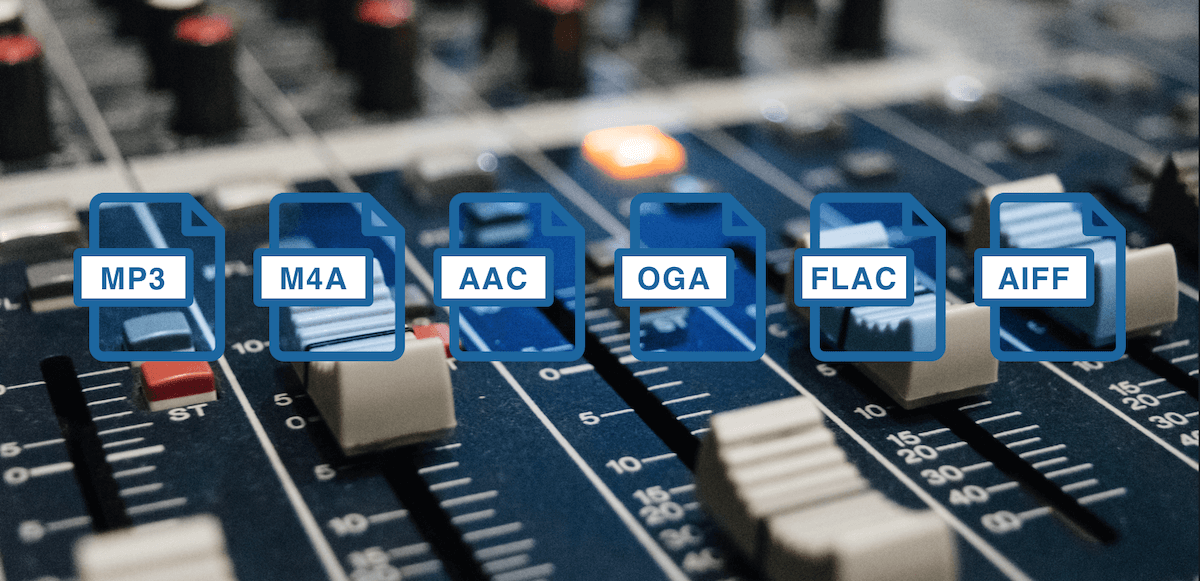
As you organize your digital music collection, you can dive into a variety of audio file formats. Almost everyone has heard of MP3, but what is OGG, AIFF, or MQA?

audio file formats

If, after reading the list, you have the suspicion that all these formats for obtaining such chic abbreviations were studied in different universities, we will help to dispel it. This material will clarify the essence of some popular music formats, the difference between them and why it is important to know them.

Regardless of what you’re listening to, low-bitrate MP3, slightly better tracks in AAC, or high-resolution audio in FLAC or WAV, it’s time to find out exactly what you get in each case and how to choose the optimal format.

Let’s evaluate the pros and cons of each.

A quick overview of file formats and codecs

In order not to beat around the bush, we’ll provide a quick guide to all file formats and the differences between them at first. If you want to know more, here is a more detailed description of the differences in size, sound quality and compatibility.

–AAC (not high resolution audio format). Apple’s popular alternative to MP3. Compressed and lossy, but with higher sound quality. Used to download from iTunes and stream from Apple Music.

–AIFF (high resolution). Apple’s alternative to WAV with more complete metadata. It is not an uncompressed and lossy format very popular with large files.

–DSD (high resolution). One-bit format used in Super Audio CD. Available in 2.8 MHz, 5.6 MHz and 11.2 MHz sample rates. Due to the use of a high quality codec, it is not currently used for transmission. Uncompressed format.

–FLAC (high resolution). Lossless compression format supporting high-resolution supporting sample rates and metadata storage; the file size is half that of WAV. Due to the absence of royalties, it is considered the best format for downloading and storing albums in high resolution audio. Its main drawback is the lack of support for Apple devices (and therefore the incompatibility with iTunes).

–MP3 (not high resolution audio format). Popular compression and lossy format with small file size and far from the highest sound quality. Convenient for storing music on smartphones and iPods.

–MQA (high resolution). Compressed format for storing high resolution files in an easier way to transmit. Used by the Tidal Masters service for high resolution audio streaming.

–OGG (not high resolution audio format). He is sometimes known as his full name: Ogg Vorbis. An open source alternative to MP3 and AAC that is not covered by patents. This 320 kbps format is used in Spotify broadcasts.

–WAV (high resolution). The standard format in which all CDs are recorded. Great sound quality, but large files due to lack of compression. Weak support for metadata (versions, song titles and artists).

–WMA Lossless (high resolution). An uncompressed version of Windows Media Audio, the compatibility of which is not often found on smartphones and tablets.

Compressed and uncompressed audio files

Let’s start by looking at three categories into which all audio file formats can be grouped. They are determined by the degree of data compression and the associated loss of sound quality.

If a special algorithm (or codec) was not used to compress the audio in your file, this will lead to a double result: first, there will be no loss of sound quality, and second, your space will soon be exhausted. HDD.

In essence, the uncompressed recording corresponds completely to the original audio file, in which real sound signals are recorded in digital representation.

WAV, AIFF or FLAC: uncompressed formats

WAV and AIFF are the most popular uncompressed audio file formats. Both are based on PCM (Pulse Code Modulation), a known mechanism for directly converting audio to digital format. WAV and AIFF use similar technologies, but the storage methods are slightly different. In these formats, you can record CD-quality files with higher resolution.

The WAV format was developed by Microsoft and IBM, and is therefore used on Windows-based platforms; it is the standard CD recording format.

The AIFF format was created by Apple as an alternative to WAV; And while AIFF files are less common, they provide more comprehensive metadata support, allowing you to store album art, song titles, and the like.

These fortmats take up a lot of space.

Description of the main audio formats

Description of the main audio formats

audio formats

In the world of music there are a large number of music formats, their modifications and versions, created by the giants of the music industry and small companies that have received public recognition in the electronic world.

audio formats

Various physical methods have been developed to store audio data for these purposes, such as vinyl records, magnetic tape, CD, DAT, MD (minidisc), DVD, or converting music scores to music (MIDI), in the same way that they have many different computing methods emerged. audio data storage – digital: OGG, Mp3, Flac, Wav formats.

It is impossible to consider and discuss all audio formats, codecs, their advantages and disadvantages, so in my article I will try to tell you about the most popular audio file extensions that you find.

Why can’t we use any universal audio file encoding format? Because implementing multiple functions requires a different format. For example: to play CDs in a CD-ROM drive, to record music or sound effects in video games, to record a movie track or video clip, to play on mobile phones or to transfer files over the Internet, in addition, there are various operating systems that are the most widely used in the world … These include: Amiga, Macintosh, NEXT, and Windows PC.

Also, the work of a dj, sound engineer, cj, video engineer, or a simple music lover is quite different in nature. This may require that your audio data be saved in your own way. For example, the audio of a CD must be saved using 16 bits and a sampling frequency of 44.1 kHz. However, to download sound over the Internet, we’d better use a different bit depth and sample rate, as each minute of 16-bit, 44-kilohertz audio takes up about 10MB, i.e. an average track of 5 minutes will be 50 meters, too much data for the average user. This article provides an overview of the most popular music formats.

AA (Audible Audio Book File) is a proprietary format developed by Audible. It is used to record audiobooks sold through the Audible and iTunes services. It is possible to reduce or accelerate the speed of listening to files: digital tone, the ability to leave bookmarks when listening to audio books, file protection, when delivering sound recordings over the Internet.

AAC (Advanced Audio Coding) is an audio file format with less quality loss when encoding than MP3 in the same sizes. Lossless music encoding of original quality using the ALAC profile. AAC is a family of MPEG4 audio coding algorithms. Unlike the hybrid mp3 filter bank, AAC uses MDST (Modified Cosine Transform) technology, which means that the listener gets better sound quality than MP3 encoding with the same or lower bit rate. Possible AAC file extensions: [.m4a], [.m4b], [.m4p].

Additionally, AAC is a wideband audio coding algorithm that uses two basic coding principles to dramatically reduce the amount of data required to transmit high-quality digital audio. This format is one of the highest quality, uses lossy compression, compatible with most modern equipment, including notebooks.

For 2009, it is much less common than MP3 and other workarounds. AAC (Advanced Audio Coding) was originally created as a successor to MP3 with improved encoding quality. The AAC format, officially known as ISO / IEC 13818-7, was released in 1997 as the new seventh part of the MPEG-2 family. There is also the AAC format known as MPEG-4 Part 3.

Benefits of AAC over MP3:

– up to 48 audio channels;

– high coding efficiency with constant and variable bit rate;

– sampling frequencies from 8 Hz to 96 kHz (MP3: 8 Hz – 48 kHz);

– More flexible set stereo mode.

ADX is a proprietary ADICM-based lossy compression and storage format developed by CRI Middleware specifically for use in video games. The most characteristic feature is the ability to repeat the sound recording, which makes using the format convenient to use as background music in various games that support this media container. It is compatible with many SEGA Dreamcast games, some PlayStation 2 games and GameCube.

Unlike MP3, it does not use the psychoacoustic model of reducing the volume of sound data (reducing its complexity). Instead, the ADPCM model uses a prediction function relative error data record to store samples.

About audio formats

About audio formats

audio formats

Installations
Installation first. There is no perfect format. Different types of audio require different approaches.

Audio Formats

Second installation. It is impossible to do something good with poor quality.

Third installation. There are three approaches to comparing quality: the discriminating edge (heavyweights), the comforting edge (consumer audio), and the intelligibility edge.

Fourth installation. Disputes in a weight category are useless and are called “holivars”. The arguments in different weight classes are meaningless: “heavy is heavier than light” and “light is lighter than heavy.” Disputes (especially between heavyweights) can only take place with the support of the “blind method”.

A brief introduction
Bit rate is one of the most important metrics for measuring digital audio recordings. It is measured in kilobits per second (for short: kbps, just kilobits, kbps, kbps, kbps, etc.).

On the fingers: answer the question “how much memory occupies a second of audio”.

All kinds of transformations are already underway: there are eight bits in a byte, 1024 bits in a kilobit, 60 seconds in a minute, 60 minutes in an hour, and we arrive at the following empirical data:

bit rate 1400 = 1 hour takes 615 megabytes on disk
320 bitrate = 1 hour takes 141 megabytes on disk
bit rate 192 = 1 hour takes 84 megabytes on disk
bit rate 24 = 1 hour takes 11 megabytes on disk
Naturally, we all want to use disk space sparingly. This is where the format war begins. 11 MB is sixty times cheaper than 615 MB. Megabytes is the cost of storing audio recordings.

The price of storage can also be expressed in bills, dividing the cost of the disk by its capacity. For an archive of audio recordings, the storage price is far from being as critical as for an archive of video recordings.

Furthermore, the storage price can be conditionally expressed in man-hours, if the playback device has a much smaller capacity than your general archive of audio recordings. It takes time to regularly download new tracks to the device.

The storage price can also be expressed in square meters of work area. 500 audio CDs will take up a lot of space and require furniture solutions, but a small external hard drive fits in your pocket.

If there is a different price, then the question of quality arises: then we assume that the lowest bitrate has the lowest quality. So we come to the main question: where is the limit of reason, where is the ideal “price / quality” ratio.

The most approximate division of audio formats in descending order of average bitrate:

uncompressed audio
lossless compression
lossy compression

Uncompressed audio is the pure signal without conversion, “as is”, the equivalent of WAV or audio CD. Classic parameters: 1411 kbps, 44100 kHz sample rate, 16-bit audio.

Codec is an abbreviation of the words (KO der and DEC oder). An encoder is a program that packages a pure audio signal in the desired special format. A decoder is a program that converts a special format into a pure audio signal. In modern English, the two terms were transformed a bit: below code and below code, which corresponds to the direct Russian counterparts for coding and racing coding. And do not confuse encryption and encryption: these are two very different processes, although externally there is a lot of similarity.

For an ordinary person, only a player that can work with this format is required (that is, it has a decoder). The “encoder” itself is only required to “create” such files.

Lossless compression – Typically used for collectible audio material. It is generally believed that this format can be converted exactly to Audio CD.

Better is this compression:

Save disk space by about half
The file format assumes the storage of additional information (artist, album, track number, track name, etc.)
The compression formats themselves differ:

format openness and compression algorithms
player support
overhead encoding, decoding costs
compression ratio
The overhead costs are negligible for the average person and the compression ratio of the codecs differs slightly. Main actors: FLAC, APE, WAVPACK, ALAC.

Lossy Compression – Provides a much higher compression ratio by discarding unimportant audio details. The smaller the size of the file we are trying to compress, the more details we will need to discard. In addition to the disappearing details, technical artifacts also appear.

What audio formats are there and how are they different?

What audio formats are there and how are they different?

Audio formats

When recording sound, the question arises which audio format to choose for disk storage. Almost all of today’s recording programs offer a multitude of options here, from highly compressed MP3 to uncompressed WAV files.

However, it’s easy to lose track in the jungle of different formats. We clarify what audio formats are available and what are the differences between the formats. FROM MP3 TO WAV, EVERYTHING YOU NEED TO KNOW ABOUT AUDIO FORMATS When you save your audio recordings digitally, they are in a specific format.

Audio Formats

Describes the structure of the file and contains all the audio signals. A distinction is generally made between two variants: uncompressed audio formats, which contain all the data, and compressed. With these, certain information is cut from the file. Compressed music formats can also be divided into lossless and lossy.

Uncompressed formats include the following: PCM (Raw Data) AIFF (Audio Interchange File Format) WAV CDDA (Compact Disc Digital Audio) The main compressed formats are: MP3 WMA (Windows Media Audio) / Lossless WMA AAC (Advanced Audio Coding) FLAC (Free Lossless Audio Codec)

This is what defines lossless formats. Uncompressed audio formats store all data in an audio file, including what the human ear cannot or can barely hear. This takes up a lot of storage space on the data carrier, but the sound quality is excellent. Lossless files are compressed to a certain extent to reduce file size.

However, this is done in such a way that no noticeable loss of quality can be detected. All original data is preserved, only the layout of the data is changed. These are lossy formats. One of the most popular lossy formats is the MP3 music format. Parts of the original file are removed to reduce storage space. Ideally, only information from the file that is not perceptible to humans is removed.

The higher the compression level, the smaller the file, but the quality also suffers with each further reduction. PROCESS YOUR AUDIO FILES EVEN MORE – SAVE STORAGE SPACE AND COMPRESS The most common uncompressed music formats are WAV and AIFF. If you record audio files on a digital audio workstation, you typically export them in one of these two formats and then process them.

If you want to save the data without any loss, but the original data must be preserved, first compress the files with an appropriate audio program in a lossless format, for example as a FLAC file. This takes up less space on the data carrier, so you can save a lot on external media and transmit the data.

Since all the information is still contained in the file and is simply unzipped when you open it, you can process these music files optimally: cutting, adding additional effects or soundtracks, or splitting the file, and all without the quality of the sound is affected. If you want to share your music and audio files, upload them to the network, send them by e-mail or if you want to save many files on a data medium, compression is essential.

You can also do this by using a corresponding audio program, some of which you can download for free from the Internet. Compression reduces the file size to a greater or lesser extent depending on the degree. At the same time, the audio file information that cannot be restored is lost. Be careful when compressing. Bit rates – this is what determines the quality of an audio file

Bit rate describes the amount of data that is processed in the music file per second. The higher the value, the higher the quality of the file. Uncompressed files typically have a bit rate of 1411 kilobytes. For example, if you convert a WAV file to MP3 format, you can set the bit rate, for example, to 192 or 320 Kb per second. THE DIFFERENT AUDIO FORMATS AT A GLANCE

What music format is suitable for what purpose and what are the sound differences?

Here you can find out when you should ideally use which format. Uncompressed formats: PCM, WAV PCM describes the raw data of an audio file. The format allows very high bit rates and therefore very high quality. The data is in the original and the sound corresponds to that of an audio CD. However, the PCM format consumes a lot of memory and cannot be played with all common audio programs that are designed for the MP3 format, for example. Therefore, you need a special program to process the flat file.

MP3? No thanks! Everything you need to know about audio files

WAV Format

In order to get your music with recordJet to all major stores, your audio files must meet some general requirements to be accepted by stores. Here we explain everything about MP3 and other file formats, as well as the requirements that stores have on audio files.

You have probably already noticed that you cannot load tracks as MP3 files into recordJet, but only in a certain WAV format. What seems annoying to some at first, however, has two important reasons: the sound quality and the avoidance of problems.

Audio Formats

WAV is actually just a container format in which audio data can be stored. The most popular are uncompressed WAV (E) files, which contain so-called PCM raw data and were created with a 16-bit sample size and a 44.1 kHz sample rate. When talking about WAV files (as is also here in this article), we usually mean exactly this variant, the so-called CD quality.

Uncompressed music files have the advantage that all the information in digital files is still available. This means that the music will sound almost as good when played back as the original recording. But at least as good as on a CD.

With a codec like FLAC (Free Lossless Audio Codec), audio files can be losslessly compressed and reduced to about half their original file size without loss of quality. This works in a similar way to packing files in zip format, only the process is specially designed for music.

MP3 (actually MPEG-1 Audio Layer III), on the other hand, is a method for lossy compression of music files. You don’t need to be a professional to hear the quality differences between WAV and highly compressed MP3 without problems. In the case of lossy compression, the file information that is as “insignificant” as possible is removed, so the file size is naturally reduced as well. For example, an audio file can be reduced from 35-60 MB to 3-8 MB by such compression.

Unfortunately, the more a sound file is compressed, the worse the sound quality, as more information is removed from the file. The amount of information from the original file that is still available can normally be read at the so-called bit rate: a song with 320 kbit / s (= kilobits per second) is less compressed and has better sound quality than a song with 192 kbit / s. With MP3 with 320 kbit / s bit rate, even a professional can hardly hear any difference in CD quality.

So why doesn’t recordJet accept MP3 files at high bit rate?
It’s simple: all stores want to receive music in a different file format. The most widespread are the WAV or FLAC formats. But MP3 at various levels of compression are also required. One of the reasons for our decision to trust WAV is that we always want to offer the highest quality possible. If we were to convert your MP3s again, more information from the file would be lost. Even if you hardly hear a difference in quality in the original MP3 compared to the uncompressed version, this may become audible after a new conversion. Also, there is not just one MP3 codec with one parameter. Different codecs produce different results. Therefore, the sound quality may vary despite the same bit rate.

And why then exactly PCM with a bit rate of 1411 kbit / s, a sample size of 16 bits and a sample rate of 44100 Hz?
As already mentioned, this specification is the standard for CD quality. No store has yet demanded higher quality levels, which are entirely possible. In addition, everyone who participates in music production knows this format. For these reasons, and to avoid misunderstandings and problems, we have defined this format as our standard. Also, due to good internet connections, files of this size are rarely a problem for uploading these days. This can certainly take a bit longer, but it should still be within an acceptable range.

Why is it not necessary, or worse yet, to add metadata or tags to the uploaded files?
Unfortunately, the metadata and tags are not 100% clearly defined in WAV files or are used differently by different audio programs. We always provide stores with high quality metadata and possibly tag the audio files, according to their standards.

The 4 most popular audio formats

Each audio file format has its individual strengths and weaknesses. Find out which one is best for certain tasks or situations; This will save you time and avoid unnecessary mistakes. Next, we will look at the five most common types of audio files and some of their distinctive characteristics and differences.

Audio Formats

1. The M4A audio file format

M4A is a file extension for an audio file in the mpeg-4 format. This is a compressed audio file format used in modern environments. The reason for this is the higher quality standards that result from the use of cloud storage and more local hard drive space on modern computers. Especially for users who have to listen to pronounced sounds in audio files, the high quality of M4A ensures that the format remains relevant compared to other common file types.

Audio format

.M4A files are compressed audio formats used in Apple iTunes.
Music download software, such as Apple iTunes, uses the M4A format instead of MP3 because it is smaller and of higher quality. There are limitations in terms of compatibility, as many software programs cannot recognize the M4A format. This makes it ideal for a single selected user type.

2. The FLAC audio file format

The abbreviation FLAC stands for Free Lossless Audio Codec, which aptly describes files in the FLAC audio format. These are audio files that have been compressed and are smaller than the original file. The sophisticated file type is rarely used as an audio format. Because although it has its advantages, it often requires special downloads to make it work.

If you also consider that audio files are often streamed, this can be associated with considerable inconvenience for any new user receiving such a file.

A .FLAC file is a lossless audio format.

The most important aspect of FLAC is that lossless compression saves size and makes it easy to publish an audio file while maintaining the original quality. Compared to the original audio file, the .flac file requires only sixty percent of storage space. This saves a lot of hard drive space and time to upload and download.

3. The MP3 audio file format

The .mp3 file extension indicates audio files that use the MPEG-Audio Layer 3 format. The most important feature of MP3 files is their compression, which saves valuable storage space while maintaining the sound quality of the original almost flawless. Compression makes the MP3 audio format extremely popular with all portable audio players, especially the Apple iPod.

Due to its high quality and small file size, the .MP3 format also keeps up with newer types of audio files.
Today’s digital landscape is indispensable without MP3, as it is compatible with almost any device that can read types of audio files. Due to its compact size, the MP3 file format is especially suitable for exchanging a large number of audio files. It also works well for websites that host audio files. The popularity of the MP3 format relies heavily on its overall sound quality. Although this is not the highest quality level, MP3 offers enough other advantages to outweigh it.

4. The MP4 audio file format

The MP4 audio format is often mistakenly viewed as an evolution of the MP3 file. But that is a fallacy. Both types of audio files are fundamentally different; the supposed similarities result only from their names, not from their functionality. So, among other things, you should be aware that .mp4 files are sometimes called video files, not audio files. This is not an error because, in fact, the format refers to both audio and video files.

There are many differences between the .MP4 and .MP3 file formats.
The .mp4 audio file type is a full multimedia file extension that can contain audio, video, and other media. In MP4 format, the data is stored in the file, not in the code. This must be taken into account as MP4 files require different codecs to artificially implement the code so that it can be read.