Advantages and disadvantages of digital sound

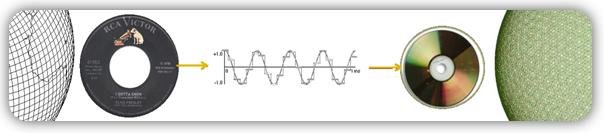
From the point of view of a normal user, there are many benefits: the compactness of modern storage media allows you, for example, to transfer all the disks and records in your collection to a digital representation and save for many years in three small ones.

one-inch hard drive or on a dozen or two CDs; you can use special software and thoroughly “clean” old records from reels and records, removing noise and crackle from their sound; It can also not only correct the sound, but also beautify it, add richness, volume, restore frequencies. In addition to the listed manipulations with sound at home, the Internet also comes to the rescue of the audio lover. For example, the network allows people to share music, listen to hundreds of thousands of different Internet radio stations, and also to show your sound creativity to the public, and for this you only need a computer and the Internet. And finally, recently, a large number of various portable digital audio equipment has appeared, the capabilities of which even for the most average representative often make it easy to carry a collection of music with a duration equivalent to tens of hours on the road. . .
From a professional’s point of view, digital audio offers truly endless possibilities. If the previous radio and sound studios were located on several tens of square meters, now they can be replaced by a good computer, which surpasses ten of those studios combined in capabilities and is much cheaper than one in terms of cost. This removes many financial barriers and makes recording more accessible to both the professional and the simple amateur. Modern software lets you do what you want with sound. Previously, various sound effects were achieved with the help of ingenious devices that did not always live up to technical thinking or were simply handcrafted devices. Today, the most complex and hitherto unimaginable effects are achieved by pressing a couple of buttons. Of course,
Of course, digital technology has its drawbacks, too. Many (professionals and amateurs) note that the analog sound was heard with greater intensity. And this is not just a tribute to the past. As we said before, the digitization process introduces a certain error in the sound, in addition, various digital amplifier equipment introduces the so-called “transistor noise” and other specific distortions. Perhaps there is no precise definition of the term “transistor noise”, but we can say that they are chaotic oscillations in the high frequency region. Although the human hearing aid can perceive frequencies up to 20 kHz, it appears that the human brain picks up higher frequencies. And it is on a subconscious level that a person still feels analog sound cleaner than digital.
However, the digital representation of data has an indisputable and very important advantage: with a saved medium, the data it contains does not distort over time. If the magnetic tape becomes degaussed over time and the recording quality is lost, if the record is scratched and pops and crackles are added to the sound, then the CD / hard disk / electronic memory is readable (if preserved) or not , and there is no aging effect. It is important to note that we are not talking about audio CDs here (CD-DA is a standard that establishes the parameters and format for recording on audio CDs), since even though it is a carrier of digital information, the effect of aging still won’t get away. This is due to the peculiarities of storing and reading audio data from an audio CD.






/bitstream-binary-5807f60f3df78cbc28b94614-a90cf1c6655b4a29b047234bfcdf9892.jpg)