
How does encoding work in digital audio? Part 4
When playing PCM 44.1×16, the most significant bits are simply ignored as they are filled with zeros, or, in the case of older multi-bit DACs, they can go to the next frame. The length of the “word” (WS) may also depend on the player through which the music is played, as well as the driver for the playback device.
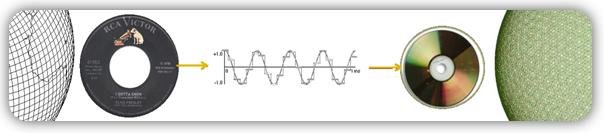
An alternative to PCM and I2S would be to record the audio signal in DSD. This format was developed in parallel with PCM, although Kotelnikov’s theorem had some influence here. To improve sound quality compared to CDDA, the emphasis was not on increasing the quantization bit, as in the DVD Audio format, but on increasing the sample rate.
DSD
DSD stands for Direct Stream Digital. It originates from Sony and Philips labs, however, just like the other formats discussed in this article.
SACD
DSD first saw the light of day on Super Audio CDs in 2002.
At the time, SACD looked like a masterpiece of engineering, applying a completely new way of recording and playback, very close to analog devices. The implementation was simple and elegant.
The media was even equipped with copy protection, although without it, no pirate was afraid. Under the Sony and Philips brands, they began to produce “closed” devices exclusively for playback, with no possibility of copying discs. Manufacturers sold recording equipment to studios, but kept control over the SACD launch.
Who knows, perhaps the SACD format could gain comparable popularity to Audio CD, if it weren’t for the cost of the playback devices. By unreasonably selling out player prices, Sony and Philips’ own leaders stymied the popularity of their format. And the next mistake put an end to the sale of specialized devices. To promote the Sony PlayStation game console, Sony engineers have added the ability to listen to SACD on it. Hackers immediately hacked the set-top box and began to copy SACD discs into ISO images, which can be burned to a regular DVD disc and played on any competing player; others simply ripped out tracks to play on a computer.
Record labels are good too: contrary to what music lovers expected, they did not take full advantage of the new high-definition format. The studios did not record music from the master tape in DSD, instead they took a digital recording in PCM, remixed and processed everything in a row: limiters, compressors, noise-shaping dithering, and various digital filters. The result was a sound so sterile and dry that even CD Audio could have sounded much better. Thus, listeners’ trust in the SACD was undermined, and at the same time in the new formats in general.
INFO
Unfortunately with vinyl records this vicious practice continues to this day: studios print vinyl from a digital recording, even if they have the recording on the master tape. So on modern vinyl it can easily be 44.1 x 16.
DSD
What is DSD? This is a one-bit stream with a very high sample rate compared to PCM. Also, DSD uses a different type of modulation, PDM (Pulse Density Modulation) – pulse density modulation. Sound recording in this format is done by a one-bit analog-to-digital converter, now these ADCs based on sigma-delta modulation are used everywhere. The recording process looks like this: while the amplitude of the wave increases, the output of the ADC is a logical unit, when the amplitude falls, the output is a logical zero, there can be no average value. It is compared with the previous value of the wave amplitude.


