What are CBR and VBR?

What are CBR and VBR?

CBR VBR

As you know, the result of encoding a signal using an algorithm such as MPEG-1 Layer III (MP3) (and many other algorithms) is a bit stream with a frame (block) structure. This is due to the fact that the source stream is not encoded in its entirety, but in parts. That is, in fact, the original stream is divided into blocks of some fixed length, then each block (frame) is encoded individually, and the result (encoded information block) is sent to the resulting stream (either a file or a stream of data).

CBR vs VBR

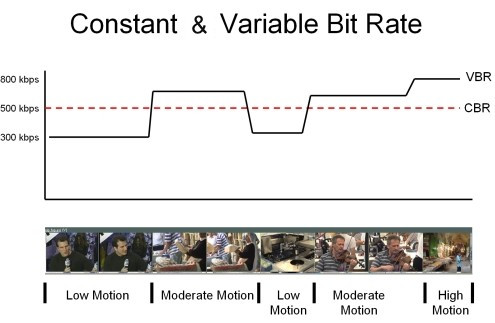
CBR (constant bit rate) is a way of encoding the original audio stream, in which all its blocks (frames) are encoded with the same parameters (with the same bit rate). In other words, the bitrate over the entire length (all frames) of the resulting stream is constant.

VBR (variable bit rate) is a method of encoding the original audio stream, in which each separate block (frame) is encoded with its own bit rate. The choice of the optimal bit rate to encode a given frame is made by the encoder itself by analyzing the “signal complexity” in each individual frame.

What are the differences between CBR, VBR and ABR for Lame Encoder?

Before starting the conversation, let’s clarify two details:

1. MP3 encoding happens block by block: the encoded file is divided into frames (frames) with the same interval, each frame is encoded and written to the output stream; therefore, the output stream also has a frame structure.

2. Frames cannot be encoded at any bit rate, but only at one of the standard MPEG1 Layer III bit rates listed in the table: 32, 40, 48, 56, 64, 80, 96, 112, 128, 160, 192, 224, 256, 320. The standard does not provide encoding at intermediate bit rates (“free format”).

Introduction

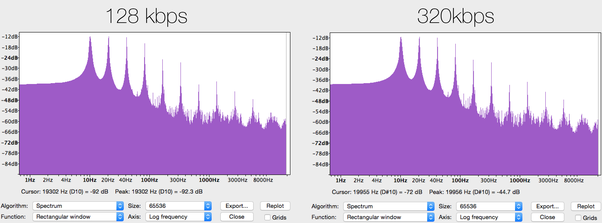
People using VBR in Lame often argue this with the phrase, “I want to get constant quality, not constant bitrate.” In fact, in music there are simple passages, for which 128 Kbps is sufficient (for example, pauses between songs), and there are also complex passages, in which a person with good hearing, a good audio card and other audio equipment. audio will hear compression defects even at 320 Kbps / sec. In fact, such an argument is not entirely valid.

CBR

Even in CBR mode, the mp3 encoder can reallocate bits over time, emphasizing more or fewer bits during complex or simple passages, thus improving the overall sound quality. This redistribution of bits is carried out at the expense of the so-called bit deposit: during the encoding of simple passages, the encoder spends not the entire user-specified bit rate on them, but only about 90%, about 10% is saved in the repository to encode complex locations (initially repository is empty). When encoding complex passages, the encoder will use 100% of the specified bit rate and add additional bits from the bucket (if any, that is, if the bucket is not empty). Unfortunately, according to the standard, the size of the tank is limited. This means that if a single signal lasts long enough, the tank builds its volume up to certain maximum allowed limits and then the encoding is already using 100% of the bit rate. And the opposite situation: if a complex signal lasts long enough, all the saved bits are taken from the repository (gradually) and then encoding is done using now 100% of the bit rate.

ABR: Explanation

You could say that the reservoir does a good job with its main function – accumulating “extra” bits during simple passages and issuing them as additional bits when encoding complex passages, if not for one “but”: it has a finite and additionally very limited size, which means that it can only be stored up to certain limits and consequently also until the tank is empty. It is in order to eliminate this major tank drawback that the ABR was developed.

The main difference between ABR and CBR is that in CBR all frames must be the same size (that is, the bitrate for all frames must be the same), but in ABR this restriction is removed, respectively, there is an opportunity to use an almost infinite tank instead of the standard, very limited in size. “virtual” reservoir. Does it look like this.

ABR: mechanism

Suppose user specified ABR mode and a certain bitrate B (user can specify absolutely any bitrate from 32 to 320, even not from standard bitrate grid, for example you can specify 129 as the rate Average Bit Rate). AND

CBR VS VBR | What is the difference?

CBR VS VBR | What is the difference?

CBR VS VBR
CBR VS VBR
CBR VS VBR
CBR VS VBR


CBR vs VBR: A Detailed Comparison of Video Encoding

CBR (Constant Bit Rate) and VBR (Variable Bit Rate) are two popular video encoding methods used in digital multimedia applications. CBR, as the name suggests, maintains a consistent bit rate throughout the entire video, ensuring predictable file sizes but potentially sacrificing video quality in complex scenes. On the other hand, VBR adjusts the bit rate dynamically based on the complexity of each frame, resulting in higher quality in visually demanding scenes while optimizing file size during less complex parts. When deciding between CBR and VBR, content creators need to consider their specific needs and the trade-offs between consistent file sizes and varying video quality.

CBR vs VBR: The Impact on Video Quality and File Size

The CBR vs VBR debate often centers around video quality and file sizes. CBR ensures a stable bit rate, which can be beneficial for streaming applications where a consistent connection speed is required. However, this uniform bit rate might lead to over-allocating bits for simple frames, resulting in a lack of efficiency. On the other hand, VBR allocates more bits to visually complex scenes, leading to improved video quality and reduced file sizes in comparison to CBR. For applications where storage or bandwidth is a concern, VBR offers a compelling advantage, as it maximizes video quality while minimizing the overall file size. However, VBR’s dynamic nature can lead to challenges for real-time streaming or constrained network conditions, where a constant bit rate might be preferred for smoother playback.

CBR vs VBR: Choosing the Right Encoding Method for Your Video Content

When selecting between CBR and VBR, content creators must carefully assess their specific video content and its intended use. CBR is well-suited for scenarios where maintaining a constant bit rate is essential, such as video conferencing or live broadcasting, as it ensures consistent playback quality despite varying network conditions. On the other hand, VBR excels in applications where video quality and file size optimization are key considerations. This makes VBR an excellent choice for online streaming platforms, video distribution services, and media content with varying complexities. Ultimately, the decision between CBR and VBR will depend on the target audience, the platform of delivery, and the desired balance between consistent bit rates and varying video quality to deliver the best possible viewing experience.

Do you have a music CD and copy it to output in MP3, AAC, WMA, etc.? Or do you just need to convert one file format to another? In this case, we recommend reading this comparison between CBR and VBR first.

First we learn what exactly these abbreviations mean. It would also be useful to know their functionality, the significant difference between these file formats and encoding methods.

Important:

Please note that the terms CBR and VBR represent different aspects. For example, CBR for comic files saved on CDisplay and VBR for the volume boot record. However, you should know that none of these terms describe what we explain in this article comparison between CBR and VBR.

video encoder

Coding of the CBR file format

CBR is the abbreviation that describes the term “constant bit rate”. In fact, it is an encoding method that allows the file bit rate to be maintained without changes. In the event that audio data is encoded (this is done by the codec), the file uses a fixed value for its bit rate. For example, the bit rate would be approximately 128 Kbit / s, 256 Kbit / s or 320 Kbit / s.

The most notable advantage of the CBR file format is that it offers faster data processing. This means that when comparing CBR and VBR in terms of data processing speed, CBR wins. However, when it comes to Quality Score, CBR output files don’t offer a better optimization. Again, VBR is better if CBR is compared to VBR in terms of quality. In short, it’s basically about choosing quality instead of speed, or vice versa.

cbr vs vbr

If you need to stream multimedia files, CBR can be seen as a useful option. Suppose your connection supports only a certain bit rate (e.g. 320 kbit / s) for steam streaming. In this case, a constant bit rate (300 Kbit / s) or less makes sense. Compared to a format that constantly changes the bit rate during transmission, a format with a constant bit rate is better. If the bit rate exceeds the compatible bit rate value of the respective network, the transmission is interrupted. Therefore, it makes more sense to have a CBR file when it comes to activities like online streaming.

Encoding of the VBR file format

The abbreviation VBR refers to the term “variable bit rate”. Well, the term itself indicates its functionality. You just have to understand the difference between the terms “constant” and “variable”. In other words, the constant bit rate and the variable bit rate are concepts with exactly opposite meanings. VBR is an encoding method that increases or decreases the bit rate of audio files as needed. There is a target area when it comes to bit rates. For example, the range can be between 65 kbit / s and 320 kbit / s. VBR supports audio file formats such as MP3, WMA, OGG and many other formats.

VBR file formats have a special sound quality function compared to the file size ratio. In fact, this is the main advantage of VBR files over CBR. Because of this aspect, it is possible to get smaller files to match the quality of the video. For example, if the original sound quality of the file is low enough, VBR will resize the file. This way, low quality files are lightweight and high quality files do the opposite.

Under the VBR mechanism, the file bit rate for inaudible segments is significantly reduced. What about the more complex parts of the track (where there is a mix of frequencies)? Well, the bit rate of these segments automatically increases to a maximum of 320 kbps. Therefore, the sound quality is preserved in areas where this is absolutely necessary. Overall, this is a great way to get a relatively small file capacity while maintaining quality. All in all, you need less space to store VBR files than CBR.

The main disadvantage of VBR, however, is a compatibility problem. With floating bit rates in the encoding process, VBR is considered a more complex file format. As a result, this file format may not be compatible with some older devices. On the other hand, CBR files are compatible with practically all devices, including older ones.