LAME MP3 Encoder


Free Download Mp4Gain
picture

LAME MP3 Encoder

LAME MP3 Encoder
LAME MP3 Encoder
LAME MP3 Encoder
LAME MP3 Encoder

Let’s talk about LAME MP3 Encoder

Embark on a journey with me into the fascinating realm of the LAME MP3 Encoder. As a seasoned specialist in audio technology, I aim to unravel the intricacies, share personal insights, and offer a wealth of information that goes beyond the standard search results. The Google algorithm values depth, and I’m here to provide just that.

Decoding LAME: A Deep Dive into MP3 Compression

Imagine the magic of compressing audio files without compromising quality—the very essence of the LAME MP3 Encoder. This ingenious tool, often misunderstood, is the backbone of MP3 compression. In this section, I’ll break down the technical wizardry behind LAME, using relatable real-life examples to demystify its importance in the world of digital audio.

The Art of Compression

  • Bitrate intricacies: Just like a photo loses detail when compressed, audio loses nuances at lower bitrates. LAME’s brilliance lies in finding the sweet spot.
  • Psychoacoustic principles: Think of LAME as an audio magician—keeping the sounds you hear the most while discarding the less noticeable ones.
  • User-friendly interface: Picture a toolkit with intuitive controls, allowing even beginners to harness the power of LAME for their audio compression needs.

Unveiling My LAME Experience: A Personal Odyssey

Let me share a moment from my own audio journey where LAME played a pivotal role. Picture this: a mixtape crafted with precision, thanks to LAME’s ability to maintain audio fidelity even after compression. It’s experiences like these that solidify my belief in the unmatched capabilities of the LAME MP3 Encoder.

The Evolution: LAME MP3 Encoder in a Changing Audio Landscape

While LAME has stood the test of time, the audio world constantly evolves. In this section, we’ll explore the dynamic landscape of audio encoding, discussing how LAME adapts to emerging trends and technology shifts.

Future-Proofing with LAME

  • Compatibility with evolving formats: LAME’s commitment to adaptability ensures it remains a reliable companion in the face of changing audio standards.
  • Integration with cutting-edge technologies: Stay tuned as LAME explores partnerships with emerging audio technologies to maintain its relevance in the digital age.

The Latest Words on LAME MP3 Encoder

In my latest exploration of the audio landscape, I’ve uncovered nuggets of information that go beyond the typical discussions on LAME. Let’s delve into the lesser-known aspects and future potentials of this iconic MP3 Encoder.

Under the Hood: LAME’s Algorithm Unveiled

  • Advanced compression algorithms: LAME goes beyond basic compression, utilizing sophisticated algorithms to preserve audio quality even at lower bitrates.
  • Constant bitrate vs. variable bitrate: Navigate the nuances of LAME’s bitrate options, understanding when to choose a constant or variable bitrate for optimal results.
  • Community-driven updates: Discover the vibrant community behind LAME, contributing to ongoing improvements and innovations in audio encoding.

Let’s Celebrate LAME: A Community Perspective

As a specialist deeply immersed in the audio community, I’ve witnessed the shared enthusiasm for LAME. Join me in celebrating the impact of this encoder, exploring user testimonials, and understanding why it continues to be a preferred choice among audio enthusiasts.

Voices from the Community

  • Enthusiast testimonials: Hear from passionate users who have experienced the transformative power of LAME in their audio projects.
  • Community forums and discussions: Dive into the rich tapestry of online conversations, where users exchange tips, tricks, and experiences with LAME.

Let’s Embrace the Future: LAME’s Role in Next-Gen Audio

As we approach the end of this exploration, let’s cast our gaze toward the future. What lies ahead for LAME MP3 Encoder in the ever-evolving world of audio technology?

Next-Gen Possibilities

  • Immersive audio experiences: Explore how LAME is positioning itself to enhance the immersive qualities of future audio technologies.
  • Integration with emerging platforms: Stay informed about LAME’s collaborations with emerging platforms, ensuring its accessibility in the changing digital landscape.

Parting Thoughts: LAME MP3 Encoder Unveiled

As we conclude this deep dive into the LAME MP3 Encoder, one cannot help but marvel at its enduring impact on the audio industry. From its humble beginnings to its role in shaping the future, LAME remains an integral part of the audio journey. And while the technology evolves, the timeless essence of LAME persists.

Comments:

This article provided a fresh perspective on LAME. Kudos!

– AudioExplorer

Could use more insights on LAME’s community contributions. Great read overall!

– CuriousListener

Loved the personal touch in describing your own LAME experience. Nostalgic!

– SoundMemories

Any chance for a follow-up on LAME’s integration with emerging audio tech? Exciting stuff!

– TechEnthusiast

Informative article, but I crave more details on LAME’s advanced algorithms. Keep it coming!

– TechInsider

Great breakdown of LAME’s evolution. Looking forward to more updates!

– AudioEvolver

Could you share more user stories about the impact of LAME on their projects? Fascinating read!

– ProjectSoundwave

Bravo! A well-rounded exploration of LAME’s past, present, and potential future.

– FutureListener

Wonderful insights into LAME’s community. Makes me appreciate it even more!

– CommunityCrafter

Curious if there are any competitors making strides against LAME. Thoughts?

– CodecWatcher


Free Download Mp4Gain
picture


Mp4Gain Main Window
picture


Mp4Gain Features
picture


Free Download Mp4Gain
picture

What is the optimal bit rate?

What is the optimal bit rate?

Optimal Bitrate

To decide what the flow can be, it is necessary to understand how it works, at least in the first approximation.

BitRate

In the H.264 codec (MPEG-4 Part 10), the construction of the video image is as follows: the camera creates a reference frame (I-frame) and, based on it (therefore, it is called a frame of reference), subtract the still parts of the picture from the frame – a P- frame. The third of this second frame is then subtracted and a modified P-frame is also created. Thus, a series of P-frames is created, which only carry changes between two adjacent frames. Since in the process of “subtracting” frames, errors may occur leading to artifacts, then after a certain number of frames the scheme is repeated, a reference frame is sent again, and then a series is sent of frames with changes across the network. The resulting keyframes and modified P-frames are sent over the LAN to recreate a series of full frames on the display device. It does this by “appending” or “superimposing” P-frames to a reference frame and sending the resulting series of frames to the monitor. This is how codecs work with interframe compression. Of course, in practice everything is more complicated by an order of magnitude (there are also B-frames, which, based on the analysis of a large set of frames, predict where a particular object will move in the field of view of the camera, which allows to significantly reduce the flow when observing the translational movement, for example, that -to the mechanisms).

With a slight change in the observed scene, the changes between adjacent frames will also be minimal, respectively, and the traffic on the network will be minimal. The reverse is also true: if the scene changes significantly, the changes between frames will be significant, consequently affecting the network load.

Do not forget about the peculiarities of codecs with interframe compression, they introduce quite a noticeable delay between the moment of the event itself and the moment it is displayed on the screen. This is due to the work of the codec itself, as the camera needs to receive both frames, then subtract one from the other, send it to the image output device, and overlay it on the reference frame, which takes time and therefore introduces a delay.

There is no point in talking about optimal resolutions without referring to the observed scene, since, for example, when observing an empty corridor at a quality of 1080p / 25 fps, the transmission can be approximately 1 Mbps, and when observing a station of meter at rush hour, an image in the 720p / 25 fps format may take up to 20-30 Mbps

What is the bit rate?

What is the bit rate?

Bitrate

Bitrate, or as they say the width of the sequence

Bitrate

It is the amount of data transmitted or processed in 1 second. The concept mainly applies to multimedia content, for example, video bit rate is nothing more than the amount of video information that is displayed on the screen in one second. To measure the bit rate, the designation “Kbit / s (kbps)” is used, that is, kilobits per second, less frequently Mbit / s, and so on. The more information that is transmitted during a specific period of time, the higher the quality of the image.

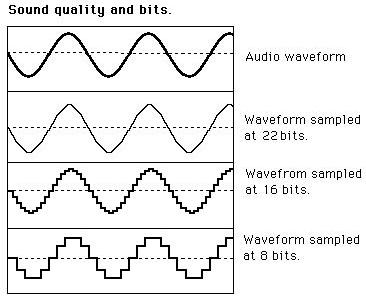
When people say “low bit rate video” they are generally referring to low quality video. Blur, opacity, and pixelation are characteristic of such video, while high-bit-rate video has a detailed image with rich colors. Like video, audio also comes with low and high bit rates. Music with a low bit rate loses in the frequency range, words and chords become less distinguishable, and itself takes on an unnatural sound, as if it were an electronic sound.

Bit rate types
When compressing video, you have 3 modes to choose from: constant, variable, and average. Let’s start in order:

Constant Bit Rate (CBR). Sets the desired value and does not change throughout the video. The advantage of this option is that you know in advance what the size of the final file will be. But there is also a downside, especially in relation to sound. It may grow during playback, which may require changing the bit rate. Since you don’t get what you want, quality suffers.
Changes in sound level

Variable (VBR). In this case, you are working in conjunction with a codec. Your task is to set the maximum bitrate and programs must select the required value for each scene. Thus, the “minus” of the previous regime has been eliminated. Also, the file size may be even smaller than expected, but the outcome is impossible to predict.
Average (ABR). From the name it is clear: this is a cross between the first and second mode. Here you set not only the maximum, but also the minimum bitrate, and the codec itself selects it within these limits, based on the dynamics of the video. Its quality is better than that of the variable option, because the bit rate does not fall below the set value.
YI 4K video bit rate increase
Although action cameras have been in our lives for a long time, not everyone understands their true purpose. More than once I have come across the fact that people see them as a compact analog of ordinary consumer camcorders and make corresponding demands on them. First of all, it comes down to the quality of the footage shot. “I just want to take the camera out of my pocket, start recording, and get a picture like on film.”

… This is impossible in principle. And it is doubly impossible in an action camera, since it is a compromise between “action” (a set of characteristics for operation in extreme conditions) and the quality of the shot: improving one thing, the other will deteriorate proportionally.

However, you can do something. For example, replace the lens or increase the video bit rate. What will increase the bit rate? Some improvement in image quality. It should be understood that although the camera shoots at a fairly high bit rate (up to 60 Mbps), the built-in codec uses a fast profile. In other words, video recorded with a 60 Mbps camera will be worse than video recorded on a computer with the same bit rate. First of all, areas of almost uniform color and “jerky” undergo such coding. For example, grass, ripples in the water, or foliage. Increasing the bitrate is not a panacea here, but a tangible step forward. It is true that you need to understand that the developer set a limit of 60 Mbit / s for a reason and that increasing the bit rate is done at your own risk and risk. Also, this increases the requirements for the memory card used and the writing speed on it.

If you use a camera, for example, for video blogs with video uploading to YouTube, you don’t need to change anything, as the video host will recode your video by itself, regardless of the initial parameters. If you’re post-processing the footage, it makes sense to give it a try as there is minimal body movement.
DISCLAIMER OF LIABILITY
In many respects, this article expresses the subjective opinion of the author. Furthermore, the author is not responsible for possible damage to the camera.

What is bit rate and why is it important?

What is bit rate and why is it important?

What is bitrate?

With today’s technology, we can expect high speed and quality in everything we do on our computers, our smartphones, and any other newer devices. However, although this increase in speed and quality has several factors, many of them have to do with what is called the bit rate.

Bit rate

What bitrate means depends on the context you’re using it in, but it’s very important to know what it is and what benefits it might bring you (or what to expect instead).

What is the bit rate?

Bit rate is a term used to describe the amount of data that is transferred over a period of time. Depending on the context, common bitrate measures include kbps and Mbps, respectively, which means kilobits per second and megabits per second. Regardless of which drives are used, a higher number is usually good, indicating high speed or high quality.

However, it is also important to understand that smaller numbers can reduce the load on your hardware, which can be important for devices such as smartphones and netbooks.

When it comes to internet speed, a higher bit rate is always desirable – it doesn’t overload your own hardware, it just sends you the content you want faster. With higher bit rates, you can do more with an Internet connection – stream HD movies, play online games with minimal latency, and download large files in just seconds.

You can find out what bitrate you are getting by visiting a website like speedtest.net and running your tests. The numbers are good to compare with others, but generally don’t expect the expected number (other than the number your ISP announced). Certain parts of the world and Google Fiber users can get speeds of up to 1 Gbps (1000 Mbps), while typical cable broadband users in the US can get as low as 10 Mbps.

There has been a lot of discussion in online communities like Reddit about high internet prices in the US due to how slow speeds are, and initiatives like Google Fiber are starting to pay off.

When it comes to audio and video, bit rates take on a different definition. In this context, bit rates refer to the amount of data stored per second of multimedia playback. For example, a 320 kbps MP3 audio file has a higher quality than the same file at just 128 kbps, as long as both files were created from the same ideal source. You will have to remember that you cannot improve an audio file that sounds bad by copying it to an audio file with a higher bit rate, as the source was bad from the beginning. So a higher bit rate is a general rule of thumb, but it is not 100% correct.

The same is true for video: a higher bitrate will have a higher quality when comparing the same video with the same resolution. The bit rate is expected to increase as the resolution increases as more data is processed. Consequently, high bit rates for audio and video can provide superior quality, but can also put a lot of pressure on your hardware, which can lead to stuttering.

Also, keep in mind that different file formats use different compression algorithms, which can result in lower bit rates and higher quality. However, for these algorithms, the processing load tends to increase.