
Digital sound. Digital audio encoding

What determines the quality of an audio signal?
The purity and timbre of the sound are mainly determined by the audio codec, or rather, by its bit depth and sample rate (the higher they are, the better the sound). This processing can be done in hardware with a special chip, an audio processor, or in software that uses controllers, which consumes CPU resources.
What is AC’97, HDA?
AC’97 and HDA (High Definition Audio) are Intel’s proposed standards for audio codecs. AC’97 was introduced in 1997 and then improved several times, but eventually became obsolete and is now replaced by HDA. HDA is fully AC’97 compliant with improved performance and enhanced capabilities.
What is the difference between AC’97 and HDA?
AC’97 defines the maximum bit depth of a 16-bit audio codec at a sampling rate of 48 kHz, HDA – 32-bit / 192 kHz. Additionally, HDA devices support 8-channel (7.1) audio, DVD-Audio, Dolby surround sound technologies, and other advanced features.
What is the sample rate and bit depth of the codec?
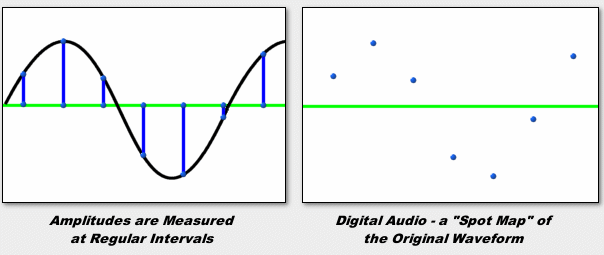
Sampling is the acquisition of instantaneous values (samples) of an analog signal with a certain time step in the digitization process. The frequency of this step is called the sample rate (it is also the sample or sample rate). The larger it is, the better the sound recorded and reproduced. In studio equipment, the frequency is 48 kHz, in home systems – 44.1 kHz.
Bit depth determines the quality of the recorded audio. Higher is better. The bit value, for example 32, denotes the number of bits that are allocated to record the amplitude of the signal at the time of its measurement.
Consequently, the more often (sample rate) and more accurately (bit depth) the audio signal is measured, the higher quality audio file is obtained.
What is the signal-to-noise ratio?
The ratio of the pure audio signal to the noise generated by the device itself. The higher the value (in dB), the better. The Sound Blaster X-Fi sound card has a signal-to-noise ratio of 118 dB. Most audio codecs are 80-95 dB.
What is DAC and ADC?
The DAC (digital to analog converter) and ADC (analog to digital converter) are part of the codec and directly perform sampling: during playback, the DAC converts the digital code to an analog signal, while recording, the ADC performs the reverse conversion. The better the ADC, the clearer and more detailed the sound that will flow from the speakers. The better the DAC, the more accurately the analog signal will be converted to digital.
Codecs for multi-channel audio support include various DACs and ADCs.
What is the bit rate?
The bit rate (literally, the information bit rate) determines the maximum amount of information that can be transmitted through the audio channel per unit of time. A high bit rate is needed to transmit a rich sound image and is not required when encoding speech. Audio recordings with a 128 Kbps bit rate are suitable for inexpensive speakers, but when accessing expensive equipment, it makes sense to get music at a 192-256 Kbps bit rate.
Convenient solution: variable bit rate encoding, change the bandwidth of the audio channel according to the quality and saturation of the musical fragment.


