What is bit rate and what is it for?


Free Download Mp4Gain
picture

What is bit rate and what is it for?
bitrate

If you become familiar with the term, you can understand that there is nothing supernatural about it.

Bit-Rate

This value can be found in multi-server settings when people are streaming video and audio.

For example, when making desktop and online converters. To understand how to change the video and audio bitrate, you need to go to a specialized site, where, in principle, more information on how to do it.

Also, it should be borne in mind that you can not do without a special program. It should be used 100 percent and only after that will it be possible to see the result on whether the bit rate has been changed in the video or audio file.

There really is a lot that you can achieve with modern software. What features of the term should I pay attention to? It should be noted that the bit rate is translated exactly as the width of the stream. Basically, it is the amount of information that is transmitted or processed per second of time.

This concept is more related to the multimedia sphere, for example, the video information that can be seen on the screen in one second – this is the bit rate. Among the characteristics are the following: To measure bit rate, one must understand what a kilobit per second is. This is the transmitted information that can be viewed. Thanks to the VideoMaster program, the kilobit can be tracked visually.

A video clip where the low bit rate is one that is low quality in digital format. Also, you can see how the video looks blurry, dull, and pixelated during streaming. At a high quality bit rate, you can see a wide color gamut, as well as hear a high enough quality sound, because the music gamut will be really distinguishable and clear. Varieties include: a constant type of bitrate, variable, averaged.

All of them can be viewed using the VideoMaster program, which directly adjusts the video to every second. Bitrate can be used in the program in any specific situation to remove one second or another from the video, or leave it.


Free Download Mp4Gain
picture


Mp4Gain Main Window
picture


Mp4Gain Features
picture


Free Download Mp4Gain
picture

What is the bit rate?

What is the bit rate?

What is bit rate

What is the bit rate? It is difficult to do without this term when we talk about audio and video files. It is not difficult to understand what you need to see behind this term. Even someone who is far from any modern technology.

What is bit rate

First, you need to understand that there is a general principle for compressing and encoding files. For example, MP3 encoding assumes that the original audio file must be cut into chunks, the length of which will be 50 milliseconds. Each of these fragments is analyzed separately to break down into harmonics.

A person perceives the sound with the ear so that it throws out those harmonics that it perceives worse. That is, quieter sounds, when the loudest are heard, you do not perceive them. Therefore, due to the inertia of hearing, a person makes masked sounds. This means that you will not be able to hear any short-term signals that will pass in a fraction of a second, for example for a clap.

Information about the harmonics remaining after filtering is recorded in an MP3 file. It is significantly smaller than the original WAV. A WAV file is a complete repository of information about the original sound, which is digitized and quantized at 44 kHz. The resulting information is stored on normal audio CDs.

When playback is in progress, reverse conversion is performed. That is, the remaining harmonics are transformed back into a sound wave. Some of the information about the original signal is lost because the sound does not match the original. Since insignificant sounds were removed, the human ear does not distinguish the signal from the original. The same as it was before packing in MP3.

This means that the bit rate should be called the amount of information per unit of time. The essence of the bit rate is how much information we can spend on each second of recording. The smaller it is, the smaller the size of the files of the same length in time. This means that it will be necessary to eliminate a greater number of “extra” harmonics.

The higher the bit rate, the larger the file size and the higher its quality. For bit rates, units of measure are provided: kilobits per second (Kbps) and megabits per second (Mbps). The MP3 audio compression algorithm is mainly used with 128 kbps compression.

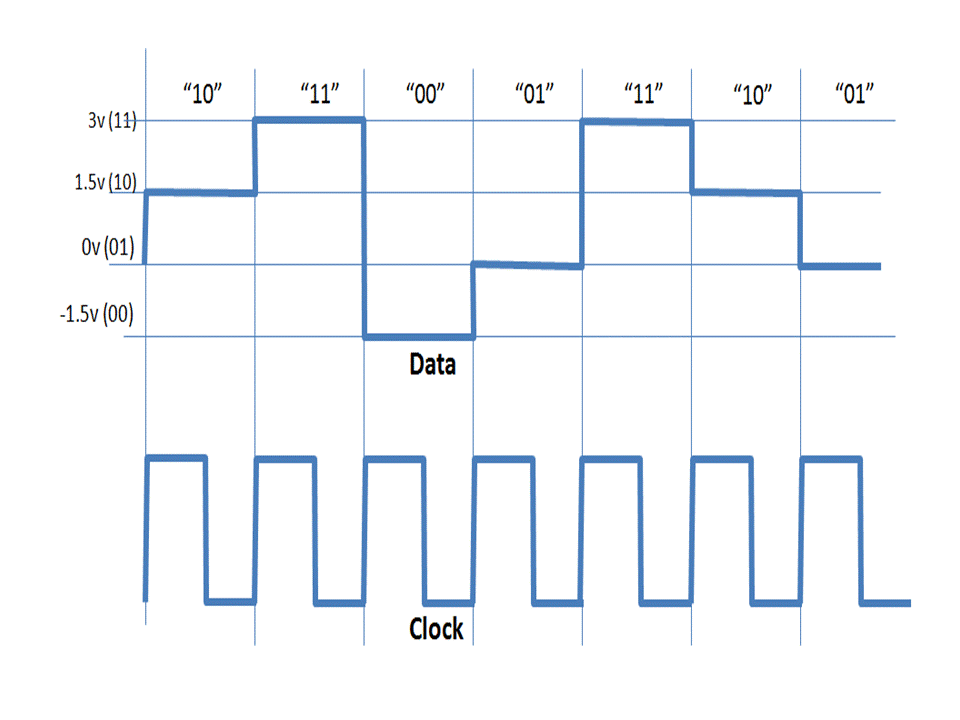
There are also two types: constants and variables. For example, in video compression, when using a constant bit rate, a fixed amount of data is used to encode one second of a movie. With a variable bit rate, depending on the scene in the movie, the codec sets its own bit rate value.

Explanation of advanced mp3 conversion settings


In this article we are going to address the audio coding settings that affect the sound quality. Understanding how conversion settings work can help you select the optimal sound coding properties in terms of file size relative to sound quality.

What is the bit rate?

The bit rate is the amount of data consumed to transmit the audio sequence per unit of time. For example, a bit rate of 128 kbps (kilobits per second) means that a second sound is encoded with 128,000 bits (1 byte = 8 bits). If you convert this into kilobytes, a second of sound occupies about 16 KB.

Therefore, the higher the bit rate of a track, the more space it will occupy on the computer. However, with the same format, a higher bit rate allows you to record the best quality sound. For example, if you convert an audio CD to MP3, the 256 kbps bit rate will provide much better sound quality than the 64 kbps bit rate.

Because today’s hard disk space is relatively cheap, it is recommended to convert to MP3 with a bit rate of at least 192 kbps or higher.

The bit rate can also be classified as constant or variable.

The difference between constant bit rate (CBR) and variable bit rate (VBR)

The constant bit rate means that the encoding of each audio segment consumes a constant amount of bits. However, the structure of the sound may be different, and the coding of a segment of silence requires much less bits than the coding of a segment of intense sound. Unlike the constant bit rate, the variable bit rate adjusts the quality of the coding at various intervals. Thus, intervals that are simple in terms of coding will use a lower bit rate, while more complex intervals will be coded with a higher bit rate. The use of a variable bit rate allows for better sound quality without increasing the file size.

What is the sampling frequency?

This term is used in the conversion of analog signal to digital form and defines the number of samples (signal level sample measurements) per second needed to convert a signal.

CBR vs VBR – which one to choose?

When you are going to pass a music CD to MP3 or AAC format you will have seen two different encoding options, the CBR and the VBR. Do you know the diference?

► The best turntables of 2019: purchase, configuration and more
CBR (Constant bitrate) encoding

CBR is a type of encoding in which a fixed bit rate is always used, so if we encode a song at 192 Kbps, the resulting file will have a bitrate of 192 Kbps for the entire duration of the song.

It is the speed at which data is processed or transferred.
It is usually measured in seconds and the most common units are:
Kb / s or Kbps (remember that the lower case “b” is bits, not bytes).
Mb / s or Mbps.
Also called: bitrate, bit-rate and BR.
The main advantage of using CBR is that the coding is a bit faster (compared to VBR). However, the resulting files are not as well optimized in size and quality.


CBR coding also has another advantage and we know in advance the transfer rate we need. For example, if we set a bitrate of 300 Kbps, we already know that with a 320 Kbps connection we will be able to transmit the data without suffering cuts, so it is usually used in real-time transmissions or streaming.

VBR encoding (bitrate variable)

VBR is an encoding method that allows a variable bit rate, this means that the bitrate of an audio file can increase or decrease dynamically depending on the complexity of the sound.

If the music is very simple or there is silence for a few seconds the bitrate can go down and then go back up in the more complex areas of a song.