Digital video encoding and compression

Digital video encoding and compression

H.264

Encoding (compressing) digital video information can seem like a difficult question to understand if you don’t know why it matters, what to look for, and generally how it works.

H.264

Why is video compression important?

The use of digital video filming was introduced in the 1980s. It was clean, uncompressed video information that required large amounts of memory and playback system resources to play and store files. But even today, compression and encoding are a prerequisite for recording any video information, despite the colossal leap in the development of digital electronic technology. Otherwise, uploading, processing, editing, playing and storing video files will become a test of the endurance of your nervous system and the capabilities of your equipment.

How does video encoding work?
In the process of encoding a video signal, the video data stream is continuously analyzed by special software, and unnecessary / unimportant data fragments are simply cut off, this helps to significantly reduce the size of the video file.

There are two types of video compression: frame-by-frame (intra-frame) and inter-frame encoding.

Frame-by-frame compression treats each frame of the video as a separate still image, similar to a photo in jpeg format. This technology is distinguished by good video quality, however, the reduction in video file size is negligible due to the fact that all frames are saved, even if there are no changes to the image for a dozen or even hundreds. of frames. In other words, out of a hundred identical photos, 100 are saved, not one.

Compression between frames works on the opposite polar principle: when a signal is processed, the whole frame is analyzed, but only key changes are saved from frame to frame, as in animation, when you need to show the movement of an object , but the background of the background and the environment around the object are the same. This enables you to significantly reduce the size of the video file compared to the intra-frame compression principle.

Image quality of
video after compression Even the most advanced video compression algorithms result in a loss of quality of the original signal. But the development of software products and codecs has reached a level where the loss of quality is almost imperceptible and indistinguishable from the original to the average human eye, especially to non-professionals in the field of digital video processing.

To preserve the highest possible video quality, while saving the volume of the video file, you need to determine the main key points: video resolution, file size, method of transferring and downloading the video file, predominance of static or dynamic scenes , color, contrast and the like. An important factor that affects the quality and size of the resulting video file is the choice of codec and compression format.

Codecs A
Video file must be compressed and encoded, and then decompressed and decoded with the same set of software tools: a codec, which includes tools to process and play the file. In other words, to view a video file, you have to decode it with the same codec that it was encoded in, for example, a video encoded in the MPEG-4 codec must be decoded with the same MPEG-4 codec; otherwise, you are guaranteed to have problems with playback. of this file.

Compression standard M-JPEG (Motion JPEG) Un
An unlicensed encoding standard created and widely used in the 1990s using intra-frame compression technology. The digital video sequence obtained with this codec is a full weight JPEG image matrix. Although this codec allows the use of a number of tools that reduce file size, it is used very rarely today due to the poor quality of the resulting image, as well as the minimal compression ratio.

MPEG-4 compression standard
Licensed coding standard that uses object-oriented compression (between frames), that is, the movement of each object in the frame is tracked separately, and based on these movements, the video signal is captured. The main advantage of this codec is the wide compression ratio setting, which can be selected for any data transfer rate, low or high. This format is universal, it is designed to watch sweat videos in real time.

Compression standard H.264 Un
licensed copying standard that greatly reduces the amount of digital video information, while making minimal changes to its quality, especially in

Why the H.264 Video Format Continues to Gain Importance for Videos and Streaming

H.264 is a video compression method. Currently, it is considered the industry standard and is one of the most widely used video formats. Full HD video and audio recording is as unthinkable without this encoding and decoding process as modern video playback.

H.264

What does H.264 mean?

The H.264 video format is now in the standard video signal encoding and decoding. It enables the transmission of high-quality video signals without imposing excessive demands on the bandwidth. At the same time, H.264 has a significantly lower bit rate than other formats.

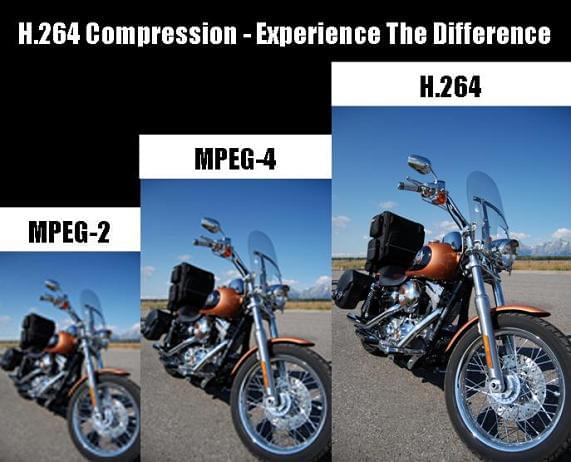
H.264 comparission

You have to know that about H.264

The term the term denotes a method for video compression.
H.264 is now considered the standard for storing and playing video formats.
The decisive factor for the success of the format is its usability up to a resolution of 4K (4092 x 2160 pixels)
The bandwidth of using H.264 ranges from YouTube to televisions and professional video productions.
The video format is an open standard, but it cannot be used without a license fee. This will be paid to the MPEG-LA consortium.

Usually we come in contact with the H.264 standard for video compression in relation to the MP4 file format. However, the two must be distinguished. One is the algorithm for compressing or decompressing. The other of the “containers” in which this process is used.

It should be noted that H.264 is not limited to the MP4 container format. When this standard was developed 15 (!) Years ago, it was deliberately designed for a wide range of applications. If you want to add audio to the image, a container format is required. As an algorithm, H.264 only compresses images.

Today, H.264 is the standard for Blu-Ray video discs. It is used uniformly by different manufacturers. The same applies to high definition television broadcasts. In general, the format is considered suitable for professional high-quality and post-processing. Rather, compression is naturally still data reduction. This is always accompanied by a certain loss compared to the original format!

Video cameras (digital cameras) also use this method to compress their recordings.

Manufacturers such as Apple use H.264 as a codec for QuickTime (version 7 or higher). The same goes for Microsoft Windows Media.

A video file that uses this method is called an H.264 file. These include, for example, MP4, HDTV, Blu-ray, and previously HD DVD.

The compression format supports a wide variety of applications. These are only limited by variables defined in the data flow. These are the maximum resolution or frame rate. The higher the video bitrate, the higher the levels.

What is AVC / Advanced Video Coding?

Advanced Video Coding (AVC) is nothing more than a video file that has been encoded with H.264.

Sometimes the term is also used as a synonym for MP4. This term can be found, for example, in the description of the recording process of digital cameras (so-called AVC camcorders), as well as in relation to Blu-ray and HDTV.

What are the limits of H.264?

The H.264 / AVC standard, contrary to what many believe, is not limited to 4K. It also allows DCI 4K (this corresponds to 4092 x 2160 pixels) at a frame rate of 60 fps (frames per second). SONY uses a system called XAVC, which is nothing more than 4K AVC.

The limits of H.264 today are not on the hardware or software side. But in the bandwidths necessary for transmission. This is where the levels come into play. They define, and limit, the maximum data rate and resolution that are available during playback.

Playback on computer

Basically, H.264 can be used independently of a specific container format. In addition to the more common MP4 video format, the standard can also be used for AVI files, Ogg formats, or Matryoshka containers (. Mkv).

For playing a video on YouTube, MP4 with H.264 is considered the most suitable format. Because these files are the best possible technical compromise between file size and data quality today.

As always, when playing videos encoded using software (a player), the computer’s processor (CPU for short) plays a decisive role. Hardware and graphics card are important.