X264 codec

X264 codec

H.264

Frequent questions

H.264

Question: What is the difference between the new H.264 standard and the old MPEG-4 standard?
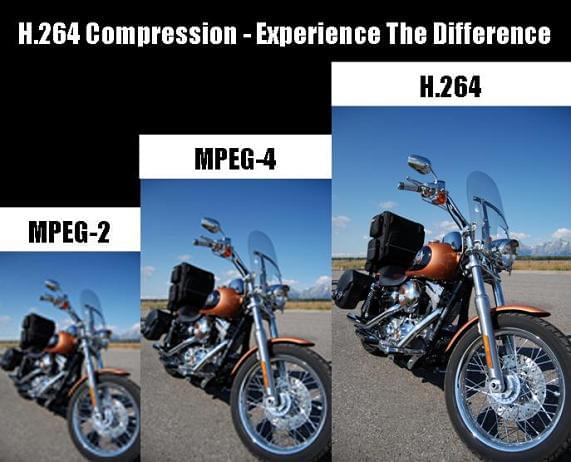
Answer: The H.264 video compression standard (the full name is MPEG-4 Part 10 AVC / H.264) is a logical continuation of the MPEG-4 Part 2 ASP standard (which is often simply referred to as MPEG-4). . The standard itself was adopted in mid-2003, but the truly effective codecs of this standard started to appear recently.

For users, the transition to the new standard means an improvement in the encoding efficiency of their video streams. That is, with the same quality of the compressed sequence, the new standard’s movie will take up less disk space or a smaller channel width (the standard’s developers set a goal of reducing the size by 50%).

More information on the standard can be obtained from the following sources:

Question: Where can I get the x264 codec?

Answer: The x264 codec is an open source H.264 codec. Several independent comparisons (see for example the comparison on the Doom9 website or our lab comparison) show that the x264 codec is one of the best codecs in the new H.264 standard.

The official page for codec developers is http://developers.videolan.org/x264.html. In it, you can subscribe to the codec developers mailing list, download the latest sources or various versions of the codec assembly (executable programs already compiled and ready to use).

Interestingly, the developers do not make official finished versions (releases), that is, the codec changes all the time. New versions of the source code appear almost every day, so it is sometimes difficult to keep track of the changes that take place.

You can find more information and discussions about the codec on the Doom9 forums.

Question: How can I use the console version of the codec?

Answer: The command line is generally used to compress video with the x264 codec. The codec can also be assembled as a Video for Windows filter, but in this case, the user has a limited set of encoding parameters.

In addition, for the convenience of work, various versions of the graphical interface can be used.

Modes of
Bit rate control algorithm The codec has three different bit rate control algorithms:

CRF (constant rate factor): constant quantizer for each type of frame, set by the user. Initialized on the command line as –crf <integer>
ABR (Average Bit Rate): Variation of the quality in different frames to achieve the best quality of the stream at a given bit rate. – Bitrate <integer> se
initializes.There may be additional parameters that control the algorithm:
–ratetol <float> Bit rate tolerance (in percent)
–vbv-maxrate <integer> Maximum frame bit rate
–vbv-bufsize <integer> Buffer size
–vbv-init <float> Initial buffer fill (percent)
Additional parameters can also be configured to control the change in the quantization factor, such as –qpmin <integer>, –qpmax <integer>, –qpstep <integer>, which specify the minimum, maximum quantization factors, and the change maximum. in the quantization factor between frames, respectively. …
Multi-pass mode. Similar to ABR, but allows you to achieve better quality by making multiple passes through the film. The first pass fills the statistics file. To do this, the codec is launched with the –pass 1 parameter. Last Pass encodes the movie using the statistics file generated in the first pass. The codec starts with the –pass 2 parameter. Multiple additional passes can be added between the first and last passes, each of which refines the statistics. In such cases, the codec starts with the –pass 3 parameter.

Digital video encoding and compression

Digital video encoding and compression

H.264

Encoding (compressing) digital video information can seem like a difficult question to understand if you don’t know why it matters, what to look for, and generally how it works.

H.264

Why is video compression important?

The use of digital video filming was introduced in the 1980s. It was clean, uncompressed video information that required large amounts of memory and playback system resources to play and store files. But even today, compression and encoding are a prerequisite for recording any video information, despite the colossal leap in the development of digital electronic technology. Otherwise, uploading, processing, editing, playing and storing video files will become a test of the endurance of your nervous system and the capabilities of your equipment.

How does video encoding work?
In the process of encoding a video signal, the video data stream is continuously analyzed by special software, and unnecessary / unimportant data fragments are simply cut off, this helps to significantly reduce the size of the video file.

There are two types of video compression: frame-by-frame (intra-frame) and inter-frame encoding.

Frame-by-frame compression treats each frame of the video as a separate still image, similar to a photo in jpeg format. This technology is distinguished by good video quality, however, the reduction in video file size is negligible due to the fact that all frames are saved, even if there are no changes to the image for a dozen or even hundreds. of frames. In other words, out of a hundred identical photos, 100 are saved, not one.

Compression between frames works on the opposite polar principle: when a signal is processed, the whole frame is analyzed, but only key changes are saved from frame to frame, as in animation, when you need to show the movement of an object , but the background of the background and the environment around the object are the same. This enables you to significantly reduce the size of the video file compared to the intra-frame compression principle.

Image quality of
video after compression Even the most advanced video compression algorithms result in a loss of quality of the original signal. But the development of software products and codecs has reached a level where the loss of quality is almost imperceptible and indistinguishable from the original to the average human eye, especially to non-professionals in the field of digital video processing.

To preserve the highest possible video quality, while saving the volume of the video file, you need to determine the main key points: video resolution, file size, method of transferring and downloading the video file, predominance of static or dynamic scenes , color, contrast and the like. An important factor that affects the quality and size of the resulting video file is the choice of codec and compression format.

Codecs A
Video file must be compressed and encoded, and then decompressed and decoded with the same set of software tools: a codec, which includes tools to process and play the file. In other words, to view a video file, you have to decode it with the same codec that it was encoded in, for example, a video encoded in the MPEG-4 codec must be decoded with the same MPEG-4 codec; otherwise, you are guaranteed to have problems with playback. of this file.

Compression standard M-JPEG (Motion JPEG) Un
An unlicensed encoding standard created and widely used in the 1990s using intra-frame compression technology. The digital video sequence obtained with this codec is a full weight JPEG image matrix. Although this codec allows the use of a number of tools that reduce file size, it is used very rarely today due to the poor quality of the resulting image, as well as the minimal compression ratio.

MPEG-4 compression standard
Licensed coding standard that uses object-oriented compression (between frames), that is, the movement of each object in the frame is tracked separately, and based on these movements, the video signal is captured. The main advantage of this codec is the wide compression ratio setting, which can be selected for any data transfer rate, low or high. This format is universal, it is designed to watch sweat videos in real time.

Compression standard H.264 Un
licensed copying standard that greatly reduces the amount of digital video information, while making minimal changes to its quality, especially in