Formats and codecs for conversion


Free Download Mp4Gain
picture

Formats and codecs for conversion.

Video File Formats and Codecs

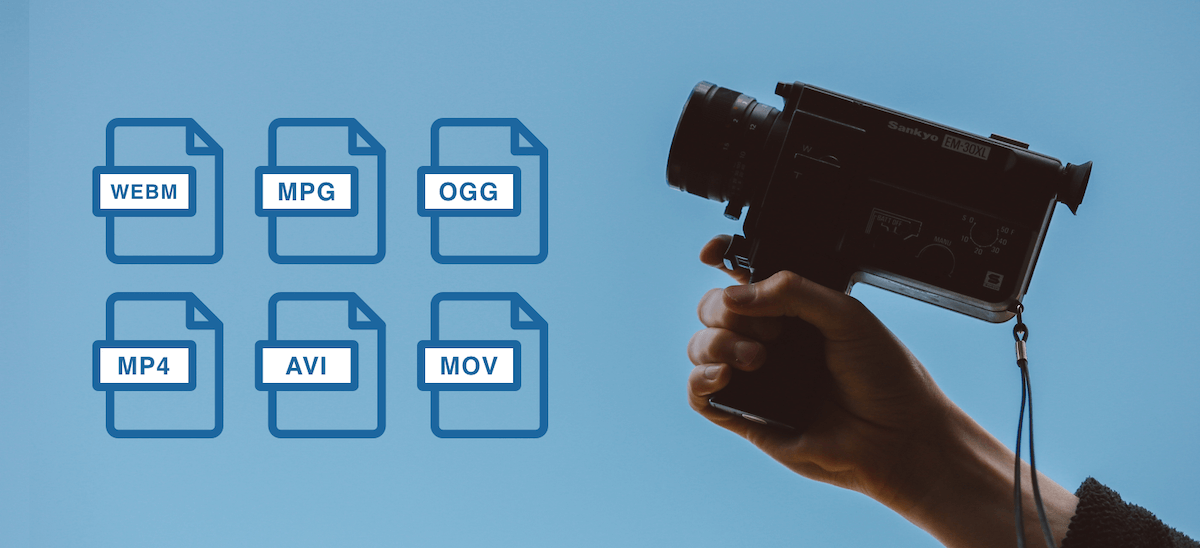
Since it is impossible to capture the immensity, we will touch only the most widespread and demanded multimedia formats, codecs, we will give a brief description and an explanation in which cases they are the most used.
Video File Formats and Codecs

In the description, we will also present a list of programs that are somehow related to this format. We will not give links, you can find all programs on the site.

Video standards
MPEG -1

MPEG -1 is a standard adopted by MPEG (Moving Picture Experts Group) video experts. Currently, MPEG-1 video is used on video CDs (VCD quality is closest to that of VHS video cassettes).

Initially, the use of MPEG -1 video is limited to a bit rate of 1.5 Megabits / s and a resolution of 352 × 240. However, this standard allows you to use any resolution up to 4095 × 4095.

MPEG -2

The MPEG-2 standard is used to convert video and audio for broadcast, including satellite broadcasting and cable television. It has strict restrictions on resolution (no more than 720 × 576), frame rate (25 fps and 29.97 fps), bit rate, etc.

MPEG -3

An audio and video coding standard for high definition television (HDTW) with data rates ranging from 20 to 40 Mbps. Work on MPEG-3 was discontinued after the modification of MPEG-2 (when the MPEG-2 standard 2 was no worse than MPEG-3 in coping with video processing).

Do not confuse MPEG-3 with the MP3 music format (MPEG-1 Part 3 Layer 3 / MPEG-1 Audio Layer 3).

MPEG -4

MPEG -4 is used to compress digital video and audio. Designed for Internet transmission (video transmission, video telephony), encoding and recording of movies on CD, (videophone) and transmission.

Video codecs
DivX (digital video express)

The most popular video codec for Microsoft Windows and Mac OS X platforms, used to compress most movies today. Compression allows you to fit an hour and a half of video material onto 1 or 2 CDs. It is distributed in two versions: DivX and DivX Pro. DivX is free (AdWare), you can use it without restrictions, the second is paid. The “Pro” prefix costs $ 19.99 along with additional package features and benefits over the free version. That:

– Better compression (about 25%) for video,
– Support for GMC (Global Motion Compensation) technology, which improves video quality and slightly improves compression ratio,
– DivX Pro provides full support for bidirectional encoding (B frames),
– Includes additional tools for video encoding.

Xvid

MPEG-4 Video Conversion Library, licensed under the GNU General Public License. Unlike the DivX codec, which was released for Microsoft Windows and Mac OS X platforms only, Xvid is a cross-platform product (used on all platforms and operating systems for which the codec source code can be compiled).

As you can see, the codec name is DivX “flip”. In practice, Xvid is the alternative to DivX. The codec is characterized by fast operating speed and acceptable image quality. Configurable both through third-party programs and through its own configuration window.

Windows Media Video

An encoding system developed by Microsoft. Included with Windows Media Multimedia Pack. It exists in several versions: Microsoft MPEG-4 Video Codec, Windows Media Video 9, etc. Although WMW video cannot compete with DivX, it is actively used in the development of multimedia and game applications for the Windows platform.

Programs to work with WMV

The Windows Media Encoder is a codec and a container for the encoder.

Windows Media Video 9 VCM – Similar to above, but does not include a graphical shell.

Indeo links

Intel initially developed the Ligos Indeo codec, but was later taken over by Ligos for review. Now the codec allows you to watch videos at different bit rates respectively with adaptive quality. Ligos Indeo supports the MMX processor instruction (although DivX has many more supported instructions).

Programs to work with Ligos Indeo

Intel Codec Installer: Offers the codec named I263, which makes it possible to play back electronic cards and videos in Ligos Indeo format.

The Intel JPEG Library Video Codec (ijlvid) is a dedicated driver based on the Intel JPEG Library that supports RGB24 decompression and RGB24 and YUY2 compression.

Intel Music Coder: Thanks to this package, you can listen to AVI video with IMC encoded sound.


Free Download Mp4Gain
picture


Mp4Gain Main Window
picture


Mp4Gain Features
picture


Free Download Mp4Gain
picture

What are Codecs?

What are Codecs

CODECS

Whether you make your own video and audio files available on the Internet or want to use existing resources, there are a host of different player programs, codecs, and file formats available. Here we guide you through the jungle of MPEG, AVI, MKV & Co. On the one hand, the relationships between the different components of the system are explained. This will solve puzzles for example why only certain AVI videos are displayed on your computer and how you can solve such problems. On the other hand, the advantages and disadvantages of the different formats and methods are explained. In this way, you can evaluate what quality you can expect from an audio or video file and which files are particularly suitable for your purposes.

Codecs

As an end user, you are particularly familiar with one type of program: playback programs (or “players”). They play audio or video files and are therefore the software equivalent to CD or DVD playback devices. The program interface contains elements of a remote control: there are buttons for play, forward, backward, pause, etc. B. Windows Media Player, VLC Player, or Apple iTunes. Instead of inserting a data carrier, the files must be opened on the software players. Audio and video files can only be opened by a player if it can do something with the file format used.

File formats

The digital data with which analog video or audio signals are represented can be organized in various formats. This can best be explained for a single image – there are multiple ways to store individual pixels in a file. For example, if the image points are stored one after the other from left to right or first from top to bottom in the file it is of course a convention that must be specified. The way a color value is stored must also be clearly defined. These and many other specifications are determined by the respective file format. To store the data, a predefined encoding rule is always followed, which is ultimately decisive for the data to be interpreted correctly. Perhaps the difference between individual formats is better understood if you think of them as different data carriers: CDs, large and small discs, tapes, etc. they may contain audio data, but you still cannot put a disc in the CD player! The MPEG, Quicktime or Matroska formats are equally different. These formats are also known as container formats. The container can easily be imagined as a box that in turn contains various audio and video codecs. These codecs can encode and decode files, that is, compress a signal for transport, and then decompress it again during playback. if you think of them as different data carriers: CDs, large and small discs, tapes, etc. can contain audio data; however, you cannot put a disc in the CD player. The MPEG, Quicktime or Matroska formats are equally different. These formats are also known as container formats. The container can easily be imagined as a box that in turn contains various audio and video codecs. These codecs can encode and decode files, that is, compress a signal for transport, and then decompress it again during playback. if you think of them as different data carriers: CDs, large and small discs, tapes, etc. can contain audio data; however, you cannot put a disc in the CD player. The MPEG, Quicktime or Matroska formats are equally different. These formats are also known as container formats. The container can easily be imagined as a box that in turn contains various audio and video codecs. These codecs can encode and decode files, that is, compress a signal to transport it and then decompress it again during playback. The MPEG, Quicktime or Matroska formats are equally different. These formats are also known as container formats. The container can easily be imagined as a box that in turn contains various audio and video codecs. These codecs can encode and decode files, that is, compress a signal to transport it and then decompress it again during playback. The MPEG, Quicktime or Matroska formats are equally different. These formats are also known as container formats. The container can easily be imagined as a box that in turn contains various audio and video codecs. These codecs can encode and decode files, that is, compress a signal to transport it and then decompress it again during playback.

Many different codecs for playing video and audio data
In the living room, the various playback devices are often combined into one system, so multiple devices are not necessary. Different playback programs work the same way: they can read and play different formats. A separate codec is used for each format. These are snippets that only do one job: encode and decode audio or video information. Each codec can be used to write and read exactly one format. Different codecs are used for different formats; correspond roughly to the individual technical components of your stereo system. But instead of a K device for playing discs and a C device for playing DVDs, there is an M codec for playing audio in MP3 files and a W codec for playing video according to the MPEG-4 standard in MP4 files. Most of the players already have multiple codecs built in and therefore can play multiple file formats. There is also the possibility for a player to learn to understand other file formats by adapting additional codecs. Just as you can connect additional devices to your stereo system, such as an old record player or a high-end CD player, the players can be upgraded with plug-ins. A codec plugin is independent of a specific player and can be used by different players. Additional codecs are required, eg. Eg B. if you want to play newer or rarely used file formats with your playback software.