Why is 44,100 used as the high quality sample rate?


Free Download Mp4Gain
picture

Why is 44,100 used as the high quality sample rate?
Sample Rate

Why did we choose 44.1 kHz as the recording sample rate?
Sample Rates

People’s ears hear a sound whose frequency varies between 20 Hz and 20 kHz. By Nyquist’s theorem, the recording speed must be at least 40 kHz. Is this the reason for choosing 44.1 kHz?

Explain in more detail, the sample rate means how many “frames” should be recorded per second to have high quality audio.
According to the famous theorem created by a famous scientist named Nyquist, the sampling frequency must be at least twice the maximum frequency that we will record … then, as the human ear can hear approximately 20 kHz at most, twice that would be 40,000 per which was proposed 44,100 as a standard sampling frequency for high fidelity audio.

It is true that, like any convention, the choice of 44.1 kHz is something of a historical accident. There are several other historical reasons.

Of course, the sample rate must be higher than 40 kHz if you want high-quality audio with a 20 kHz bandwidth.

How to make 48.0 kHz was discussed (this matched well with 24fps and supposedly 30fps movies on North American television), but given the physical size of 120mm, there was a limit to the amount of CD data that could be stored and what an error detection and correction scheme is needed that requires some data redundancy, the amount of logical data that a CD can store (about 700MB) is about half of the physical data. With all of this in mind, at 48 kHz, we were told that it cannot hold all of Beethoven’s 9s, but that it can hold all of 9 on one record at a slightly slower speed. So 48 kHz is not.

However, why 44.1 and not 44.0 or 45.0 kHz or some nice round number?

Then in the late 1970s, there was a product called the Sony F1, designed to record digital audio onto readily available videotape (Betamax, not VHS). It was at 44.1 kHz (or more precisely 44.056 kHz). Thus, it will facilitate the transfer of recordings without oversampling and interpolation from F1 to CD or in the other direction.

My understanding of how this turns out is that the horizontal scan speed of the NTSC TV was 15,750 kHz and 44.1 kHz is exactly 2.8 times. I’m not entirely sure, but I think this means you can have three pairs of stereo samples per horizontal line, and for every 5 lines where you would normally have 15 samples, there are 14 samples plus an extra sample for some checking. for parity or redundancy in F1. 14 samples for 5 lines is the same as 2.8 samples per horizontal line and 15,750 lines per second, which is 44,100 samples per second.

With the transition to digital formats, audio was stored in the form of pseudo-video, which could be viewed as black or white (representing a binary format).

The frequency and field structure used by the television standard is as follows for 60 Hz video: 245 lines per field (excluding the first 35 skipped lines). With three samples per line, that is 60 x 245 x 3 = 44100 = 44.1 kHz.

This convention was later used for the CD format due to hardware compatibility issues (the first computer used to make master CDs used for CD replication was video-based).

Now, with the advent of color television, they’ve had to slow the horizontal line speed a bit to 15,734 lines per second. This setting results in 44,056 samples per second on the Sony F1.


Free Download Mp4Gain
picture


Mp4Gain Main Window
picture


Mp4Gain Features
picture


Free Download Mp4Gain
picture

Digital Sound and Sample Rate

Digital Sound and Sample Rate

Sample Rate

Given the wide availability of inexpensive digital audio equipment, we invite you to take a closer look at digital audio.

Sample Rate

Acoustic sound is a continuous process in time and in amplitude, that is, the air pressure changes smoothly with time and does not jump from one value to another. Acoustic sound can be converted into an electrical signal using a microphone that, depending on the change in air pressure, changes the electrical voltage it generates at the output. After the conversion of an acoustic sound into an electrical signal, continuity is maintained in time and in amplitude: the signal voltage changes in the same way that the air pressure changes, which is why this sound is called analog. We can record an electrical signal on magnetic tape and convert it back to sound using a loudspeaker that functions as a “reverse microphone”: it moves air in response to changes in voltage. Respectively,

Despite the fact that the analog electrical signal has regularly served humanity for decades, over time some of its representatives (of humanity) became clear that the analog signal and magnetic recording are not the best ways to transmit and store audio information, since both during transmission and during storage occur. unavoidable losses, i.e. sound degradation. At the same time, the transmission and storage of data on computers that operate exclusively on digital data can be done without any loss. The only question is how to convert analog audio to digital and vice versa.

To solve the first problem, there are special devices known as analog-to-digital converters (ADCs). These devices are capable of converting a continuous analog signal into a sequence of separate numbers, that is, making it discrete (English discrete – separate, consisting of separate parts). The conversion takes place as follows: the device measures the amplitude of the analog signal many times per second and outputs the measurement results in the form of numbers.

Analog signal
Sampling
Sampled signal
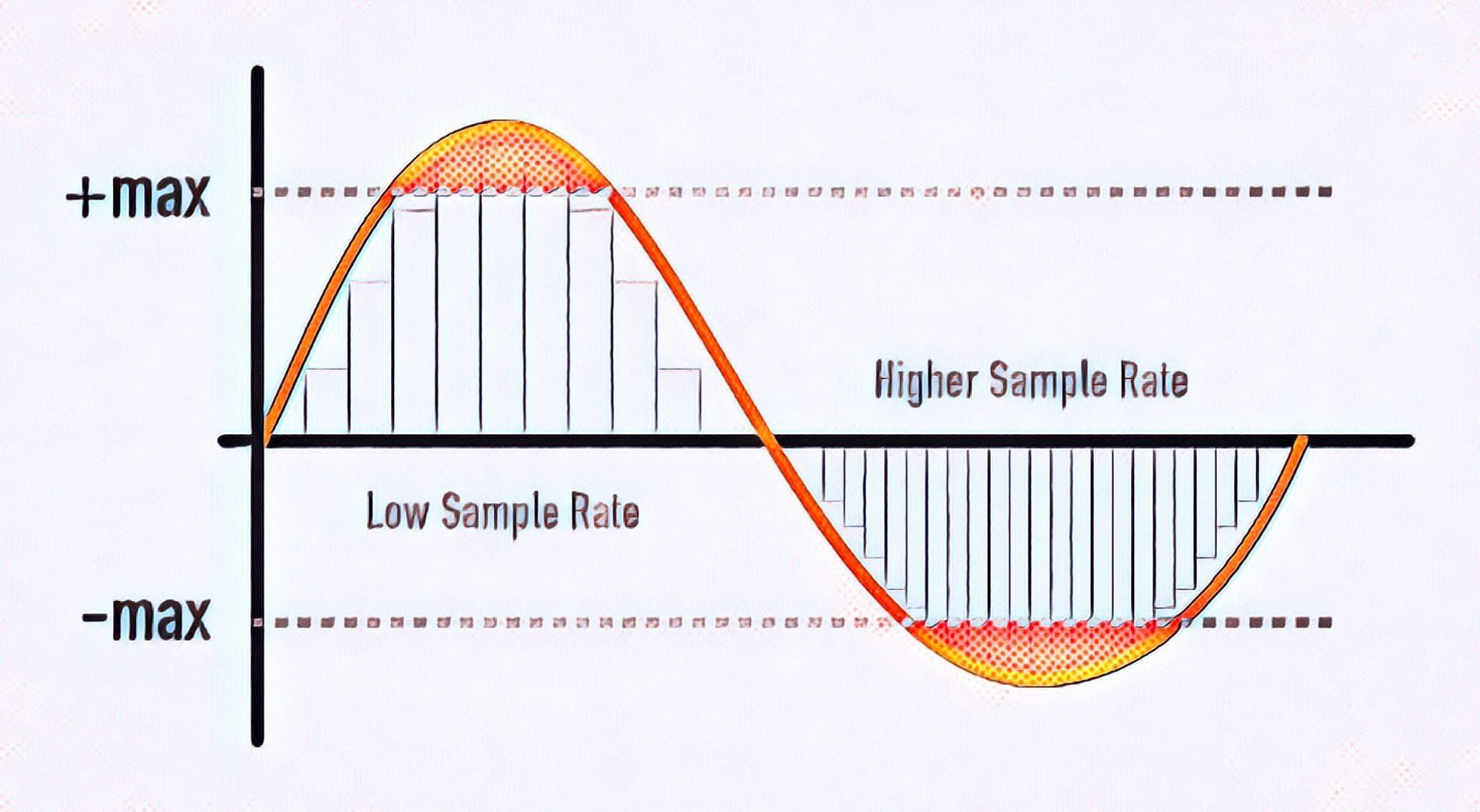
As seen in the figure, the measurement result is not an exact analog of a continuous electrical signal. How much does digital sound compare to analog? Obviously, this correspondence will be more complete the more often the measurements are made and the more accurate they are. The frequency at which measurements are taken is called the sample rate. And the precision of amplitude measurements is indicated by the number of bits used to represent the measurement result. This parameter is called the bit depth.

Sampling rate
So, the conversion of an analog signal to digital consists of two stages: sampling in time and quantization in amplitude. Time sampling means that the signal is represented by a number of its samples (samples) taken at regular intervals. For example, when we say that the sample rate is 44.1 kHz, it means that the signal is measured 44,100 times per second (in MO, the more intelligible term “sample rate” is usually used, however, “sample rate “is more correct.).

The main issue in the first stage of converting an analog to digital signal (digitizing) is to choose the sampling frequency of the analog signal. As already mentioned, the higher the frequency, the closer the digital signal is to the analog. However, in proportion to the increase in frequency, the following increases: a) the intensity of the digital data stream and the bandwidth capabilities of the interfaces are not unlimited, especially if several channels are recorded / played simultaneously; b) the computational load of digital effects processors and their computational capabilities are also limited; c) the amount of memory required to store the digital signal. Obviously a compromise is needed.

The choice of the sampling frequency affects the frequency range of the received digital sound or the maximum frequency of an analog signal, correctly represented in digital. The range of frequencies a person hears is believed to be 20 to 20,000 Hz. According to the well-known Nyquist theorem, in order for an analog (continuous in time) signal to be accurately reconstructed from its samples, the sampling frequency it must be at least twice the maximum audio frequency. An audio frequency equal to half the sampling frequency is called the Nyquist frequency and is the maximum frequency that a given digital system can store and reproduce correctly. Thus, if the real analog signal that we are going to digitize contains frequency components from 0 Hz to 20 kHz.

Sampling frequency.

Sampling frequency.

Sample Rate

What is its importance for sound recording?

Sample Rate

Time sampling is a process that is directly related to the conversion of an analog signal to digital. Along with it, the data is quantized in amplitude. Time sampling means measuring a signal at the time of its entire transmission.

A sample is taken as a unit. If in words this is not entirely clear, then in an example it seems more convincing. Let’s say the sample rate is 44100 Hz, the same as that used on audio CDs.

This means that the signal is measured 44100 times in one second.

An analog signal is always higher in saturation than a digital one. And its transformation is an inevitable loss of quality.

The sample rate serves as a kind of benchmark: the higher it is, the closer the digital sound quality is to analog. This is clearly visible in the list below. Shows which sound frequency is best.

As you study it, you will see a direct relationship between sampling and track quality:

1,8000 Hz. This frequency is typical for telephone conversations and voice recording on a dictaphone with a simple set of functions. It is used in audio converted through the Nellymoser codec.
2. 22050 Hz is used in broadcasting.
3.44100Hz. As mentioned above, this frequency is typical for audio CDs, and this figure has long been identified with the highest quality level. And today the format does not lose its positions.
4.48000 Hz. These are the DAT and DVD formats, which have replaced AUDIO.
5.16000 – DVD-Audio MLP-5.1.
6.2822 400HZ is a high-tech Super Audio SACD format.
Also read 3D Builder Windows 10 what it is
The list clearly indicates which sound frequency is the best. In addition, technologies do not stop and new formats appear.

But before making far-reaching plans, a very significant nuance must be taken into account.

Its essence is simple: the higher the sampling frequency, the more difficult it is to achieve it technologically. This requires:

Provide high intensity transmission of digital streams. And this is not possible on all interfaces. And the more channels are involved in the recording (which is typical for musical ensembles), the more complicated the process will be;
be armed with a processor capable of powerful computing operations. But even with the most advanced examples, the possibilities for ultra-high quality sound are limited;
Use it to record computer equipment with a large amount of RAM.
Considering the above information, it is not surprising that the sound frequency equal to 44100 Hz is still the most in demand today.

It has been meeting even the most demanding quality requirements for decades, and at the same time there are all the technical possibilities to achieve it. This last factor is decisive for both normal users and most recording studios.

Even knowing what the best sound frequency is, to achieve this, it is necessary to take care of the technical equipment.

What is the sample rate and how does it help improve the quality of the audio or video?

What is the sample rate and how does it help improve the quality of the audio or video?

It is important to distinguish what is a sample, as opposed to what is analog audio.
When digitizing the music, a digital equipment takes an X amount of “samples”, saves the values ​​of each one of them and thus it will be able to “reconstruct” a sound (a video too).

Sample Rate

As sound and video contain much information, it is necessary to take many samples, in order to obtain as much information as possible to later reconstruct one signal, very similar to the original.

Sample rate

There is a theorem that explains why the number of 44 thousand 100 samples per second was reached, but we will not enter from such a technical point of view.

What is important for you to know is that the minimum for HD quality audio to be considered is 44100 samples per second.

With less it will sound like talking on a landline phone or even talking on a walkie talkie.

With 44100 samples per second, the sinusoidal wave can be reconstructed without the existence of “closing teeth” in the wave, rather it will be possible to obtain a very detailed curvature, without peaks or ridges, without areas with squares.

Some use 48,000 samples per second, already reaching very high levels of audio quality. Of course, the greater the number of samples per second, the greater the use of disk space, whether you use an mp3, aac, flac, etc. But nowadays with large storage disks, that is not a problem, because these formats continue to be small.

If you manage to combine a sample rate of at least 44100 and preferably 48000 and a bitrate of more than 160 kbs, your music will sound very good, really good.

What will be good is that you buy headphones or speakers that are capable of delivering a good quality of audio, as well as the device that will compute this audio. Be it a computer, a player, an ipod, etc.

And obviously, starting from an “original” good. That is, get original audio that has a good quality.

By following these simple steps, without having to go into very technical details, you will have a very good sound quality.

Obviously Mp4Gain is the perfect software to mormalize the volume and even give other touches or tweaks like correcting the equalization, etc.

The sample rate: looking for the best sound

When it comes to digital music and sound effects, the sample rate plays an important role. This applies to both CDs and file formats like MP3 and network players. The values ​​specified for the height or frequency of the removal rate differ significantly from each other. An important reference value is 44.1 kHz. We explain why this is so.

Sample rate

What is sampling frequency about

For a guitar voice or riff to be stored on a CD or hard drive, the sound must be digitized. To do this, samples of the analog signal are taken at constant time intervals (discrete time). These are used to convert the recorded information into a code.

Raumfeld connector
Raumfeld connector

If the signal is digital, such as MP3, it can also be converted back to an analog signal, such as fluctuating current intensity, to make the membrane of a speaker sound. The frequency of these samples or samples is indicated by the sampling frequency. In general, the more samples there are, the more detailed the sound can be digitally reproduced.

A CD accepts signals that have been digitized with a sampling frequency of 44,100 Hz or 44.1 kHz. That corresponds to 44,100 samples per second. Of course, this frequency was not determined by chance. Such a resolution takes into account the maximum audible audio frequency of about 20 kHz and an important rule of data processing: the Nyquist-Shannon theorem. From this it can be deduced that the sampling frequency must be at least twice as high as the highest frequency of the signal to be digitized. So if the highest tones we can hear vibrate at 20 kHz, according to this theorem, the sample rate must be at least 40 kHz in order to digitize and decode all the tones correctly. Otherwise, the digitized signal can only be incorrectly converted to analog.

44.1 kHz is not the end of the story

The sampling frequency development did not stop at 44.1 kHz. Modern data carriers and transmission methods now make it possible to process significantly larger amounts of data. Lossless formats like FLAC or high resolution multi-channel standards exceed this value many times over.

Dolby TrueHD, for example, supports very high sample rates. Thus, significantly finer digitized signals can be processed. Additionally, audio masters can use better reconstruction and anti-aliasing filters.

Sample rate isn’t the only measure – bit depth

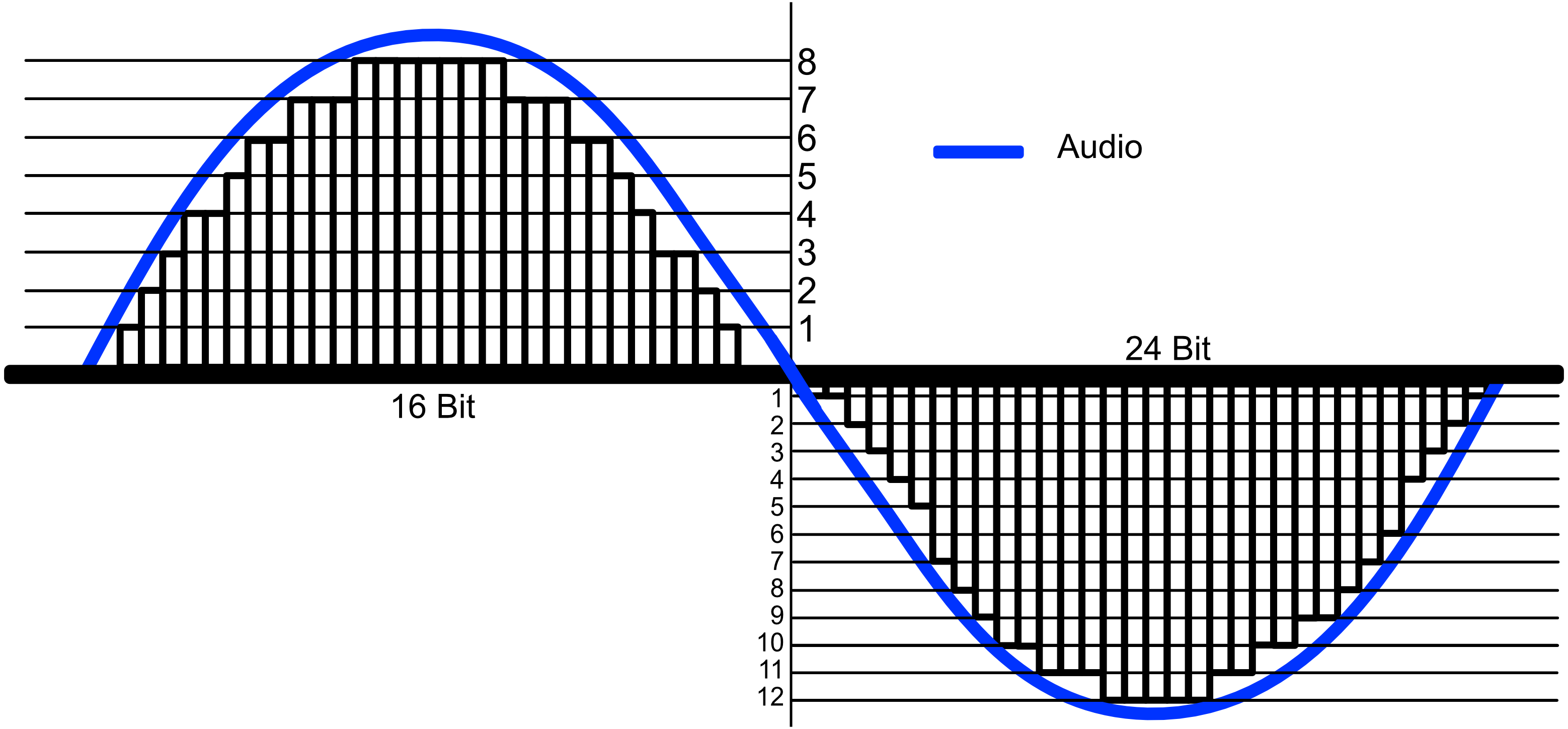
While the sample rate describes the frequency of the samples, the bit depth indicates how many bits are used per sample. In other words, the bit depth tells you how accurate or how high the resolution is for each individual sample. The amplitude or dynamic range of the analog signal at the time of the sample is determined. So the area between the weakest and strongest sound pressure level. On a CD, each sample is 16-bit deep, although this value is also exceeded by modern digital standards. Dolby TrueHD reaches 24 bits.

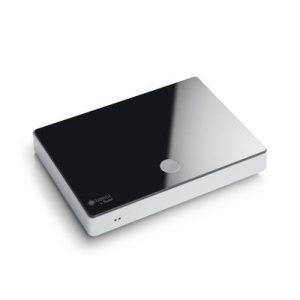
The Raumfeld connector brings out what is digitally possible
The raumfeld connector supports a sampling rate of 192 kHz.

▶ Hardly anyone makes bits sound as good as the Raumfeld plug. Because it plays high-resolution formats up to 96 kHz and 24-bit. An integrated high-end converter from Cirrus Logic converts digital data into analog. The Raumfeld connector has a powerful WLAN module for wireless data transmission. Thanks to Google Cast, multi-room speakers can also be conveniently controlled via the connector. If you connect the network player to a conventional system via Cinch or Toslink, it will be integrated into the local network.

Conclusion: sample rate as a bargaining chip for digital sound formats
The sampling rate indicates how often signals are sampled from an analog signal for digitization.
The Nyquist-Shannon theorem states that for the digitization to be true to the original, the sample rate must be at least twice the highest analog frequency.
CDs support sample rates up to 44.1 kHz. Modern formats, on the other hand, can reproduce 96 kHz and more.
Bit depth indicates how individual samples are resolved and influences the digitized dynamic range.
While CD samples have a 16-bit resolution, Dolby TrueHD, for example, reaches 24-bit.

Sample rate (Hz and kHz), resolution (bits), and bit rate (kBit / s) for music and audio

Because it always leads to misunderstandings, today there is a short explanation of the most important key figures for music and audio files. These basically apply to all uncompressed formats (WAV and AIFF). I’ll also go into the bitrate of compressed formats like MP3, WMV, and OGG below.

Sample Rates

Basic knowledge: An audio file stores a number at very short intervals that represents the level of the audio signal. During playback, the contour is calculated from this sequence of numbers.

Audio Sample Rate

An audio file can have multiple channels. Mono (one channel), stereo (2 channels), and 5.1 and 7.1 (Surround) are common. Each channel provides the information from one of the speakers and is a separate audio signal. That means we can split a stereo file and save it into two mono files.

The sample rate (Hertz) indicates how often the audio level is recorded and saved in one second. A specification of 44,100 Hz (44.1 kHz) means that 44,100 values ​​are stored for one second of music. Typical sample rates are 44.1 kHz (music CD), 48.0 kHz (film), and 96 kHz (recording studio).

The resolution (bit) indicates how much memory is used for that sample value. For example, 16 bits (2 to the power of 16) allow a scale of 65,536 values ​​for each individual sample value. If we have a lot of memory for a value, we can process the signal more precisely. Typical settings are 16-bit (music CD) or 24-bit or 32-bit in the studio.

Bit rate (kBit / s) is often confused with resolution. Represents the “bandwidth” of the audio file, that is, the amount of data that is processed in one second. For uncompressed formats like WAV and AIFF, you can easily calculate the bit rate by multiplying the above three values:

Bit rate = channels x sample rate x resolution

Example:

A WAV file in CD quality has the following bit rate:
2 channels x 16 bits x 44.1 kHz = 1411.2 kBit / s

The bit rate for compressed formats (MP3, OGG, WMV, AAC, etc.)
Unfortunately, this formula does not work with MP3 and other compressed formats because the signal is packaged to save space. The encoder reduces the bandwidth of the data to a desired bit rate and tries to obtain the best possible quality within this frame. The bit rate can be constant (CBR mode) or variable (VBR mode). A variable bit rate often makes sense if the audio signal is highly varied (for example, a movie or radio playback).

Sample Rate

Sample Rate

The seconds are defined by taking as a time sample the period of oscillation of the light waves emitted by a cesium 133 atom in a particular atomic transition.

As we have already observed in the dedicated paragraph, sound is generated by small variations in atmospheric pressure that propagate in space and time and until the end of the 40s of the last century it could only be transduced by the human auditory system or by the microphone devices used. for the transmission of signals by radio but it cannot be stored in any type of support dedicated to mass cultural diffusion. In fact, there were already several technologies dedicated to the memorization of sound waves but they were either of poor quality and diffusion such as phonographs and gramophones or were used only experimentally or were dedicated to communications between military devices.

The only vehicle to transmit sound events for musical purposes was still the score that had to be interpreted by a human interpreter and, if someone wanted to listen to a certain piece of music, they had to go to a theater or concert hall that had it on the bill. We emphasize that the performance (as well as the listening) was unique and non-repeatable and the only memory capable of preserving the sounds was the human. All this until 1948, when in the United States Columbia patented the first 33 rpm vinyl record in the 25 and 30 cm formats and where the waveform (as previously happened with 78 rpm records) was printed in micro-grooves that were They developed in a spiral along the surface of the disk and were read by one of the giradichi heads.

The following year (1949) another type of media dedicated to the preservation and reproduction of sound was also introduced on the market: the first magnetic tape recorders wound on reels and later in 1964 Philips commercialized the four-track cassette in Europe. The era of massive musical (and cultural) enjoyment has begun, which after hundreds of years has profoundly and definitely changed our relationship with the world of sounds.

All the means and systems for storing sound waves that we have just exposed (in addition to others that I have not considered appropriate to mention here) belong to the world of analog audio since the information or rather the representation of the sound wave is produced in a continuous and analogous to the original changes in atmospheric pressure. This is because analog recording devices (transducers or microphones) transform changes in atmospheric pressure into changes in the voltage of an electrical signal, which can be stored on mechanical (vinyl records) or electromagnetic (magnetic tapes) media. to be eventually reproduced one or more times at later times. This, in addition to being a transcendental technological revolution, has also greatly influenced the diffusion of music in society, the role of music within it and the development of languages ​​closely linked to the sound or musical arts.

In 1971 a new revolution began which, however, this time is strictly technical (from the cultural and social point of view it only amplifies and accelerates the process of global dissemination of information already underway): the birth of digital audio. In fact, in that year the research laboratories of NHK (Japanese public television radio) created the first digital audio recorder that, using the PCM (Pulse Code Modulation) technique patented by the British A.

Sampled signal

We have said that sampling a signal means measuring its amplitude (y) in each sampling period, obtaining a discrete signal in time and continuous in amplitude:

Sample rate

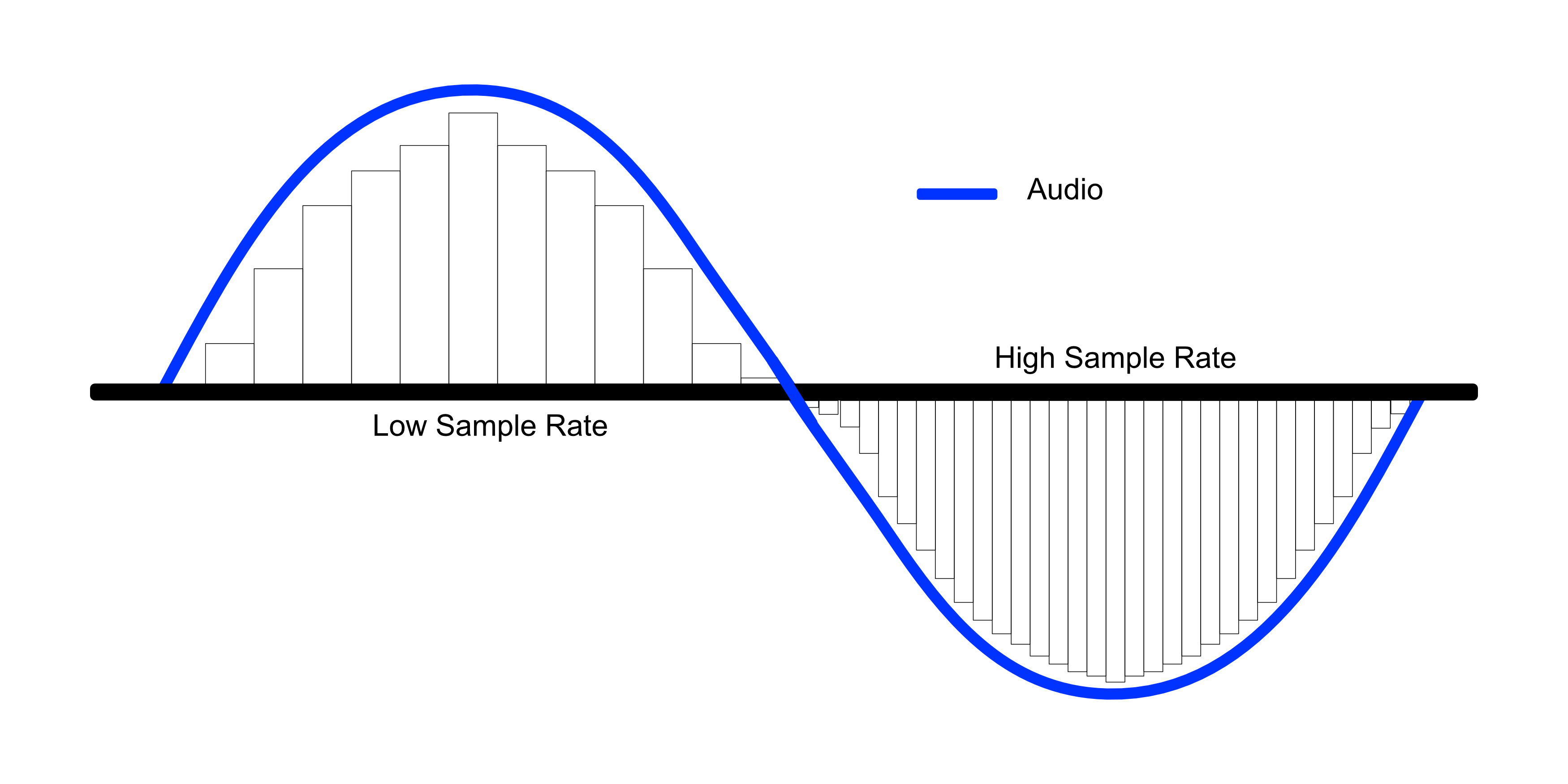
At this point, however, we are faced with a question: how often to sample the signal? Theoretically we can say that the shorter the sampling period, the less information will be lost between one sample and the next, obtaining a digital signal more similar to the original up to the ideal limit (infinitely small period) in which the analog signal and the sampled.

Sample rate

In practice, however, there are technological limits in the construction of ADC converters that do not allow us to achieve such short periods. Therefore, we must start from the assumption that the samples must be taken with a speed dependent on the variation of the signal and this speed depends on the harmonic component of higher frequency that will determine the sampling period.

Sample rate, a clear explanation about what the sample rate is

Let’s proceed in order and start from the sampling frequency, defined as the number of times per second in which our AD converter will measure the electrical signal placed at its input: it is measured in Herz (Hz).

Obviously, the greater the number of “photographs” that we take of our electrical signal in one second, the greater its fidelity to the “original” sound wave. At the same time, obviously, our converter will be obliged to spend a greater amount of “energy” (faster information processing speed, greater storage space, etc.) which therefore translates into a different quality of components and obviously at a higher cost.

La tasa de muestreo

Sampling rate

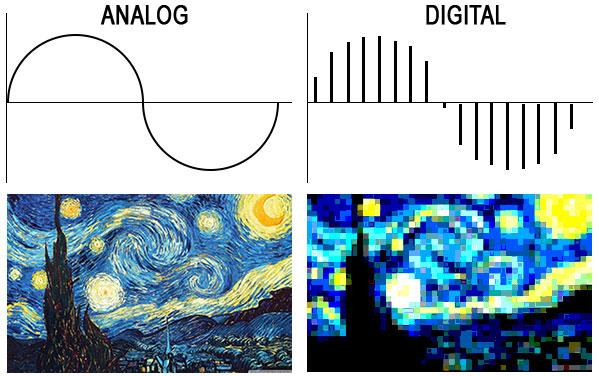
On the left an analog wave (a sine wave) in the time / amplitude domain and an image of Vincent Van Gogh’s “Starry Night” which, for our teaching purposes, we intend to be very high resolution. On the right, a quick reconstruction of the same sampled analog waveform and the same photograph reproduced with a much smaller number of pixels.

Well, if it were that simple, there wouldn’t be a bit of fun. Let’s go back to the diagram of the AD converter at the end of the previous article. Surely you have noticed that the first block through which our signal passes is the so-called “Anti-aliasing filter”, nothing less than a low pass filter.

Coooooooooooosaaaaaaaaaaaaaaaaaa !? Do we want to faithfully reproduce our signal in the digital domain and the first thing we do is pass it through a filter to change its frequency component (remove all components above a certain frequency)?

Yes my dear … you need to share a minimum (but I swear, a minimum) of signal theory to tell you a bit about the “Nyquist-Shannon Sampling Theorem” (for the “fetishists” – no offense, for course …. I am also part of it: of the mathematical treatment, take a look at the related Wikipedia page where you can find a good perspective), based on which, to sample an analog signal without loss of information (that is, to be able to re-enter it – then convert it DA – into the analog domain without “noticeable” differences compared to the original signal) it is necessary that the number of samples taken per second (the sampling frequency) is at least twice the maximum present frequency into the signal to be sampled, Therefore, it is worth introducing frequencies in the digital signal that do not exist in the original analog signal (the calls, and hence the filter name, alias frequencies).
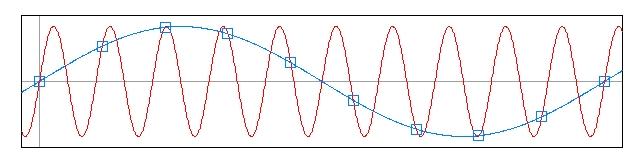
The aliasing phenomenon occurs because we do not have enough samples to describe the trend of the higher frequencies, which are therefore translated into the digital signal as lower frequencies, although nonexistent in the original signal. See this beautiful image always taken from the omniscient Wikipedia. In red the sinusoid sampled at intervals not sufficient to reconstruct it, and in blue the frequency alias (lower) that originates from the points we have taken.

La tasa de muestreo

Sampling rate

As we already know, the human ear is sensitive, at most (at an early age and in good hearing health), to frequencies around 20 KHz; In theory, our anti-aliasing filter should be set at 40,000 Hz and that should be our sample rate, but since it is practically impossible to build a filter with such a steep slope in analog, we opted for a filter with less steep slope and so both leaves the signal to sample frequencies slightly higher than 20,000 Hz (which we don’t hear, but there are), sampling at a slightly higher frequency. Therefore, the minimum sample rate used is equal to 44,100 samples per second.

Obviously, technological development and, nevertheless, the opinion and experience of many professionals (which I personally share very modestly) have in any case led to the awareness that, having set the minimum limit of 44,100 Hz (we will see later, it is the sampling frequency of the files that make up an audio CD), sampling at higher frequencies certainly leads to better results both from the point of view of signal manipulation (passing through a plug-in, the sum of two or more signals within a DAW, etc.) and from a listening point of view.

Later we will return to the topic, we will develop it further and we will begin to understand the logic with which the converter assigns a value in “machine language” to the different samples taken during the sampling phase.