What is the sample rate and bit rate?


Free Download Mp4Gain
picture

What is the sample rate?
Sample Rate

Frequency is defined as the number of cycles of periodic motion per unit of time. The SI unit of frequency is called hertz (Hz, after its inventor Heinrich Hertz). One hertz corresponds to one cycle (or complete oscillation) per second.

Sample Rate

Example. Sound waves have a frequency in the range of approximately 20 to 20,000 Hz. This means that at any point along the path of the sound wave, the pressure will fluctuate from high to low, 20 to 20,000 times per second.

In digital audio, the maximum frequency that can be successfully recreated is half the sample rate. Therefore, with a sample rate of 44.1 kHz, frequencies up to 22.05 kHz can be recreated. Wave frequency refers to how many times per second a wave moves from its highest point to its lowest point and vice versa. It is usually measured in hertz (Hz) or cycles per second. The frequency of the wave determines its height. High-frequency waves have a high pitch, while lower frequencies have a lower pitch. The average person can hear frequencies from 15 or 20 Hz to about 20,000 Hz (20 kHz).

Analog wave The wave amplitude refers to half the distance between the highest point of the wave and the lowest point. The greater the amplitude of the wave, the greater its volume, which is generally measured in decibels (dB). The decibel range for human hearing is complex and depends on the frequency of the sound in question, the age of the person and the listening environment, but varies from approximately 0 to 120 dB, with each 10 dB change corresponding to a doubling of the perceived volume.

Absolute Threshold: ATH is the volume level at which a certain sound can be detected 50% of the time.

What is the bit rate?

Bit rate refers to the data transfer rate (that is, how many bits are transmitted in a given time), generally expressed in bits per second. Common units of bit rate are kilobits per second (Kbps) and megabits per second (Mbps). The term is also commonly used when talking about digital sampling and sample rates. For example, the MP3 audio compression algorithm is often configured to output files at a bit rate of 128 kbps. This means that the file contains an average of 128 kilobits for every second of audio (960 KB per minute). This is in contrast to CD audio, which is encoded as 44,100 16-bit stereo samples per second: 1411.2 kbps (16-bit x 44100 Hz x 2ch).

Often times, bytes are written in uppercase and are multipliers (for example, “KB” for kilobytes) and lowercase factors are bits (for example, “kb” for kilobytes). All modern computers use 8-bit bytes.

MP3 bit rate
The MP3 bit rate can be misleading. For example, an MP3 “constant bit rate” (CBR) of 128 kbps will use approximately 128 kilobits for every second of encoded audio (so the file size in bits divided by the length of the audio is approximately 128,000), and Your frame headers will appear at regular intervals, but internally, frame-by-frame, you can encode audio at bit rates higher or lower than 128 kbps by using a bit pool (the ability of a frame to use spare bits from a previous block). However, the size of this bucket, and thus the amount of variability, is limited, so 128 kbps will be very close to the effective bit rate throughout the file.

See also: 8D surround sound and how to do it
As another example, “128 kbps VBR MP3” is often incorrect, as the purpose of VBR is to allow each of the internal MP3 sectors to have its own bit rate. When people refer to the VBR MP3 bit rate, they are generally referring to the actual average bit rate of their frames. If the length of the encoded audio is known, then the “bit rate” can be the data size of the file divided by its duration, which will be fairly close to the same number. However, the length of an MP3 VBR cannot be accurately determined without scanning all the frames.


Free Download Mp4Gain
picture


Mp4Gain Main Window
picture


Mp4Gain Features
picture


Free Download Mp4Gain
picture

Audio sample rate and bit depth – in simple, understandable language

Audio sample rate and bit depth – in simple, understandable language

Bit Depth and Sample Rate

What is the sample rate (sample rate)? What is bit depth?

Sample Rate & BitDepth

Even if you are not dealing directly with digital sound recording, you will be interested!

Are you new to the world of digital music? Not sure what all these designations and complex numbers mean?

Hmm, no wonder! After all, every day there is more and more information. And knowing everything is almost impossible.

Yes, this is not necessary! You need to know the essentials.

Sample rate and bit depth are sound engineering concepts that you should know if you decide to make music in a computer environment.

Even if you haven’t had to record music in a virtual environment yet, but have dealt with audio (be it on a portable digital player, a player on a computer, or elsewhere), you may have seen some numbers in the properties of audio: “16 bit, 24 bit, 44100 Hz, 48000 Hz …”

The material is presented briefly and is accessible even to the uninitiated. Just the essentials.

So what are sample rate and bit depth? What is it for?

To begin with, we agreed that in different sources you can find: Sample rate and Sample rate. The abbreviations are equivalent. Call it what you like the most.

And bit and bit depth. It’s the same, the same, it just sounds different.

So.

Sample rate (sample rate) …

All inanimate music (music produced by a computer, music center, etc., that is, not live) has this parameter. This is the number of samples per second. Without going into details, I will say that 44100 Hz is optimal for humans. Since at a higher value, the sounds to be sampled will be practically inaccessible to our ears, we will simply not hear them, because they will be out of earshot.

I’ll explain a bit more in datell about sample rate. Discrete means discontinuous. That is, the sampling process is the processing of each bit of information one by one (that is, discretely and not all at once). In our case, this happens 44100 times per second. By Nyquist’s theorem, the required sampling rate for normal perception should be twice the hearing threshold. Since an average person listens up to 16 KHz (KiloHz or 16000 Hz), and something (normal for a healthy young person) up to 20 KHz, the sampling frequency was determined at 44.1 KHz (44100 Hz), that is, twice the threshold. audibility of the human ear. Why not 40 kHz (40,000 Hz)? Taken with margin (nobody canceled errors and noise on the route and after the CD release).

I hope everything is clear now.

The bitness (Bitness) is a kind of resolution of these same samples. Why am I calling this permission? Just so you prefer to understand by analogy what is what.

Grab your monitor – the higher the resolution, the better the picture, right? At low resolution you will see individual pixels and the eye will no longer be happy as before. I smile

Bitness is dynamic range, that is, the oscillation of your audio up and down (in terms of volume, power, so to speak), the nuances of performance.

The higher the audio bit rate, the more space the audio will occupy on your hard drive (on your computer); keep in mind.

For projects that are important to you, I advise you to use 24 bits and a sample rate of 48000 Hz. THIS IS A STANDARD. Then, for CD output, it will be possible to downgrade the data to 16 bits and 44.1 kHz.

But some people prefer to work on 24/96 (24 Bits – bit depth, 96 KHz – sample rate) or 24 / 88.2. The taste and the color …

For most projects, 16 / 44.1 is adequate (16 bit – bit depth, 44100 Hz is equivalent to 44.1 KHz – sample rate).

The sample rate and bit depth go directly next to each other and never go alone. That is their destiny.

Why is 44,100 used as the high quality sample rate?

Why is 44,100 used as the high quality sample rate?

Sample Rate

Why did we choose 44.1 kHz as the recording sample rate?

Sample Rates

People’s ears hear a sound whose frequency varies between 20 Hz and 20 kHz. By Nyquist’s theorem, the recording speed must be at least 40 kHz. Is this the reason for choosing 44.1 kHz?

Explain in more detail, the sample rate means how many “frames” should be recorded per second to have high quality audio.
According to the famous theorem created by a famous scientist named Nyquist, the sampling frequency must be at least twice the maximum frequency that we will record … then, as the human ear can hear approximately 20 kHz at most, twice that would be 40,000 per which was proposed 44,100 as a standard sampling frequency for high fidelity audio.

It is true that, like any convention, the choice of 44.1 kHz is something of a historical accident. There are several other historical reasons.

Of course, the sample rate must be higher than 40 kHz if you want high-quality audio with a 20 kHz bandwidth.

How to make 48.0 kHz was discussed (this matched well with 24fps and supposedly 30fps movies on North American television), but given the physical size of 120mm, there was a limit to the amount of CD data that could be stored and what an error detection and correction scheme is needed that requires some data redundancy, the amount of logical data that a CD can store (about 700MB) is about half of the physical data. With all of this in mind, at 48 kHz, we were told that it cannot hold all of Beethoven’s 9s, but that it can hold all of 9 on one record at a slightly slower speed. So 48 kHz is not.

However, why 44.1 and not 44.0 or 45.0 kHz or some nice round number?

Then in the late 1970s, there was a product called the Sony F1, designed to record digital audio onto readily available videotape (Betamax, not VHS). It was at 44.1 kHz (or more precisely 44.056 kHz). Thus, it will facilitate the transfer of recordings without oversampling and interpolation from F1 to CD or in the other direction.

My understanding of how this turns out is that the horizontal scan speed of the NTSC TV was 15,750 kHz and 44.1 kHz is exactly 2.8 times. I’m not entirely sure, but I think this means you can have three pairs of stereo samples per horizontal line, and for every 5 lines where you would normally have 15 samples, there are 14 samples plus an extra sample for some checking. for parity or redundancy in F1. 14 samples for 5 lines is the same as 2.8 samples per horizontal line and 15,750 lines per second, which is 44,100 samples per second.

With the transition to digital formats, audio was stored in the form of pseudo-video, which could be viewed as black or white (representing a binary format).

The frequency and field structure used by the television standard is as follows for 60 Hz video: 245 lines per field (excluding the first 35 skipped lines). With three samples per line, that is 60 x 245 x 3 = 44100 = 44.1 kHz.

This convention was later used for the CD format due to hardware compatibility issues (the first computer used to make master CDs used for CD replication was video-based).

Now, with the advent of color television, they’ve had to slow the horizontal line speed a bit to 15,734 lines per second. This setting results in 44,056 samples per second on the Sony F1.

Digital Sound and Sample Rate

Digital Sound and Sample Rate

Sample Rate

Given the wide availability of inexpensive digital audio equipment, we invite you to take a closer look at digital audio.

Sample Rate

Acoustic sound is a continuous process in time and in amplitude, that is, the air pressure changes smoothly with time and does not jump from one value to another. Acoustic sound can be converted into an electrical signal using a microphone that, depending on the change in air pressure, changes the electrical voltage it generates at the output. After the conversion of an acoustic sound into an electrical signal, continuity is maintained in time and in amplitude: the signal voltage changes in the same way that the air pressure changes, which is why this sound is called analog. We can record an electrical signal on magnetic tape and convert it back to sound using a loudspeaker that functions as a “reverse microphone”: it moves air in response to changes in voltage. Respectively,

Despite the fact that the analog electrical signal has regularly served humanity for decades, over time some of its representatives (of humanity) became clear that the analog signal and magnetic recording are not the best ways to transmit and store audio information, since both during transmission and during storage occur. unavoidable losses, i.e. sound degradation. At the same time, the transmission and storage of data on computers that operate exclusively on digital data can be done without any loss. The only question is how to convert analog audio to digital and vice versa.

To solve the first problem, there are special devices known as analog-to-digital converters (ADCs). These devices are capable of converting a continuous analog signal into a sequence of separate numbers, that is, making it discrete (English discrete – separate, consisting of separate parts). The conversion takes place as follows: the device measures the amplitude of the analog signal many times per second and outputs the measurement results in the form of numbers.

Analog signal
Sampling
Sampled signal
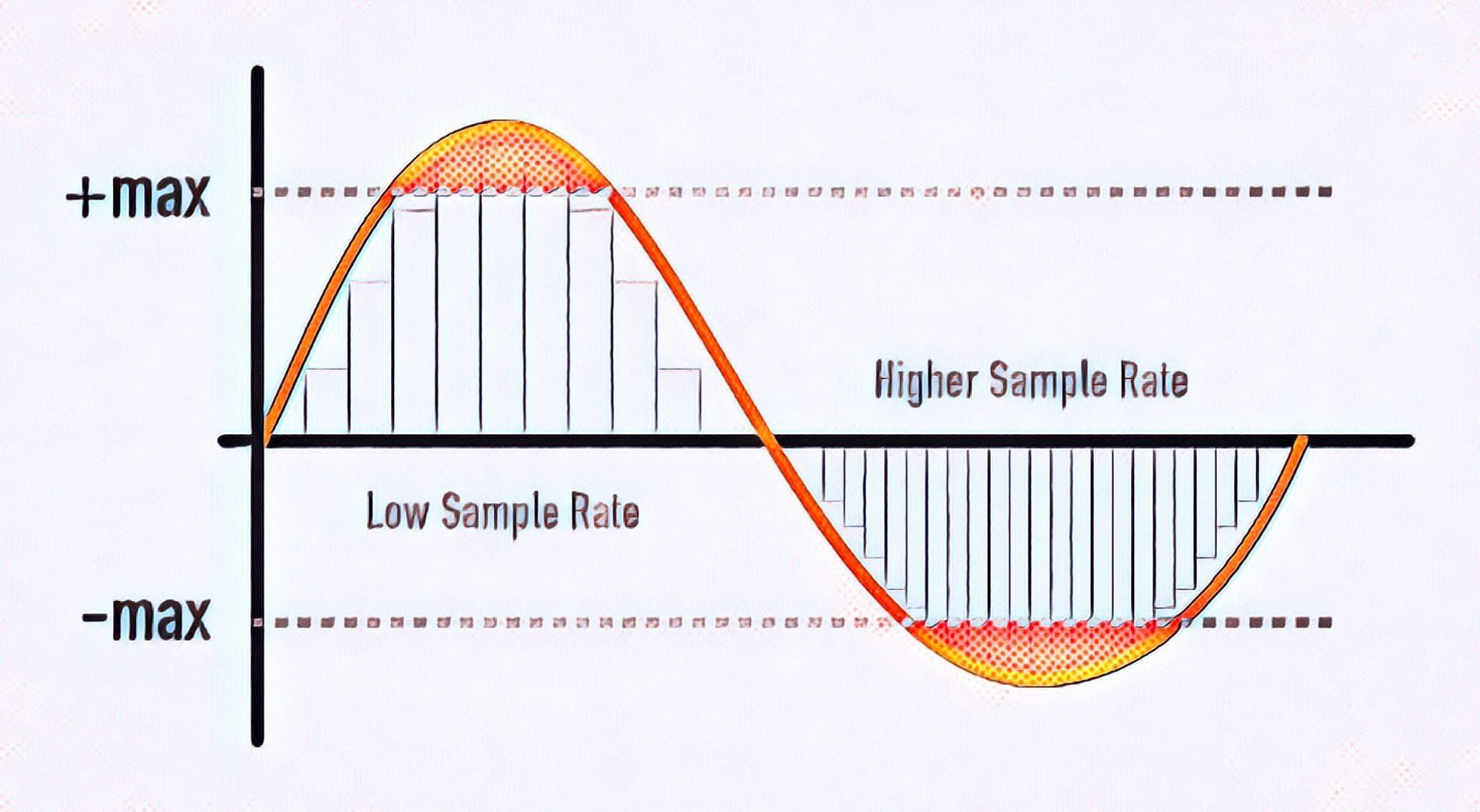
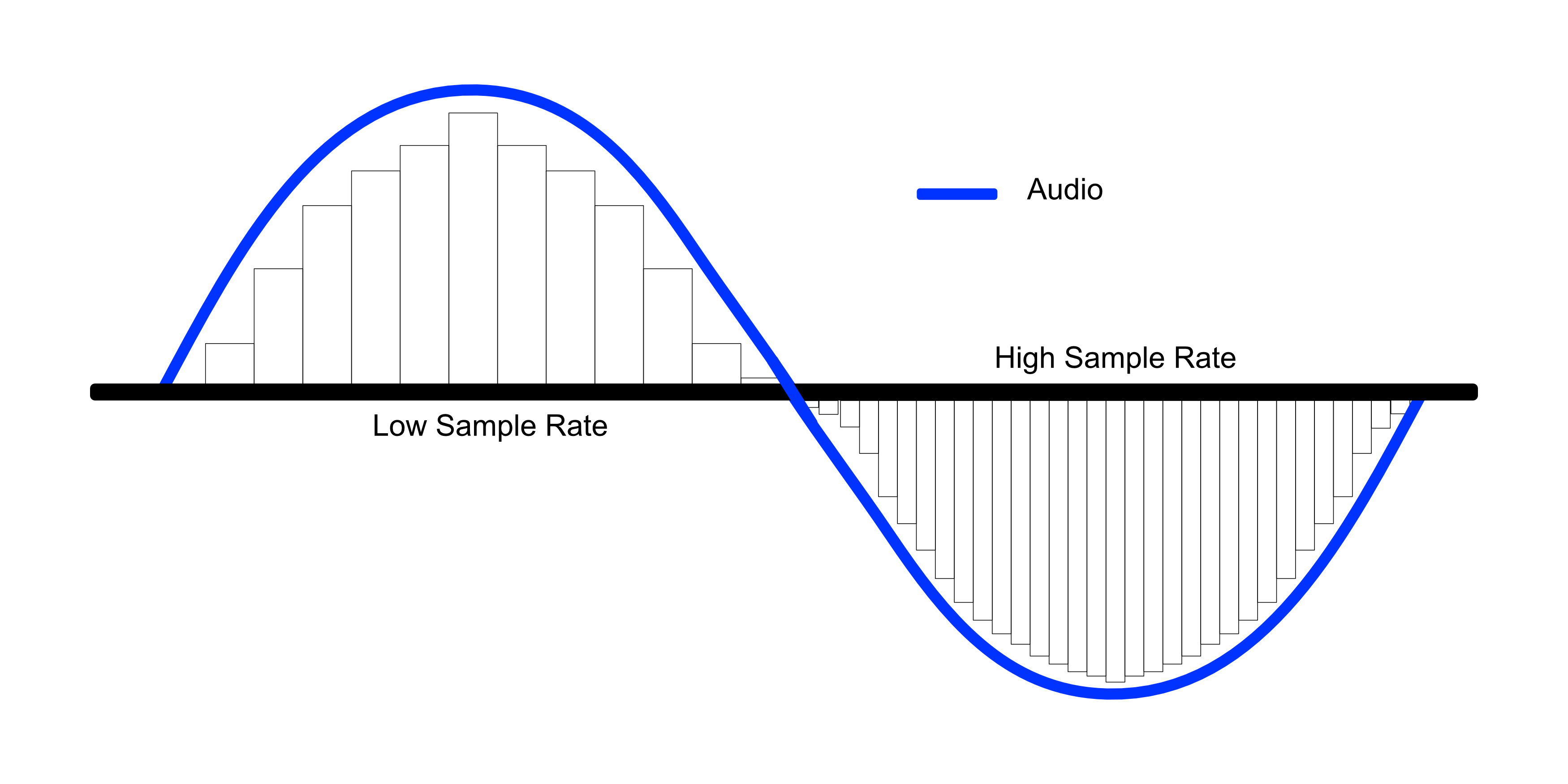
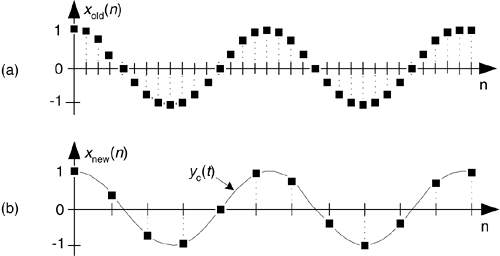
As seen in the figure, the measurement result is not an exact analog of a continuous electrical signal. How much does digital sound compare to analog? Obviously, this correspondence will be more complete the more often the measurements are made and the more accurate they are. The frequency at which measurements are taken is called the sample rate. And the precision of amplitude measurements is indicated by the number of bits used to represent the measurement result. This parameter is called the bit depth.

Sampling rate
So, the conversion of an analog signal to digital consists of two stages: sampling in time and quantization in amplitude. Time sampling means that the signal is represented by a number of its samples (samples) taken at regular intervals. For example, when we say that the sample rate is 44.1 kHz, it means that the signal is measured 44,100 times per second (in MO, the more intelligible term “sample rate” is usually used, however, “sample rate “is more correct.).

The main issue in the first stage of converting an analog to digital signal (digitizing) is to choose the sampling frequency of the analog signal. As already mentioned, the higher the frequency, the closer the digital signal is to the analog. However, in proportion to the increase in frequency, the following increases: a) the intensity of the digital data stream and the bandwidth capabilities of the interfaces are not unlimited, especially if several channels are recorded / played simultaneously; b) the computational load of digital effects processors and their computational capabilities are also limited; c) the amount of memory required to store the digital signal. Obviously a compromise is needed.

The choice of the sampling frequency affects the frequency range of the received digital sound or the maximum frequency of an analog signal, correctly represented in digital. The range of frequencies a person hears is believed to be 20 to 20,000 Hz. According to the well-known Nyquist theorem, in order for an analog (continuous in time) signal to be accurately reconstructed from its samples, the sampling frequency it must be at least twice the maximum audio frequency. An audio frequency equal to half the sampling frequency is called the Nyquist frequency and is the maximum frequency that a given digital system can store and reproduce correctly. Thus, if the real analog signal that we are going to digitize contains frequency components from 0 Hz to 20 kHz.