The Loudness War


Free Download Mp4Gain
picture

The Loudness War: Understanding the Battle for Loudest Sound
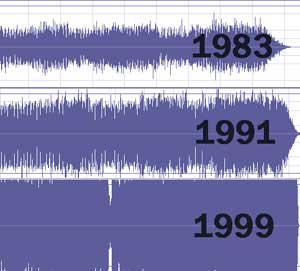
Loudness War
Loudness War
Loudness War
Loudness War

What is the Loudness War?

The Loudness War is a phenomenon in the music industry where music producers and mastering engineers compete to make their songs the loudest possible. This has resulted in a trend where songs are heavily compressed and limited to achieve a consistent volume level, often at the expense of dynamic range and overall sound quality.

Why is the Loudness War a problem?

The Loudness War is a problem because it sacrifices sound quality for loudness. Songs that are heavily compressed and limited can sound distorted and lack the natural dynamics that make music enjoyable to listen to. Additionally, this trend has led to a decrease in the overall quality of music production, as producers focus more on volume than on the nuances of the music itself.

How did the Loudness War start?

The Loudness War began in the 1990s, when CDs became the dominant format for music distribution. Record labels wanted their songs to stand out on the radio and in stores, so they began using compression and limiting to make them louder than their competitors. This led to a trend where each subsequent release was louder than the previous one, resulting in a race to see who could make the loudest song.

What is compression?

Compression is an audio processing technique that reduces the dynamic range of a recording. This means that the difference between the loudest and quietest parts of the recording is reduced, resulting in a more consistent volume level.

What is limiting?

Limiting is an audio processing technique that prevents the peaks in a recording from exceeding a certain level. This is done to ensure that the recording remains at a consistent volume level and to prevent distortion.

What is dynamic range?

Dynamic range refers to the difference between the loudest and quietest parts of a recording. A song with a wide dynamic range will have both quiet and loud sections, while a heavily compressed and limited song will have a more consistent volume throughout.

What are the consequences of the Loudness War?

The consequences of the Loudness War include decreased sound quality, reduced dynamic range, and listener fatigue. Additionally, songs that are heavily compressed and limited can sound distorted and lack the natural dynamics that make music enjoyable to listen to.

Is the Loudness War still happening?

The Loudness War is still happening, although it has become less pronounced in recent years. Many music producers and mastering engineers have become more aware of the negative effects of excessive loudness and are now focusing on producing music with a wider dynamic range and better overall sound quality.

What is the difference between loudness and volume?

Loudness refers to the perceived intensity of sound, while volume refers to the physical measurement of sound pressure level. In other words, loudness is how loud a sound seems to be, while volume is how loud it actually is.

What is mastering?

Mastering is the final stage of audio production, where the final mixes are processed and prepared for distribution. This includes adjusting the overall volume, EQ, and other effects to ensure that the final product sounds as good as possible on a variety of playback systems.

What is the role of mastering in the Loudness War?

Mastering is often the stage where the Loudness War is fought. Mastering engineers are under pressure from record labels and producers to make songs as loud as possible, often at the expense of sound quality. However, many mastering engineers are now advocating for a more balanced approach to mastering that prioritizes sound quality over loudness


Free Download Mp4Gain
picture


Mp4Gain Main Window
picture


Mp4Gain Features
picture


Free Download Mp4Gain
picture

Sound quality of Vinyl vs CD

Sound quality of Vinyl vs CD

Vinyl vs CD

Short answer: NO !!

At the moment, the best sound quality is HD audio formats such as DVD or Blu-ray Audio.

CD VS VINYL

So now we are faced with the problems of the skeptics, like you can’t hear the difference between audio CDs and HD audio, because audio CDs can play louder sounds than anyone else, or vinyl records they sound so much better. But just ignore these people as I explain how digital audio works, which most people don’t understand.

Uncompressed digital audio has two components. One is the sample size, the other is the sample rate.

The sample size determines how loud the music can be, or more precisely, the dynamic range, the difference between the quietest and the loudest parts (you can always turn the stereo up to 11 for more volume). It turns out that people can easily hear more than 16-bit dynamic range than a 16-bit audio CD provides. What this really means for HD audio is that you can have a very quiet section (and not hear noise) and then play loud music. In practice, extremely loud sounds are just instantaneous peaks, but you can, if you wish, record something with a large difference in volume, for example, next to an emergency siren. You will hear the background sounds of the birds and then the siren. If you turn up the volume to hear the birds well enough to hear them during playback,

Another component is the sampling rate, the frequency with which you sample the sound to reproduce the sound wave. The higher the sample rate, the more realistic the recording will be. Since CDs are played 44.1K times per second, sounds can be played up to 20 kHz, which is louder than most people can hear (I can only hear up to 17 kHz), so in In theory, a CD can reproduce a wider frequency range than people can listen to. … But sadly, this does not account for all the people who can hear. People have a highly developed sense of stereo sound. We can easily determine the direction of the sound. This is the result of very small differences in the time it takes to reach each of our ears. The brain processes this and produces spatial awareness of where the sound is coming from, and that’s pretty accurate. So this is where HD (high definition) audio comes in. With a higher sample rate, you can get a more refined waveform with enough detail to reproduce these subtle differences, which make the sound more vivid and lifelike than typical CD recordings.

When it comes to analog audio sources, the main problem with all analog formats (tape and vinyl) is that they degrade with each playback (and not even playback). Vinyl is famous for the awe, the thrill, the shock, and of course the scratches, cracks, and pops when the needle goes through the grove. The tape is elastic, has speed issues, and only sounds great at 15IPS or higher. Neither is perfect.

A few things to consider when considering HD audio.

Never discuss HD audio with someone who has never heard it. A complete waste of time arguing with idiots. This is the main rule of HD audio.
Most of the commercially available audio is already compressed for CD and radio playback. They deliberately remove dynamic range so music sounds clearer and better on low-quality systems (like phones).
The higher the sample rate, the more natural the sound will be. Good uncompressed 24/192 sound sounds open and natural, like you’re in the room listening with headphones. Compare the same recording on HD and CD if you can. You want to listen to uncompressed music, not a rap or pop cut. The quality of the CD is good enough for this.
Ignore those who say you have to spend a lot of money to listen to HD sound. You can use any analog amp (most of them), a DVD or Blu-ray player (make sure it can handle up to 192), and decent speakers or headphones. Good speakers and headphones can be bought for less than $ 300 if you look around. Obviously, you can spend more, but that will get you to the door. And, of course, a DVD or Blu-ray disc. Look for full digital recordings with a sample rate of 96 or higher. 48k is not much different from 44.1 except for the dynamic range (which can be significant). I have created new systems for $ 500 and even novice listeners can tell the difference.

Answer 2:
No, but that’s more than enough if you haven’t spent thousands on a listening room / system.