Hardware for processing digital audio – Part 4
As a practical example of a MIDI device, consider a conventional MIDI keyboard.
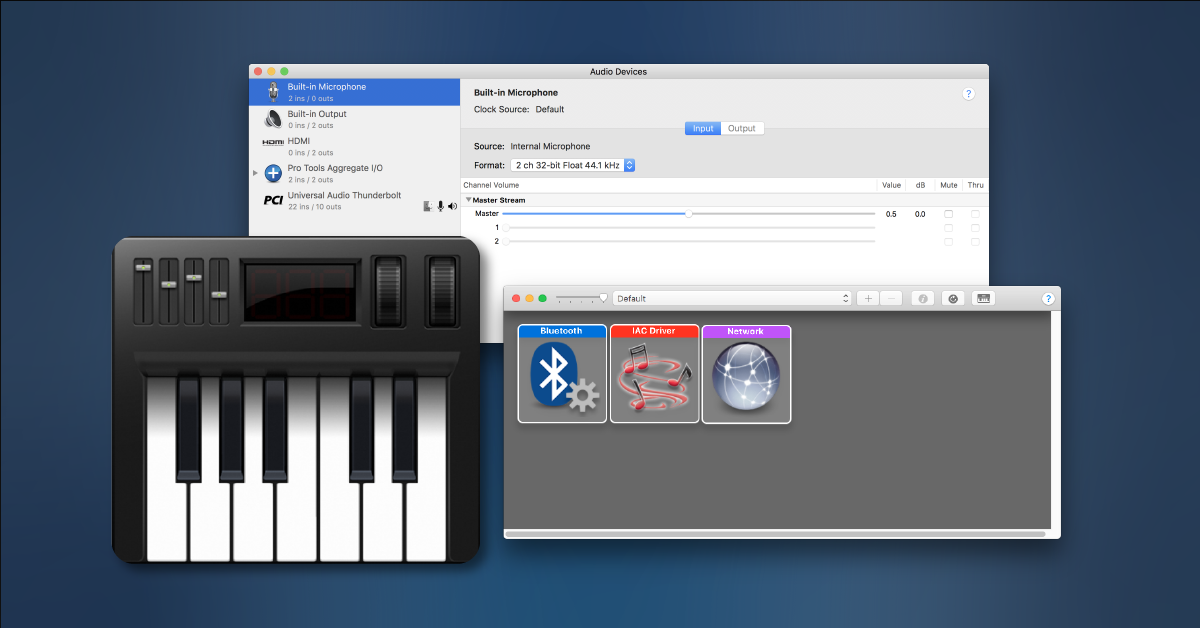
Simplified, a MIDI keyboard is a shortened grand piano keyboard in a housing that contains a MIDI interface that allows you to connect it to other MIDI devices, such as a MIDI synthesizer, that is installed on your computer’s sound card. With special software (for example, a MIDI sequencer), you can turn a MIDI synthesizer into play mode, for example, on a grand piano, and by pressing the keys on a MIDI keyboard, you can hear the sounds of a piano from line. Naturally, the matter is not limited to the grand piano: in the GM standard there are 128 melodic instruments and 46 percussion instruments. Additionally, using a MIDI sequencer, you can record notes played on a MIDI keyboard on a computer for further editing and arrangement, or simply to print notes.
It should be noted that since MIDI data is a set of commands, music written using MIDI is also recorded using synthesizer commands. In other words, a MIDI score is a sequence of commands: what note to play, what instrument to use, how much and how much it will sound, etc. Familiar MIDI files (.MID) are more than just a collection of such commands. Naturally, since there are a large number of MIDI synthesizer manufacturers, the same file can sound differently on different synthesizers (because the instruments themselves are not stored in the file, there are only instructions to the synthesizer on which instruments to play. while the differences synths may sound different).
Let’s go back to the consideration of sound cards. As we have already clarified what MIDI is, we cannot ignore the characteristics of the hardware synthesizer built into the sound card. A modern synthesizer, most often, is based on the so-called “wave table” – WaveTable (in short, the principle of operation of such a synthesizer is that the sound in it is synthesized from a set of recorded sounds dynamically superimposing them and change of sound parameters), before the main synthesis type was FM (Frequency modulation: sound synthesis generating simple sinusoidal oscillations and mixing them). The main characteristics of a WT synthesizer are: the number of instruments in the ROM and their volume, the presence of RAM and its maximum volume, the number of possible signal processing effects, as well as the possibility of channel-by-channel effect processing. . (of course, in the case of an effects processor), the number of oscillators that determines the maximum number of voices in polyphonic mode (polyphonic) and, perhaps most importantly, the standard by which the synthesizer is manufactured (GM , GS or XG). By the way, the amount of memory of the synthesizer is not always a fixed value. The thing is that recently synthesizers have stopped having their own ROM, but use the main RAM of the computer: in this case, all the sounds used by the synthesizer are stored in a file on disk and, if necessary, are they read into RAM.