Frame rate


Free Download Mp4Gain
picture

Frame rate

Frame Rate

Frame rate is an important setting factor that affects the “smoothness” and file size of a video.

frame rate

The unit is fps (frames / second). You can also tell how many still image frames are embedded per second.

A moving image uses the image persistence phenomenon of the human eye to display still images continuously so that they can be recognized as a moving image. It is said that the ability of the human eye can recognize up to 60 fps. So if you create a video at 60fps, you can tell that the video doesn’t look jerky.
On the other hand, this frame rate has a great effect on file size. Since it is necessary to save 60 still images in 1 second at 60 fps and 1 still image in 1 second at 1 fps, the file size varies greatly depending on the frame rate.
Generally, TVs and DVDs use 30 fps (29.97 fps) and most of them are set to 30 fps (29.97 fps) or less.
Unless you really need to reduce the file size, specify 30 fps (29.97 fps).
For reference when setting less than 30fps (29.97fps), the movie is 24fps and the 1Seg TV is 15fps. It is said that it can be lowered to 15 fps for videos with little movement, such as a person sitting and talking. If you set it to 10fps or less, it will no longer be a video but a slideshow level, and it will definitely look jerky. The minimum line for video is around 15 fps.

On the other hand, for videos with a lot of motion, such as sports and action, you may feel that 30 fps (29.97 fps) at the TV or DVD level is not enough. The file size will be large and it will be difficult to send and receive it over the Internet, but if image quality is prioritized, it is worth setting it to 60fps.
Current playback devices that support 120 fps are still rare, but next-gen TV streaming standards, 4K and 8K streams are specified up to 120 fps.
2. 2. Resolution (angle of view)
It can also be said that it is the size of the area to display videos. In terms of TV streaming,
1Seg → SD → HD → Full HD → 2K → 4K → 8K How much
The higher the resolution, the larger the rendering area, so naturally the video file size will increase accordingly.

Resolution (angle of view) TV broadcast Compatible storage devices
SD (720 px x 480 px) Analog broadcast DVD
HD (1280px x 720px) HDTV broadcast
* mainly in Europe —
Full HD (1920px x 1080px) High definition transmission
* Japan, strictly speaking,
High Definition BS: 1920px x 1080px Transmission
digital terrestrial: 1440px x 1080px Blu-ray Disc
(BD)
4K UHD (3840px x 2160px) 4K UHD streaming means Ultra HD.
Streaming started on December 1, 2018 with the Next Generation Streaming Standard. Ultra HD Blu-ray Disc
(UHD BD)
8K UHD (7680px x 4320px) 8K Transmission As with
4K, streaming started on December 1, 2018. Unknown current status

When considering Internet video usage, YouTube’s maximum resolution is Full HD (HD1080). With reference to this, if resolution is prioritized, it is set to Full HD, and if file size is prioritized, it is set to SD or less.

aspect ratio
It is the aspect ratio of the resolution (angle of view). 16: 9 is the standard for televisions, and 16: 9 monitors have become mainstream for personal computers, but there are still products with aspect ratios such as 16:10 and 4: 3, iPhone 3: 2, and Andoroid 16. : is not unified like 9.
Therefore, if the prepared video file has an aspect ratio of 16: 9 and the aspect ratio of the playback device is different, it will be played back by adjusting, expanding or contracting it on the side of the playback device.
When uploaded to YouTube, videos other than 16: 9 are automatically rendered with black frames at the top, bottom, left, and right.
For those who create and prepare videos, it is very kind to prepare video files with every aspect ratio, but if you can’t take the trouble, it’s usually fine to just create a 16: 9 aspect ratio.


Free Download Mp4Gain
picture


Mp4Gain Main Window
picture


Mp4Gain Features
picture


Free Download Mp4Gain
picture

Video Compression: Bit rate

Video Compression: Bit rate

Video Bitrates

It is not good to increase the bitrate too much
Bit rate = it is useless to rise above a certain level
It does not mean that you need to increase the bit rate.

Video Bitrate

For example, even if you encode a video with an original image quality of 100 at an ultra-high bit rate, the image quality will not exceed 100. (If possible, 99, etc.)

It is often the case that the image quality is 95 at a 5 Mbps bit rate, but the image quality is only 96 even if a 10 Mbps bit rate is assigned.

In such cases, it is useless to assign a bit rate of 10 Mbps.

The bit rate is to maintain the image and sound quality of the original video. It is not intended to raise the bottom.

High bit rate = high playback load
The higher the bitrate, the more playback load will be placed on the PC.

If you use a unnecessarily high bit rate, you will end up with the worst video, “Although the image quality is normal, the playback load is extremely high and the file size is a huge waste.”

So if you want to encode it for your own storage,

Video resolution
Video content
Let’s think about the bitrate to be assigned.

Related: How to Calculate Video Bitrate [Ratio to File Size]

However, if you want to post to Youtube, it will be encoded on the Youtube side and set to a suitable bitrate, so it’s okay if you encode at an ultra-high bitrate for now.

Related: Enco conditions and methods for videos published on Youtube


Video Compression: Relationship to Resolution

Video Compression: Relationship to Resolution

Video Bitrate

Higher resolution videos require higher bit rates. (Because it increases the amount of information per frame / second)

Video Bitrate

For example

Video “1280 x 720”
Video “1920 x 1080”
If you have two videos, the latter requires more bitrate. “1280 x 720” may be sufficient bit rate, but “1920 x 1080” is not sufficient.

For “Recommended bit rate” for “Resolution”, see Youtube recommended bit rate.

Recommended encoding settings for uploaded videos (details) – YouTube Help
→ https://support.google.com/youtube/answer/1722171?hl=ja

Relationship to frame rate
If the frame rate doubles, the bit rate will inevitably double.

This is because “the number of frames per second” is doubled.

For example

30 fps (2 Mbps)
60 fps (2 Mbps)
If there are two videos,

For 60 fps, “60 sheets at 2 Mbps” should be displayed, while

For 30fps, you only need to display “30 sheets at 2Mbps”, so the bitrate is actually half.

Reference: What is the frame rate? Difference between VFR (variable) and CFR (fixed)

It is not good to increase the bitrate too much
Bit rate = it is useless to rise above a certain level
It does not mean that you need to increase the bit rate.

For example, even if you encode a video with an original image quality of 100 at an ultra-high bit rate, the image quality will not exceed 100. (If possible, 99, etc.)

It is often the case that the image quality is 95 at a 5 Mbps bit rate, but the image quality is only 96 even if a 10 Mbps bit rate is assigned.

In such cases, it is useless to assign a bit rate of 10 Mbps.

The bit rate is to maintain the image and sound quality of the original video. It is not intended to raise the bottom.

High bit rate = high playback load
The higher the bitrate, the more playback load will be placed on the PC.

If you use a unnecessarily high bit rate, you will end up with the worst video, “Although the image quality is normal, the playback load is extremely high and the file size is a huge waste.”

So if you want to encode it for your own storage,

Video resolution
Video content
Let’s think about the bitrate to be assigned.

Related: How to Calculate Video Bitrate [Ratio to File Size]

However, if you want to post to Youtube, it will be encoded on the Youtube side and set to a suitable bitrate, so it’s okay if you encode at an ultra-high bitrate for now.

Related: Enco conditions and methods for videos published on Youtube

Resume
In short, it looks like the following.

If you want to make a video that emphasizes the quality of the image
→ Increase the video bit rate

If you want to make a video that emphasizes the sound quality
→ Increase the audio bit rate (increase the sample rate and bit depth)

When you want to make a video that emphasizes movement (smoothness)
→ Increase the frame rate of the video (simply doubling the frame rate requires doubling the bit rate)

Reference: What is the frame rate? Difference between VFR (variable) and CFR (fixed)
Reference: How to Change the Frame Rate (fps) of a Video

By the way, it is a bit rate encoding method.

CBR
Vbr
APR
The “image quality” and the “sound quality” also depend on this, so be careful with this as well.

Reference: Difference between CBR (fixed), VBR (variable) and ABR (average) [bit rate]


Video compression: Relationship to codec

Video compression: Relationship to codec

Video Bitrate

I mentioned earlier that “the higher the bit rate, the better the image quality and sound quality”, but the image quality and sound quality are closely related to the “codec”.

A “codec” is something like a “compression algorithm” for compressing “video” and “audio”.

Reference: What is video format? Codec difference

For example, the video codec “H.264” It is a very famous codec that is also used on Youtube and Nico Nico Douga,

(Addendum: Not used now …)

There is a codec called “H.265” that improves the “image quality per file size” of “H.264”.

“H.265” is “H.264 at about half the bit rate of”, “H.264 will get the equivalent of image quality and”. (The compression rate is double)

For example

Using “2Mbps” video bit rate with “H.264 codec”
Video with a bit rate of “2 Mbps” with the codec “H.265”
If there are two videos, the image quality of “H.265” is twice as beautiful even though the bit rate (file size) is the same.

s-25-11-2015_14h09_08
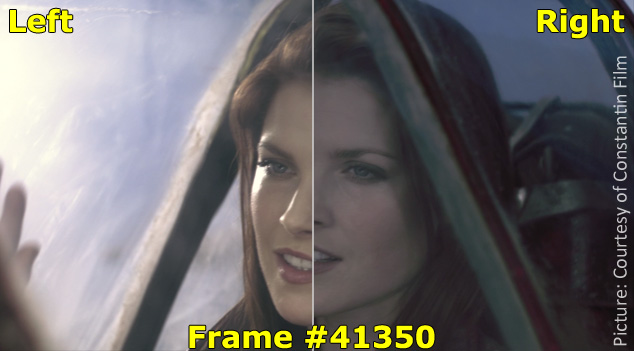
▲ Image comparing H.264 and H.265
(the character part etc. is quite different)
In addition, there is an almost four times difference in picture quality between videos using the “MPEG-2” codec used in DVDs and videos using “H.265”.

Also, the image quality is almost eight times different from that of “MPEG-1”, which is the predecessor of “MPEG-2”.

In other words, if you want to achieve the same image quality as “H.265” video with “MPEG-1”, you need 8 times the bit rate of “H.265”.

By the way, the video in unzipped state without using the codec
Uncompressed video
Uncompressed video
Is named. (Also called “raw video”)

The intro has gotten long, but what I mean after all is

“If you use a codec with a good compression rate, you can maintain reasonable picture and sound quality even at low bit rates.”

That’s why

In other words, the picture and sound quality are good.

Image quality (sound quality) = high bit rate x codec type
It is decided by the formula.

Reference: Different from the type of video codec (H.264, VP9, ​​MPEG, Xvid, DivX, WMV, etc.)

Reference: Different from the type of voice codec (MP3, AAC, WMA, WAV, Vorbis, FLAC, etc.)

Reference: Difference Between Lossy Compression and Lossless Compression [codec]