What is bit?


Free Download Mp4Gain
picture

What is bit?

BIT

bit is an abbreviation for binary digits.

Binary Code System BIT

16 bits and 24 bits in catalogs, etc. represent the number of binary digits * handled by computers, etc.

In digital audio, analog sound is converted to a digital signal,
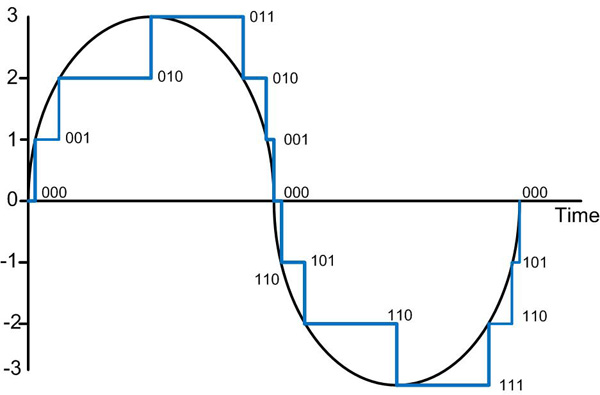
but the number of bits determines how precisely the amplitude value is converted when it is converted to a binary number (quantization) after sampling.
In the case of 1 bit, only 1 or 0 can be judged, but in 8 bit (10001001), 2 raised to the eighth power, that is, 256 steps can be judged in detail.

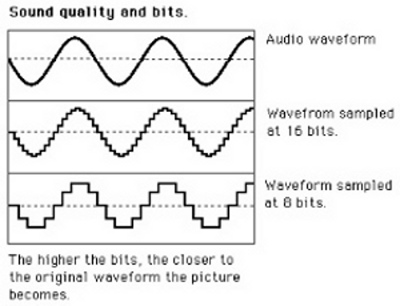
Currently, the 16-bit mainstream has 65,536 steps and the 24-bit mainstream has 16,777,216 steps.
Now,
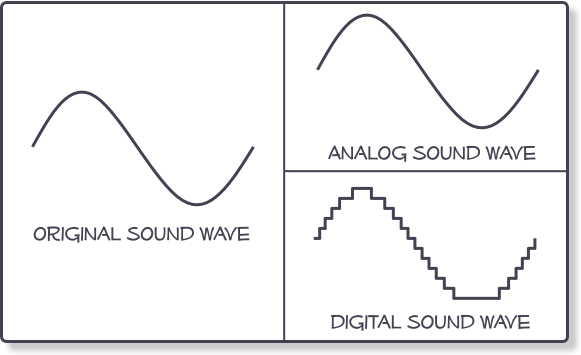
there is a part that does not match the actual waveform (analog waveform) and the quantized and sampled digital waveform. This is called quantization noise.
This noise is especially noticeable when the number of bits is small.

So simply increasing the F’s and the number of bits will improve the sound (closer to the original sound)
, but it will consume a lot of memory. Also, in the case of digital recording, it is
very important to manage the input level to bring out the high quality of the sound.
If the recording level is too low, you won’t be able to bring out its goodness.

It is important to configure it so that it is not clipping at the maximum level of the music to be recorded,
but try to increase the overall average level as much as possible to have a wider dynamic range
(recordable high and low level difference) than analog. Make the most of it and record with a good signal-to-noise (SN) ratio.

* The decimal numbers that we usually use are represented by a combination of 10 types of numbers from 0 to 9, but in
binary numbers, are represented by a combination of 0 and 1.

For example, in a 4-digit binary number,

Decimal number 0 1 2 3 Four ・ ・ ・ ・ 14 15
Binary number 0 1 Ten 11 100 ・ ・ ・ 1110 1111
You can express a number from 0 to 15 as.

(5) What is timing?

It is a state in which each device moves in harmony with each other at the same time in the system.

Digital devices use a reference signal called a word clock, and
Each device can be synchronized with a high precision that cannot be compared with analog devices.

For the configuration of each device, the device that supplies the reference word clock is set as the word clock master, and
all other devices are configured as
word clock slaves so that they can operate synchronously in response to the instruction of a unit set by this master increases.

The role of the word clock is similar to that of the conveyor belt used on factory assembly lines.

The digitized audio data is divided into small times, it is
transmitted to each device, processed and finally returned to an analog audio signal by the DA converter.
What happens if the speed of the conveyor belt changes along the way?
The data will be lost or the time will not match.

If there are devices in the system that are not synced
, problems such as loss of sound and noise mixing will occur due to the same cause.

Regarding synchronization, if each device is precisely configured and word clock transmission between each device is guaranteed,
can achieve high-performance and comfortable operation unique to digital technology.

(6) Digital recording medium

CD compact disc. Introduced in 1982.
Bonus CD A CD that can also play back photos and pictures.
CD-R A CD that can only be burned once.
CD-RW A CD that can be recorded many times.
DAT Digital audio tape. Record and play back on magnetic tape.
Maryland Mini disco. Introduced in 1991.
MP3 Achieve CD-quality sound quality on the Internet, personal computers, etc.
SACD Super Audio CD. Higher sound quality than current CD.
DVD Audio You can play videos and music.


Free Download Mp4Gain
picture


Mp4Gain Main Window
picture


Mp4Gain Features
picture


Free Download Mp4Gain
picture

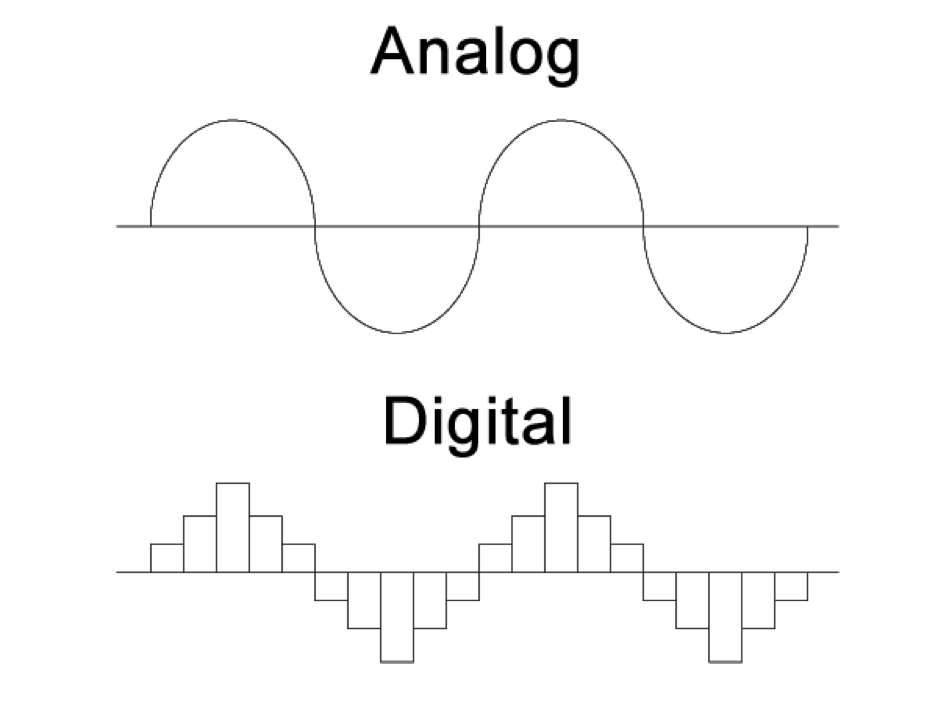
Difference between digital and analog

Difference between digital and analog

Analog vs. Digital

The sound is analog. And sound is the vibration of the air. How is this sound vibration transmitted?

Analog vs Digital

For example, when a stone is thrown into a calm water surface, the ripples spread around it, but if
Cut in the direction of the waves and look at the cut end, the waveform is as shown in Fig.1.

Air waves spread from the point where sound is emitted even in air. Although invisible to the eye, it has a
similar waveform. This is the analog waveform of sound.

Therefore, although it is digital, when such a sound waveform is recorded or communicated by phone or wireless, as
shown in Fig. 2, the change in the analog waveform is electrically replaced with a series of numerical values ​​according to a certain promise. ..

When recording or communicating, if you handle it as analog, it is easy for noise to enter and the sound quality to deteriorate, but when trying
the waveform of the sound as digital = numerical data, you can eliminate that worry and
maintain a certain quality. You can do various processing while maintaining it.

(2) What is convenient when it is digital

Digital audio signals are convenient because they can be recorded and edited using a personal computer, for example.

In addition, 74 minutes of music can be recorded on a CD with a diameter of only 12 cm, and through digital compression processing
, music of the same length can be recorded on an MD with a smaller diameter.

Since digital signals can be compressed in this way, it is also convenient for storing large amounts of information.
Not only sound, but also video signals with a higher amount of information can be recorded and communicated at high speed through the use of compression technology.

Especially in communication, a two-way digital multiplex communication can be realized communicating multiple pieces of information with a single wire.
In addition to electrical signals, laser light can also be used for optical communication, making communication possible at extremely high speeds.

(3) What is the sampling frequency?

Digital signals are processed at predetermined fixed time intervals.
The sample rate (sample rate) indicates how many times a second is processed and is expressed as Fs or fs.

The sampling frequency unit is Hz (Hertz), and the
44.1 kHz (kilohertz) sampling rate means 44,100 pieces of data are processed per second.
(K represents 1000 times)

AD conversion converts a continuous analog signal into a digital signal,
measures the size of the signal at each moment determined by the sampling frequency (sampling) and converts
the result in a binary number (quantization).

On the other hand, DA conversion converts a digital signal into an analog signal,
It reads the digital signal in the sample rate time interval and connects it smoothly.

Since digital signals can be reproduced up to half the sampling frequency, how much
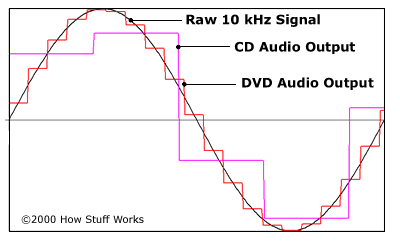
The higher the sample rate, the higher the playable frequency and the better the sound quality.
In familiar areas, 44.1 kHz is used for CD, and 48 kHz is used for DAT and B modes of satellite transmission.

In addition, recent professional equipment uses high sampling frequencies (high sampling), such as 88.2 kHz and 96 kHz,
and are designed to faithfully reproduce even higher frequency sounds to improve sound quality.

Digital sound quality

Digital sound quality.

Sound quality

Sound information. Sound is a wave that travels through air, water, or other medium with a continuously varying intensity and frequency.

Digital Sound Quality

A person receives sound waves (air vibrations) supported by hearing in the form of sound of varying volume and pitch. The greater the intensity of the sound wave, the louder the sound, the higher the frequency of the wave, the higher the pitch of the sound

Dependence of the volume and pitch of sound on the intensity and frequency of a sound wave

The human ear receives sound with a frequency of 20 vibrations per second (small sound) to 20,000 vibrations per second (loud sound).

A person can receive sound in a wide spectrum of intensities, in which the highest intensity is 1014 times greater than the lowest (100 thousand billion times). To measure the volume of sound, a special unit “decibel” (dbl) is used (Table 5.1). Decreasing or increasing the sound volume by 10 dB is suitable for decreasing or increasing the sound intensity by 10 times.

The sound volume
sound in decibels
lower limit of human ear sensitivity 0
leaf whisper 10
Conversation 60
Gudok Vehicle 90
Jet engine 120
Pain threshold 140
Sound time sampling. In order for a computer to process sound, a continuous audio signal must be converted to a discrete digital form with support for time sampling. A constant sound wave is divided into small separate time sections, for each section a certain value of sound intensity is set.

Therefore, the constant dependence of the loudness of the sound on time A (t) is replaced by a discrete sequence of loudness levels. On the graph, this appears to replace a smooth curve with a sequence of “steps”

Sampling frequency. To record analog sound and transform it into digital format, a microphone is used, connected to the sound card. The quality of the digital sound obtained depends on the number of measurements of the sound volume level per unit of time, that is, the sampling frequency. The more measurements that are made in 1 second (the higher the sampling frequency), the more accurately the “ladder” of the digital audio signal repeats the curve of the dialogue signal.

Audio sample rate is the number of audio volume measurements in one second.

The audio sample rate can range from 8000 to 48000 sound volume measurements per second.

Audio encoding depth. Each “step” is assigned a specific value for the sound volume level. Loudness levels of sound can be viewed as a set of probable states N, for which encoding a certain amount of information I is required, which is magnified by the encoding depth of the sound.

Audio encoding depth is the amount of information required to encode the discrete volume levels of digital audio.

If the encoding depth is known, then the number of digital sound volume levels can be calculated using the formula N = 2I. Let the sound encoding depth be 16 bit, then the number of sound volume levels is the same:

N = 2I = 216 = 65536.

During the encoding process, each sound volume level is assigned its own 16-bit binary code, the lowest sound level will correspond to the code 0000000000000000, and the highest – 1111111111111111.

The quality of digitized sound. The higher the sound sampling frequency and depth, the higher the quality of the digitized sound. The lowest quality of digitized sound, suitable for the quality of a telephone connection, is obtained at a sample rate of 8000 times per second, an 8-bit sample rate, and by recording an audio track (“mono” mode). The highest quality digitized sound, suitable for audio CD quality, is achieved at a sampling rate of 48,000 times per second, a 16-bit sampling rate, and by recording 2 audio tracks (“stereo” mode ).

It should be remembered that the higher the quality of the digital sound, the greater the volume of information in the audio file. You can estimate the volume of information in a digital stereo sound file with a duration of 1 second with an average sound quality (16 bits, 24,000 measurements per second). To do this, the encoding depth must be multiplied by the number of measurements in 1 second and multiplied by 2 (stereo sound):

16 bits 24,000 2 = 768,000 bits = 96,000 b = 93.75 KB.

Which is better, analog or digital sound?

Is there really a difference ?, Do you need a very expensive audio equipment to notice the differences ?, and does it really matter ?.
Before entering the discussion, we should take a quick look at what makes a sound digital or analog. It all has to do with how a sound is recorded. An analog sound recording copy is a continuous electronic signal.

digital vs analog sound

Today, improvements in analog to digital conversion methods have improved the quality of digital recordings. Some people say that there is no distinction between digital and analog mode. Others disagree and insist that analog systems provide better sound.

What are the differences in the actual sound of analog recordings and the sound of digital recordings? Read on to find out.


History of digital sound

Before the 1970s, musicians recorded with analog recording equipment. Microphones that record the sound and generate an analog wave that other devices could transfer directly to the appropriate media (usually magnetic tape).

Assuming that the musician uses reliable equipment, the recorded sound was a faithful representation of the original sound.
With digital recording, audio equipment converts analog waves into digital signals. There are many different types of equipment that can convert from analog to digital.

analog sound compared with digital sound

The first digital recordings sacrificed fidelity, or sound quality, in favor of reliability. One of the drawbacks of an analog format is that analog media tend to wear out quickly. Vinyl records can be deformed or scratched, and this can dramatically affect the sound quality. The magnetic tape eventually wears out and is vulnerable to magnets, which can erase or destroy the information stored on the tape. Digital media such as compact discs can reproduce sound indefinitely, and are more durable.

Analog vs Digital

Some music lovers believe that digital recordings fall short when it comes to reproducing sound accurately. They use intricate language, and jargon, to describe the capabilities or deficiencies of an audio system. Most of his criticisms deal with the frequency of sound.

analog vs digital

Humans can perceive or hear sounds ranging from 20 hertz (Hz) to 20 kilohertz (kHz). The frequency of a sound wave corresponds to our perception of the height of a sound, that is, it sounds more acute. The higher the frequency, the greater the tone we hear.

Sound lovers describe the sound quality of an audio system with respect to different frequencies by using terms such as full or warm.
A complete or powerful sound comes from a system that reproduces the most serious or low frequencies with better quality.
Airy or delayed sound means that the music played gives the listener the impression that the instruments are in a spacious environment and usually refers to sounds in the high frequency range.

Some music lovers say vinyl albums perform better at lower frequencies, which means they provide a warm sound. They argue that compact discs are not as accurate in the reproduction of sounds in this range. Others insist that there is no detectable difference between a well-produced digital file and a good-looking vinyl record.
If the artist uses an analog format to create the original recording, then an analog copy is the best. That is because there would be no need to convert the sound from analog to digital. The copy must be an exact representation of the original track. But if the artist uses digital recording, then it would be better to buy the album on CD.

The perception of musical quality is subjective. Two people who listen to the same music, with the same equipment, may have different opinions regarding the quality of the recording.


The perception of musical quality is subjective.

Two people who listen to the same music, with the same equipment, may have different opinions regarding the quality of the recording.

Analog and digital signals

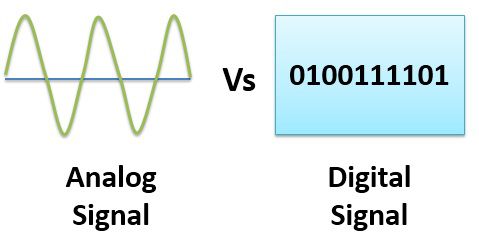
Sound is, of course, an analog signal. An analog signal is continuous, which means there are no breaks or interruptions. The digital signals are not continuous. Specific values ​​are used to represent the information. In the case of sound, a sound wave is represented as a series of values ​​that represent tone and volume over the length of the recording.
Some argue that analog recording methods are better at capturing a faithful sound image. Digital recordings can lose subtle nuances. But as digital recording processes improve, digital devices can use higher speeds with greater precision. Although the signal is not yet continuous, the high frequency can create a sound similar to the original source.

Another advantage of digital media over analog is that you can make as many copies of the original sound file as you want, without harming it. Over time, even a master analog recording will not sound as good as the original sound. But nothing corrupts a digital file, which will remain the same, no matter how much time has passed or the number of copies made.