
Is there really a difference ?, Do you need a very expensive audio equipment to notice the differences ?, and does it really matter ?.
Before entering the discussion, we should take a quick look at what makes a sound digital or analog. It all has to do with how a sound is recorded. An analog sound recording copy is a continuous electronic signal.
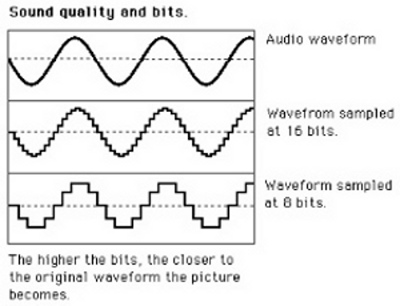
Today, improvements in analog to digital conversion methods have improved the quality of digital recordings. Some people say that there is no distinction between digital and analog mode. Others disagree and insist that analog systems provide better sound.
What are the differences in the actual sound of analog recordings and the sound of digital recordings? Read on to find out.
History of digital sound
Before the 1970s, musicians recorded with analog recording equipment. Microphones that record the sound and generate an analog wave that other devices could transfer directly to the appropriate media (usually magnetic tape).
Assuming that the musician uses reliable equipment, the recorded sound was a faithful representation of the original sound.
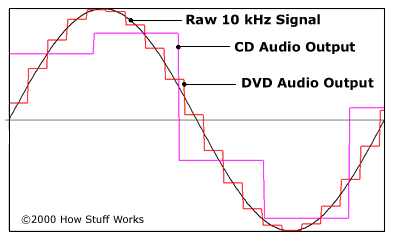
With digital recording, audio equipment converts analog waves into digital signals. There are many different types of equipment that can convert from analog to digital.
The first digital recordings sacrificed fidelity, or sound quality, in favor of reliability. One of the drawbacks of an analog format is that analog media tend to wear out quickly. Vinyl records can be deformed or scratched, and this can dramatically affect the sound quality. The magnetic tape eventually wears out and is vulnerable to magnets, which can erase or destroy the information stored on the tape. Digital media such as compact discs can reproduce sound indefinitely, and are more durable.
Analog vs Digital
Some music lovers believe that digital recordings fall short when it comes to reproducing sound accurately. They use intricate language, and jargon, to describe the capabilities or deficiencies of an audio system. Most of his criticisms deal with the frequency of sound.
Humans can perceive or hear sounds ranging from 20 hertz (Hz) to 20 kilohertz (kHz). The frequency of a sound wave corresponds to our perception of the height of a sound, that is, it sounds more acute. The higher the frequency, the greater the tone we hear.
Sound lovers describe the sound quality of an audio system with respect to different frequencies by using terms such as full or warm.
A complete or powerful sound comes from a system that reproduces the most serious or low frequencies with better quality.
Airy or delayed sound means that the music played gives the listener the impression that the instruments are in a spacious environment and usually refers to sounds in the high frequency range.
Some music lovers say vinyl albums perform better at lower frequencies, which means they provide a warm sound. They argue that compact discs are not as accurate in the reproduction of sounds in this range. Others insist that there is no detectable difference between a well-produced digital file and a good-looking vinyl record.
If the artist uses an analog format to create the original recording, then an analog copy is the best. That is because there would be no need to convert the sound from analog to digital. The copy must be an exact representation of the original track. But if the artist uses digital recording, then it would be better to buy the album on CD.
The perception of musical quality is subjective. Two people who listen to the same music, with the same equipment, may have different opinions regarding the quality of the recording.
The perception of musical quality is subjective.
Two people who listen to the same music, with the same equipment, may have different opinions regarding the quality of the recording.
Analog and digital signals
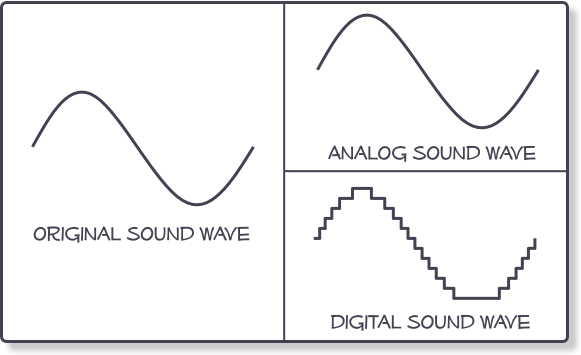
Sound is, of course, an analog signal. An analog signal is continuous, which means there are no breaks or interruptions. The digital signals are not continuous. Specific values are used to represent the information. In the case of sound, a sound wave is represented as a series of values that represent tone and volume over the length of the recording.
Some argue that analog recording methods are better at capturing a faithful sound image. Digital recordings can lose subtle nuances. But as digital recording processes improve, digital devices can use higher speeds with greater precision. Although the signal is not yet continuous, the high frequency can create a sound similar to the original source.
Another advantage of digital media over analog is that you can make as many copies of the original sound file as you want, without harming it. Over time, even a master analog recording will not sound as good as the original sound. But nothing corrupts a digital file, which will remain the same, no matter how much time has passed or the number of copies made.

