What methods are used to effectively compress digital audio?

What methods are used to effectively compress digital audio?

Digital audio Compresssion

Currently, the most famous are Audio MPEG, PASC and ATRAC. All use the so-called “perception coding” (perceptual coding), in which information that is barely perceived by the ear is removed from the sound signal.

Audio compression

As a result, despite the change in the shape and spectrum of the signal, your hearing perception is practically unchanged and the compression ratio justifies a slight decrease in quality. Such encoding refers to lossy compression methods, when it is no longer possible to accurately restore the original waveform from the compressed signal.

Techniques to remove some of the information are based on a characteristic of human hearing, called masking: if there are pronounced peaks (dominant harmonics) in the sound spectrum, the weakest frequency components in the immediate vicinity of them are practically not perceived (masked) by ear. During encoding, the entire audio stream is divided into small frames, each of which is converted into a spectral representation and divided into several frequency bands. Within bands, masked sounds are detected and removed, after which each frame undergoes adaptive coding directly in spectral form. All these operations make it possible to significantly reduce (several times) the amount of data while maintaining the quality acceptable to most listeners.

Each of the described encoding methods is characterized by the bit rate at which the compressed information must enter the decoder when the audio signal is recovered. The decoder converts a series of compressed instantaneous signal spectra into a conventional digital waveform.

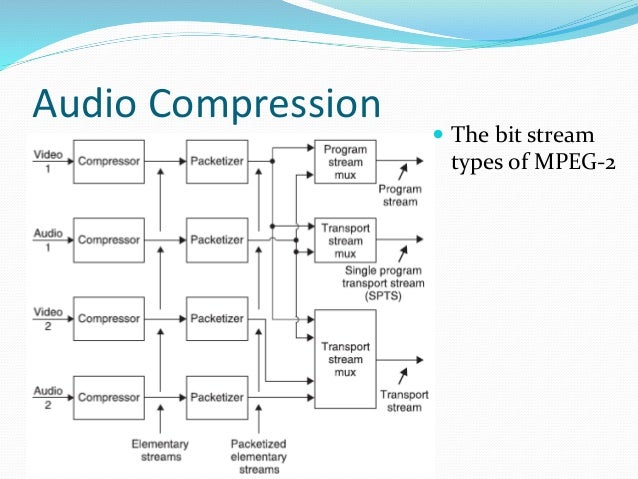
Audio MPEG is a group of audio compression techniques standardized by MPEG (Moving Pictures Experts Group). MPEG audio methods come in various types: MPEG-1, MPEG-2, etc .; currently the most common type is MPEG-1.

There are three layers of MPEG-1 audio to compress stereo signals:

1 – 1: 4 compression ratio with a data stream of 384 kbps;
2-1: 6..1: 8 at 256..192 kbps;
3 – 1: 10..1: 12 at 128..112 kbps.
The minimum data rate at each layer is defined as 32 kbps; the specified bit rates keep the signal quality close to that of a CD.

All three layers use a frame input spectral transform divided into 32 frequency bands. The most optimal level in terms of data volume and sound quality is recognized as level 3 with a bit rate of 128 kbps and a data density of approximately 1 Mb / min. When compressing at lower speeds, the forced limiting of the frequency band to 15-16 kHz begins, and phase distortions of the channels also appear (effect like a phaser or flanger).

MPEG audio is used in computer sound systems, CD-i / DVD, “audio” CD-ROM, digital radio / television, and other mass audio transmission systems.

PASC (Precision Adaptive Sub-Band Coding) is a special case of Audio MPEG-1 Layer 1 with a bit rate of 384 kbps (1: 4 compression). Used in the DCC system.

ATRAC (Adaptive TRansform Acoustic Coding) is based on a stereo audio format with 16-bit quantization and a sample rate of 44.1 kHz. When compressed, each frame is divided into 52 frequency bands, resulting in a transmission rate of 292 kbps (1: 5 compression). Used in MiniDisk system.

What is audio and video compression?

Do you know what audio and video compression is? It is the technology that allows you to play and store multimedia files on PCs, mobile phones and tablets.

Audio & Video Compression

Internet users are consuming more and more multimedia content. The audiovisual format is estimated to represent 80% of online content by 2020.

However, files are often heavy and may not run easily on all computers, so understanding what audio and video compression is is essential.

Audio and video compression

To work with audiovisuals, the professional needs to understand how compression of multimedia files works. In this post, you will know what audio and video compression is and why it is so important to do so.

After all, what is audio and video compression?
It is reducing a large volume of data in a file so that it takes up less space in the memory of a device or requires less transmission bandwidth. It can happen with or without loss, although most eliminate some almost imperceptible details.

However, the higher the audio and video compression, the lower the quality.

This is how each type of compression works:

Audio compression

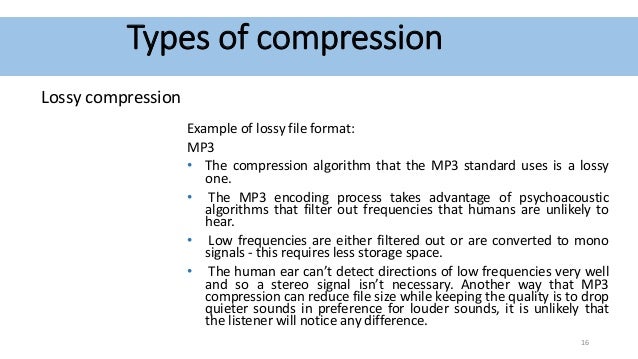
By compressing sound files, the software reduces or simplifies the repetition of bits and eliminates the data considered imperceptible to the human ear.

To play an audio format on a certain device, you must select a codec, a program that encodes and decodes the media file.

In short, it compresses the file into a smaller format and unzips it, converting it back to sound when the user wants to listen to it. However, the same codec will not be used for all types of compressions and decodes.

The standard computer audio storage (WAV) file is too heavy to hold from essential data to unnecessary data to maintain its quality. This is because it transforms information into sounds that are not perceived by our ears. Codecs remove this less important data and offer a quality format, playable by the vast majority of gamers.

Modern techniques explore the perception of the human ear and provide compression that has apparently not suffered any loss. The most popular are:

FLAC (Free Lossless Audio Codec; Lossless Compression) – Unlike most, it doesn’t remove any information from the sound file, but it can shrink by up to 50%. Despite the decrease, it can be up to ten times heavier than MP3 format;
ALAC (Apple Lossless): compression of audio data produced by Apple;
MP3 (MPEG-1/2 Audio Layer 3; lossy) – The most popular audio compression format greatly reduced file size and still maintained its quality. It was officially discontinued in 2017, but is still very popular;
Ogg Vorbis (lossy) – Audio format that offers a lower bit rate and more quality than MP3. It is divided into two parts, Ogg, responsible for the file’s metadata, and Vorbis, an encoder that compresses the songs;
AAC (lossy) – Designed to be the successor to MP3, AAC is the standard format for playing audio on computers like iPhone, iPad, and PlayStation 3.
Video compression
Like audio, video compression involves reducing the file size, but in this case, removing the parts that have already been designed.

When not lost, no part of the data is discarded from the image.

In lossy compression, bits are selectively discarded. One way to do this is to reduce the number of frames, which is generally the same as on television (30 per second).

Once compressed, each type of video uses a specific set of codecs. Some of the most popular compression formats are:

MKV (Matroska Video): Widely used for high resolution videos, MKV offers effective compression and maintains quality. To make this happen, the codec encapsulates the audio, video, and subtitle tracks in a single container;
MPEG (Moving Picture Experts Group): defined by ISO as the standard video compression format, it can vary between MPEG-1 (for VCD), MPEG-2 (DVD) and MPEG-4;
AVI (Audio Video Interleave): Like MKV, AVI encapsulates audio and video in the same container. With this, both play synchronously. As it was produced by Microsoft, the format runs easily on Windows and is recognized by DVD and Blu-Ray players that are compatible with the DivX codec.
Why is audio and video compression technology important?
In addition to taking up less space, downloading and uploading a compressed file takes much less time. This makes it much easier when you want to post a video file on social media.