
What methods are used to effectively compress digital audio?
Currently, the most famous are Audio MPEG, PASC and ATRAC. All use the so-called “perception coding” (perceptual coding), in which information that is barely perceived by the ear is removed from the sound signal.
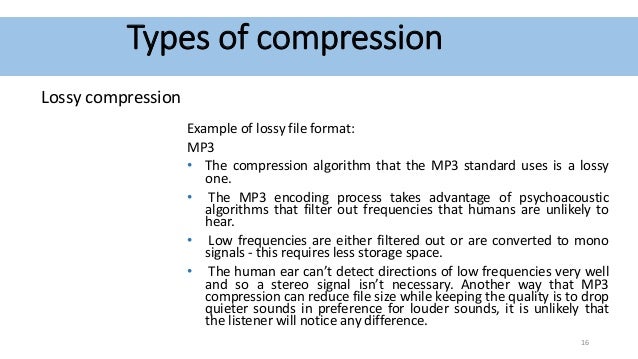
As a result, despite the change in the shape and spectrum of the signal, your hearing perception is practically unchanged and the compression ratio justifies a slight decrease in quality. Such encoding refers to lossy compression methods, when it is no longer possible to accurately restore the original waveform from the compressed signal.
Techniques to remove some of the information are based on a characteristic of human hearing, called masking: if there are pronounced peaks (dominant harmonics) in the sound spectrum, the weakest frequency components in the immediate vicinity of them are practically not perceived (masked) by ear. During encoding, the entire audio stream is divided into small frames, each of which is converted into a spectral representation and divided into several frequency bands. Within bands, masked sounds are detected and removed, after which each frame undergoes adaptive coding directly in spectral form. All these operations make it possible to significantly reduce (several times) the amount of data while maintaining the quality acceptable to most listeners.
Each of the described encoding methods is characterized by the bit rate at which the compressed information must enter the decoder when the audio signal is recovered. The decoder converts a series of compressed instantaneous signal spectra into a conventional digital waveform.
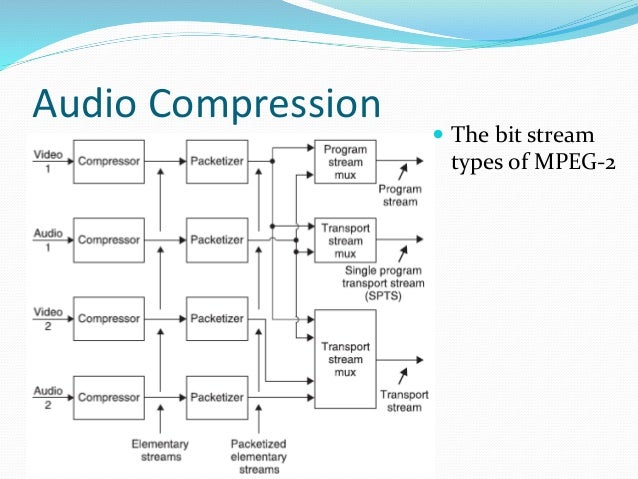
Audio MPEG is a group of audio compression techniques standardized by MPEG (Moving Pictures Experts Group). MPEG audio methods come in various types: MPEG-1, MPEG-2, etc .; currently the most common type is MPEG-1.
There are three layers of MPEG-1 audio to compress stereo signals:
1 – 1: 4 compression ratio with a data stream of 384 kbps;
2-1: 6..1: 8 at 256..192 kbps;
3 – 1: 10..1: 12 at 128..112 kbps.
The minimum data rate at each layer is defined as 32 kbps; the specified bit rates keep the signal quality close to that of a CD.
All three layers use a frame input spectral transform divided into 32 frequency bands. The most optimal level in terms of data volume and sound quality is recognized as level 3 with a bit rate of 128 kbps and a data density of approximately 1 Mb / min. When compressing at lower speeds, the forced limiting of the frequency band to 15-16 kHz begins, and phase distortions of the channels also appear (effect like a phaser or flanger).
MPEG audio is used in computer sound systems, CD-i / DVD, “audio” CD-ROM, digital radio / television, and other mass audio transmission systems.
PASC (Precision Adaptive Sub-Band Coding) is a special case of Audio MPEG-1 Layer 1 with a bit rate of 384 kbps (1: 4 compression). Used in the DCC system.
ATRAC (Adaptive TRansform Acoustic Coding) is based on a stereo audio format with 16-bit quantization and a sample rate of 44.1 kHz. When compressed, each frame is divided into 52 frequency bands, resulting in a transmission rate of 292 kbps (1: 5 compression). Used in MiniDisk system.

