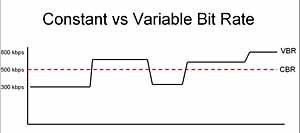
Bit rate denotes a unit in which the relationship between the amount of data and time occurs. It is measured in the unit of bits per second. Common abbreviations for bit rate are bit / s or bps. The output quantity of information units in relation to digital multimedia formats limited by a constant output time is designated on a timeline.

Bit rate is used in video and audio compression. Encoding is possible with constant (short CBR) and variable (short VBR) bit rate. The variable bit rate aligns the encoding with the content of the multimedia content. In the case of a predominantly quiet scene in a movie, for example, fewer units of information are required relative to time. However, in scenes with a lot of movement, the bit rate increases. This is intended to allow optimal use of storage space with high image quality at the same time when compressing with a codec. Often times the required memory space is also less when encoding with a variable bit rate compared to a fixed rate.
Constant bit rate
Constant bit rate describes a compression method for video and audio content during storage and transmission. A constant data rate is used, regardless of the complexity of the respective signal. The same amount of data is always produced per unit of time.
Constant bit rate is often used in multimedia broadcasts. The reason for this is the limited streaming capabilities. By using constant bit rate, optimal quality is achieved with the same data throughput. In some cases, however, it may also happen that amounts of data are “given away”. This is the case when the content to be encoded requires a lower rate than specified. This is especially true for videos with quiet scenes or very quiet audio files. The constant bit rate is used, for example, for video CDs or Internet radio.
Variable bit rate
In addition to the constant bit rate, encoding with a variable bit rate is also possible. Here is audio and video content in constant quality at different bit rates depending on the content stored or transmitted.
This solution has established itself in the media storage field as it offers higher quality with less memory consumption at the same time. When encoding with a variable bit rate, individual sections of a medium receive different compressions depending on the complexity of the content. This enables the highest possible quality to be achieved with low memory consumption.
For a long time, encoding with the help of variable bit rates was considered insecure. In the meantime, however, the technology has matured, so good results can also be achieved by converting a medium with a variable bit rate. The downside of this method is that you cannot predict before conversion how big the file will be in the end. In most cases, only a minimum and maximum bit rate can be set. Individual encoders also offer the option of specifying how large the file should be before converting it.
Average bit rate
A third compression method is the definition of an average bit rate. A medium is converted at a variable bit rate. This enables a fixed file size to be achieved while maintaining high quality. For this variant of media compression, some codecs offer the option to compress in two passes. This allows the average bit rate to be reached very precisely.
In the first pass, the material is analyzed and then compressed in the second. Basically the method corresponds to that of variable bit rate, but an average bit rate allows you to calculate the size of a file. A deviation tolerance can be specified for individual programs.
Nominal bit rate
Nominal bit rate indicates the average bit rate that is achieved by encoding with a variable bit rate. Despite the possible fluctuations that arise in the various VBR modes, a quality assessment can be made.
The nominal bitrate concept was introduced by the developers of the OggVorbis codec. This should make it easier for MP3 users to start using variable bit rate. Many Mp3 codec users were only used to compressing an audio file with a fixed bit rate.