
Constant bit rate is a tool used in digital telecommunication signals, for example, when transferring audio files from the Internet. A constant bit rate file is encoded to produce a file that plays at exactly the same bit rate throughout its duration. The biggest advantage of a constant file bit rate type is that it allows for constant playback of the media stream, as the bit rate will never fluctuate, reducing any delay and jitter from the end of the server stream. Although this file type is ideal in such circumstances, it is disadvantageous for storing more complex file types, as the constant bit rate can be overloaded or underused depending on file variations.

A constant bit rate file is like a trickle of sand through an hourglass – it will always go exactly the same speed. Counter this with an opposite file type, the variable bit rate file. In a variable bit rate file, the “sand” is uncomfortable, resulting in sometimes small information flows and sometimes larger, more complex blocks.
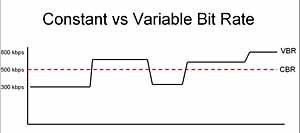
As mentioned, one of the best uses for a constant bit rate stream is when playing a media file. Compressing the entire content of the video or audio file into a single playback ensures consistency across the file, forcing images and tones to become substantially similar to each other. In a multimedia file encoded in a variable bit rate format, the quality of the file can change dramatically from one moment to the next as the bit rate peaks and slows like a roller coaster. Although a file using a constant bit rate does not always have the optimal image quality, as some images may have to be reduced in appearance to “adapt” the selected bit rate, at least the entire presentation will be smooth and fluid for the user.
It may seem that a file with a constant bit rate is always preferable, but this is not always the case. Some circumstances tend to favor the ability to model the bit rate within a specific range of values. Consider archiving a multimedia repository of popular paintings. While some paintings in the collection are hopelessly complex, requiring a high bitrate to capture their true essence, others are much simpler, requiring a much lower bitrate to keep the overall file size low. In cases like this, files that use a bit rate that remains constant would normally provide too much or too little storage space for each virtual drawing image.
Although a solution could be to increase the bit rate “ceiling”, allowing even the most complex paintings to be preserved with impunity, but this is not optimal from a programming point of view. Files with a higher bitrate require more storage space on the hard drive, as each item in the file has more room to “breathe” with the higher bitrate. The greater the space wasted by files whose complexity is not justified by the chosen high bit rate, the more inefficient the solution becomes.

