Audio normalization explained


Free Download Mp4Gain
picture

Audio normalization – Audio normalization

Audio normalization is the application of a constant amount of amplification of a sound recording to bring the amplitude of a target level (standard). Because the same amount of gain over the entire recording, the signal-to-noise ratio and relative dynamics are unchanged.

Two basic types of audio normalization exist. Peak normalization adjusts the recording based on the highest signal level present in the recording. Loudness normalization adjusts the recording based on perceived loudness.

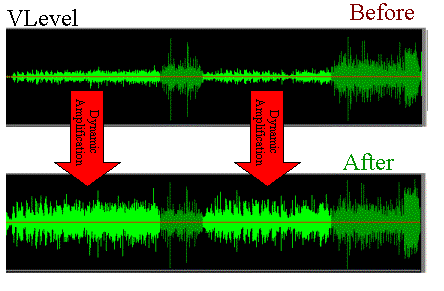
Normalization differs from dynamics compression, which applies varying levels of gain across a recording to fit the level within a minimum and maximum range. Normalization adjusts the gain with a constant value over the entire recording.

Normalization is one of the functions usually provided by a digital audio workstation.

Peak normalization

One type of normalization is peak normalization, where the gain is changed to bring the highest PCM sample value or analog signal peak to a certain level – usually 0 dBFS the loudest level allowed in a digital system.
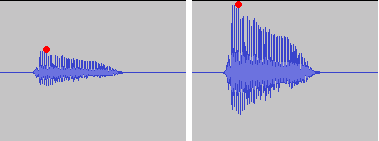
Peak normalization

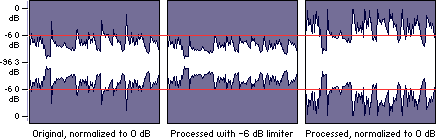
Since it only goes to the highest level, only peak normalization does not take into account the apparent loudness of the content. As such, peak normalization is commonly used to change the volume so as to ensure optimal use of the available dynamic range during the mastering phase of a digital recording. In combination with compression / restriction, however, peak normalization becomes a feature that can provide a volume advantage over off-peak normalized material. This feature of digital recording systems, compression and limiting followed by peak normalization, sets contemporary trends in program loudness.

Loudness normalization

Another type of normalization is based on a measurement of loudness, where the gain is changed to bring the average amplitude to a target level. This average can be a simple measurement of average power, such as the RMS value, or it can be a measure of human perceived loudness, such as that offered by ReplayGain, Soundcheck and EBU R128.

Loudness Normalization

For example, YouTube reference level -14 LUFS, so if a program analyzed at -10 LUFS, YouTube will decrease the level 4 dB to the reference of -14 LUFS.

Loudness normalization was made in different volume combat when listening to different music in a series. Before loudness normalization, one song in a playlist would be quieter than the rest, so the end listener would have to put a volume knob to adjust the playback volume.

Depending on the dynamic range of the content and the target level, loudness normalization may result in peaks that exceed the storage medium. Software offering such normalization usually offers the option of using dynamic range compression to avoid clipping when this happens. In this situation, signal-to-noise ratio and relative dynamics changed.


Free Download Mp4Gain
picture


Mp4Gain Main Window
picture


Mp4Gain Features
picture


Free Download Mp4Gain
picture

Volume normalization, an explanation

Audio Normalization: Make Your Audio & Video Consistently Loud

Audio normalization is a process in which the amplitude (volume) of an audio recording is increased or decreased in a constant relationship over time, so that the maximum amplitude or the maximum effective value or the perceived volume (volume) reaches a predetermined level, the standard. If the signal has multiple tracks, they all undergo the same correction.

Normalize Audio

Example: normalization of peaks to -3 dB:
A collection of digital recordings is made with a peak modulation standard of -3dB FS.
A new stereo recording is measured. The highest maximum level is -5.5 dB FS on the left track, -5.7 dB FS on the right track.
Normalization consists of applying a constant gain of 5.5 – 3 = 2.5 dB.
Standardization requires two passes. The first determines the maximum level, the second applies the correction to the entire recording.

Audio Normalization

Maximum normalization changes the level, but not the dynamics of the sound.
Volume normalization or perception of loudness often includes compression that changes the dynamics of sound.

Peak normalization

Peak normalization applies a constant gain to a recording to bring the highest peak to a target level, 89% professional audio (-1 dBFS true peak (True Peak)).

The sound dynamics of the recording are more or less preserved, except that maintaining a low distortion level after multiplication of all samples may involve the application of a known quantization error decorrelation noise. under the name redithering (tingling of the least significant bit) 2, which slightly increases the background noise level.

Volume normalization

The purpose of volume normalization is to bring all sound elements in a collection to the same sound volume level, so you can hear them without having to adjust the volume. In fact, the normalization of the maximum level in no way guarantees a homogeneity of the perceived sound volume (Loudness).

A simple approach to volume normalization, which is provided by various software programs, is to normalize the RMS value of the integrated signal within a few tenths of a second. The most advanced machines use extensive algorithms for more accurate evaluation of the perceived noise level. The European Broadcasting Union published a recommendation 1 in 2011, which provides a relatively simple method for this evaluation.

If the standard is not low enough, volume normalization involves compression for recordings whose sound dynamics would be higher than implied when setting the standard from the maximum level. If not, the signal peaks would exceed the quantization limits.

In the simplest implementation, volume normalization collects volume data during the first pass, determines the gain or attenuation necessary for the maximum volume to reach the norm, and applies this correction to the second pass. If the elements of the collection have the same characteristics, from form factor to top factor and dynamics, as is the case with popular music collections or recorded speech, this approach produces satisfactory results.

Extensive implementations use a standard that includes not only the volume of the sound, but also the maximum maximum values ​​and dynamics of the sound. They collect loudness levels and maximum values

VOLUME NORMALIZATION: WHAT IS THE VOLUME NORMALIZATION FUNCTION?

Audio Normalization

HOW IS THE VOLUME BETWEEN TITLES NORMALIZES?

WHAT ARE the benefits of activating the normalization feature?

The “NORMALIZE VOLUME” volume normalization feature allows you to achieve a volume of the same level, music title after music title, regardless of which one succeeds during playback.

How Audio Normalization Works

This provides undeniable listening comfort rather than having to, as before, sometimes turn the volume up or down depending on certain pieces of music.

Note that this difference between a high volume and a low volume sound is called dynamic. If this sound is short or long (1 second or 3 minutes …), be it music, voice or noise.

WHY IS THE SOUND MUSIC OR LETTERS STRONG, SOME TIME?

We must not forget that music, recorded or not, as well as everyday acoustic sounds (those that surround us) are something “alive” which, like during a human discussion, necessarily contains volume passages. weaker sound and others that are louder.

The human ear is by definition used to these differences in sound levels. If these sound differences between the low and high levels did not exist, it could end up giving us a headache because the sound heard would not be natural. The ear needs moments of rest, even if only for a moment, and stronger moments for words to remain audible (and to work the ear again!). The human ear needs this natural “breath”.

Today’s music is very “compressed” (constant sound level, few low levels) when recording (mixing), that is, there are few passages with a big difference between the lowest and highest passage of the song. The STANDARDIZE feature can even be activated and not work much if all the titles of an album are very “compressed”.

Finally, the sound world is like the aquatic world: there are high and low waves. Some tracks are not recorded (mixed) like others. They leave a big difference between low and high noise levels. The NORMALIZE VOLUME feature allows you to level up and try to get everything back to the same level.

WHEN SHOULD I USE THE STANDARDIZATION FUNCTION?

Eg. On the street or in the subway, standardization plays an additional role in making your music more audible. And of course, first and foremost to get a comfortable listening when listening to different music titles with as much sound as possible.

WHY disable the standardization feature?

When the need arises, you can turn this feature off at any time when you want to find this “breathing sound”, titles read (play), with multiple moments that contain smoother (weaker sounds) and higher variations (it’s loud).

Especially if all the titles in your album or playlist are compressed at source, disabling the NORMALIZER feature will help your ear rest, at the end of the day you will be less tired.

Deezer’s NORMALIZE feature does not compress sound and fatigue, it only reduces the major differences between high-level and low-level titles.

Digital audio normalization

Digital audio normalization

In the last decade the term digital audio normalization has become popular. You could say that most people have a vague idea of ​​what they mean. However, it is important to understand some concepts that relate very closely to the issue of the volume gain of an audio file.

One of these issues is audio quality, so we think it is very important to start by explaining what kilobytes per second means.

It is not difficult to understand this concept, however very few people understand it and much less people manage to understand

So let’s try to understand what the subject of kilobytes per second means and how it impacts the quality of an audio file of any format.

This will allow us to have a greater vision to understand the issue of volume, digital audio normalization and loudness given that all this is closely related to audio quality.

So let’s begin to understand why at higher kilobytes per second we will usually have better audio quality.

For this it is necessary to use some examples. But first we need to understand that the greater amount of kilo bytes per second means a greater amount of information per second.

Many will ask And why more information per second synonymous with better audio or video quality?

For that it is important to keep in mind that audio or video files are capturing information and this information is usually very rich in data. For example, the amount of data per second in the performance of a musical group with five or six instruments is quite a lot. Or say the information per second in an image What is very many. So if we lower the number of bytes per second we are reducing the amount of information which impoverish our audio or video file.

The war of volume

For some years now, music recording companies have detected that people listen as a synonym for quality if there is a greater volume And then they have opted for the strategy of increasing the volume of the music they record a little more and produce.

If we had a graphic that will show us the volume and loudness that music used to have in the 70s and we were comparing by decade we could see that the loudness and volume level and volume gain have been increasing decade after decade.

This as I mentioned produces a deceptive effect of perception in the human being that confuses an increase in volume with an increase in audio quality.

And this has been called the war of volume because as we mentioned they have gradually increased the volume level of musical productions to make it appear that they have a higher sound quality.

And how does this compare to bytes per second? As it happens that the amount of information per second does really determine a higher quality and does not need an artificial increase in volume to appear to have a higher quality of digital audio.

So a modern digital audio normalization like the one offered by mp4gain is not misleading, but tries to ensure that each musical passage and each instrument have their optimum volume so that the loudness is constant and so that the quality is the best possible.

Audio normalization

Audio normalization

The concern to achieve an adequate sound in the music and a correct balance of the volume levels is something that actually takes centuries.

As soon as the first string quartets or the first symphony orchestras were formed, it was detected that there was a need to maintain an adequate balance of the volumes of each instrument section.
In fact, it is not accidental with a symphony orchestra to have a certain amount of each of the instruments, nor is it accidental that they are accommodated in the way they are accommodated when they are going to play a symphonic concert.

The reason for this is to achieve an adequate balance to the sound of the complete musical piece and it is something that has been thoroughly studied for many centuries.
That is, the human being many years ago of text, what was important to take care of the loudness of each part of a musical piece And of course the global musical work.

Hence we have become accustomed to musical dynamics, What is it that music has more intense moments and softer moments but must be audible all the time, it must be something that is not taken lightly.

Great masters of classical music paid a lot of attention and that is how it was achieved that symphonic orchestras were formed from the amount of instruments that are formed and that were accommodated in a specific way in order to achieve adequate volume management.

This has generated that our ear is used to hearing an adequate musical balance with the correct audio levels and when that is not so we detect that there is a problem and we seek to solve it.

With modern technology and the emergence of digitized music it has been very noticeable for all people that it has become an almost indispensable necessity to normalize the audio.

Normalizing the audio means achieving a standardization where the highest and lowest levels are maintained within a certain standard or certain limits so that it is audible and pleasant for us to listen to all the musical parts that make up a song.

The normalization of the audio has evolved since the music that at first was simply looking for the highest volume peaks was digitized and now in programs such as mp4gain it has achieved very important sophistication that resembles a compression mix, with the use of limiters, and an adequate management of the volume gain of each of the instruments and sounds that form a song.

In other words, we are facing much more modern and advanced algorithms that manage to normalize the audio of music files and videos, even being able to convert from one format to another without problem and normalizing it at the same time. Even The Advance are modern What can perfectly modify the speed of the audio without affecting the Pitch and vice versa.

If you need to achieve the normalization of the audio of a video in the most popular formats of an audio file in the most popular formats the solution is mp4gain which will allow you to easily convert to the format you want and normalize in the most efficient way that exists in the moment your audio or your favorite video.