62c-digital audio When recording at home began to become popular …
It happened for a simple reason:
The analog equipment of the past decades was being slowly but inexorably replaced …
For a new generation of audio interfaces and other digital equipment that was cheaper and easier to use.
And that trend has continued since then.

Today … digital audio is the standard in almost all studios, both professional and amateur.
However, surprisingly, there are few people who really understand what it is about.
So let’s see what it is about:
1. The Rise of the Digital Age
binary code Although digital audio is the standard in today’s music …
It has not always been that way.
Originally, music information only existed as sound waves in the air.
Then, as technology progressed, people discovered new ways to convert that information to other formats, including:
notes on a page
electrical signals inside a cable
radio waves in the atmosphere
relief on vinyl records
But in the end, with the rise of computers, digital audio ended up being the dominant format in the music production industry, since it allowed copying and transporting songs in a simple and free way.
And the device that made all that possible was … the digital converter.
Let’s see how they work …

2. Digital Converters
In recording studios there are 2 types of digital converters:
Those that are an independent device, which are normally seen in more advanced studies, or …
Those that are integrated into the audio interfaces, which are usually seen in home studios.
To convert the audio to binary code, they take tens of thousands of samples (samples) per second to make an “approximate” image of the analog waveform.
The image is not accurate because in the intervals between samples, the converter basically has to guess what is happening.
Digital waveform
As you can see in the diagram, in which:
the red line is the analog signal, and …
the black line is the conversion …
The results are not perfect, but they are good enough to generate excellent sound quality.
How excellent? That depends largely on …

3. Sample Rate
Check out this image:
sample rate diagram
As you can see…
When taking more samples per second, the highest sampling rate:
Collect more real information,
Go less to the estimate, and
It generates a much more accurate image of the analog signal.
Logically, the end result is … better sound quality.
Let’s talk about specific data:
Normal sampling frequencies in professional audio range around:
44.1 kHz (audio CD)
48 kHz
88.2 kHz
96 kHz
192 kHz
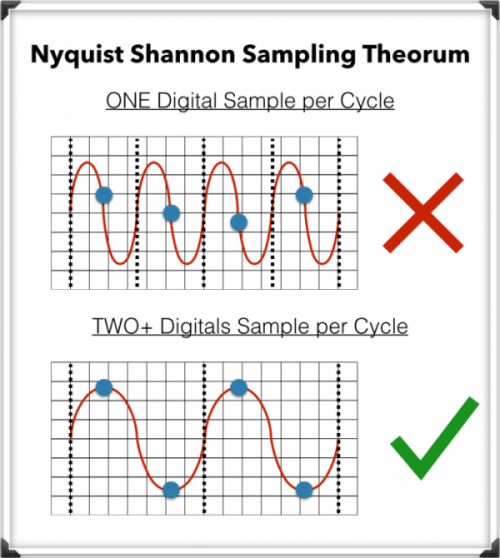
The minimum of 44.1kHz is due to a mathematical principle known as …
The Nyquist-Shannon Sampling Theorem
To record digital audio accurately, converters have to capture the entire human listening spectrum, which is between 20Hz – 20kHz.
According to the Nyquist-Shannon Sampling Theorem …
To capture a specific frequency, at least 2 samples are needed for each cycle … to measure both the upper and lower points of the sound wave.
That means that recording frequencies of up to 20kHz require a sampling rate of 40kHz or more, which explains why the audio CDs are just above that minimum, at 44.1kHz.