
Digital audio information (Part 1)

The history of recording technology
The creation of sound by computer is a modern stage in the history of the development of sound technology. Let’s take a brief look at this story.
Since the late 19th century, the technical means of storing and transmitting information have developed rapidly. So in the late 1800s, the famous American inventor Thomas Edison made a phonograph.
The principle of operation of the phonograph is as follows. Speech, music, or song create sound vibrations that are transmitted to the recording pen of the phonograph. The needle, acting on the surface of the rotating wax roller, leaves in it a groove with variable depth: a sound track. When a sound is reproduced, the opposite process occurs: the movement of the reading needle along the soundtrack is accompanied by its oscillations with the same frequency. These vibrations are converted by the phonograph into an audible sound. The Edison phonograph is the first sound recording device.
The same idea served as the basis for the production of celluloid gramophone records and mechanisms that reproduce the sound recorded on them: gramophone and gramophone.
In the middle of the 20th century, an electrophone appeared, an electrical analog of a gramophone.
Analog sound representation
The soundtrack of a phonograph record is an example of a continuous form of sound recording.
The electrical signal is transmitted to the speaker of the microphone and converted into sound.
In the 20th century, the tape recorder was invented, a device for recording sound on magnetic tape. It also uses an analog form of audio storage. Only now the soundtrack is not a mechanical “pit groove”, as shown in fig. 1.1, and a line with continuously changing magnetization. With the help of a magnetic reading head, an alternating electrical signal is generated, which is emitted by an acoustic system.
Until recently, all sound transmission technology was analog. This is both telephone communication and radio communication. During a telephone conversation, the sound vibrations from the microphone membrane are converted into an alternating electrical signal that is transmitted through electrical cables. On the receiving phone, they become sound.
Audio encoding and processing
Sound information. Sound is a wave that travels through air, water, or other medium with a continuously varying intensity and frequency.
A person perceives sound waves (air vibrations) with the help of hearing in the form of sound of different volume and pitch. The greater the intensity of the sound wave, the louder the sound, the higher the frequency of the wave, the higher the pitch of the sound.
Dependence of the volume and pitch of the sound on the intensity and frequency of the sound wave.
The human ear perceives sound at a frequency of 20 vibrations per second (low sound) to 20,000 vibrations per second (high sound).
A person can perceive sound in a wide range of intensities, in which the maximum intensity is 1014 times greater than the minimum (one hundred thousand billion times). To measure the volume of sound, a special unit “decibel” (dbl) is used (Table 5.1). A decrease or increase in sound volume by 10 dB corresponds to a decrease or increase in sound intensity by 10 times
Sound volume
Sound volume in decibels:
-Lower limit of human ear sensitivity 0
-Rustling leaves 10
-Talk 60
-90 car horn
-120 jet engine
-Pain threshold 140
Sound time sampling. (Part 1)
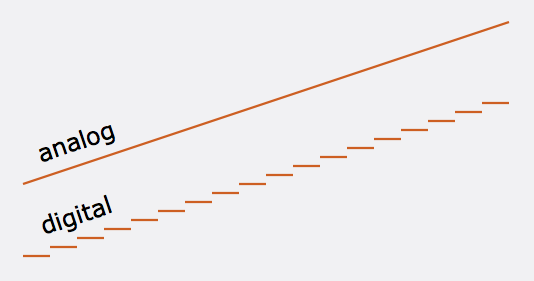
In order for a computer to process sound, a continuous audio signal must be converted to a discrete digital form using time sampling. A continuous sound wave is divided into separate small time sections, for each section a certain value of sound intensity is set.
Therefore, the continuous dependence of the loudness of the sound at time A (t) is replaced by a discrete sequence of loudness levels. On the graph, this appears to replace a smooth curve with a sequence of “steps”).


