Audio sample rate and bit depth – in simple, understandable language


Free Download Mp4Gain
picture

Audio sample rate and bit depth – in simple, understandable language

Bit Depth and Sample Rate

What is the sample rate (sample rate)? What is bit depth?

Sample Rate & BitDepth

Even if you are not dealing directly with digital sound recording, you will be interested!

Are you new to the world of digital music? Not sure what all these designations and complex numbers mean?

Hmm, no wonder! After all, every day there is more and more information. And knowing everything is almost impossible.

Yes, this is not necessary! You need to know the essentials.

Sample rate and bit depth are sound engineering concepts that you should know if you decide to make music in a computer environment.

Even if you haven’t had to record music in a virtual environment yet, but have dealt with audio (be it on a portable digital player, a player on a computer, or elsewhere), you may have seen some numbers in the properties of audio: “16 bit, 24 bit, 44100 Hz, 48000 Hz …”

The material is presented briefly and is accessible even to the uninitiated. Just the essentials.

So what are sample rate and bit depth? What is it for?

To begin with, we agreed that in different sources you can find: Sample rate and Sample rate. The abbreviations are equivalent. Call it what you like the most.

And bit and bit depth. It’s the same, the same, it just sounds different.

So.

Sample rate (sample rate) …

All inanimate music (music produced by a computer, music center, etc., that is, not live) has this parameter. This is the number of samples per second. Without going into details, I will say that 44100 Hz is optimal for humans. Since at a higher value, the sounds to be sampled will be practically inaccessible to our ears, we will simply not hear them, because they will be out of earshot.

I’ll explain a bit more in datell about sample rate. Discrete means discontinuous. That is, the sampling process is the processing of each bit of information one by one (that is, discretely and not all at once). In our case, this happens 44100 times per second. By Nyquist’s theorem, the required sampling rate for normal perception should be twice the hearing threshold. Since an average person listens up to 16 KHz (KiloHz or 16000 Hz), and something (normal for a healthy young person) up to 20 KHz, the sampling frequency was determined at 44.1 KHz (44100 Hz), that is, twice the threshold. audibility of the human ear. Why not 40 kHz (40,000 Hz)? Taken with margin (nobody canceled errors and noise on the route and after the CD release).

I hope everything is clear now.

The bitness (Bitness) is a kind of resolution of these same samples. Why am I calling this permission? Just so you prefer to understand by analogy what is what.

Grab your monitor – the higher the resolution, the better the picture, right? At low resolution you will see individual pixels and the eye will no longer be happy as before. I smile

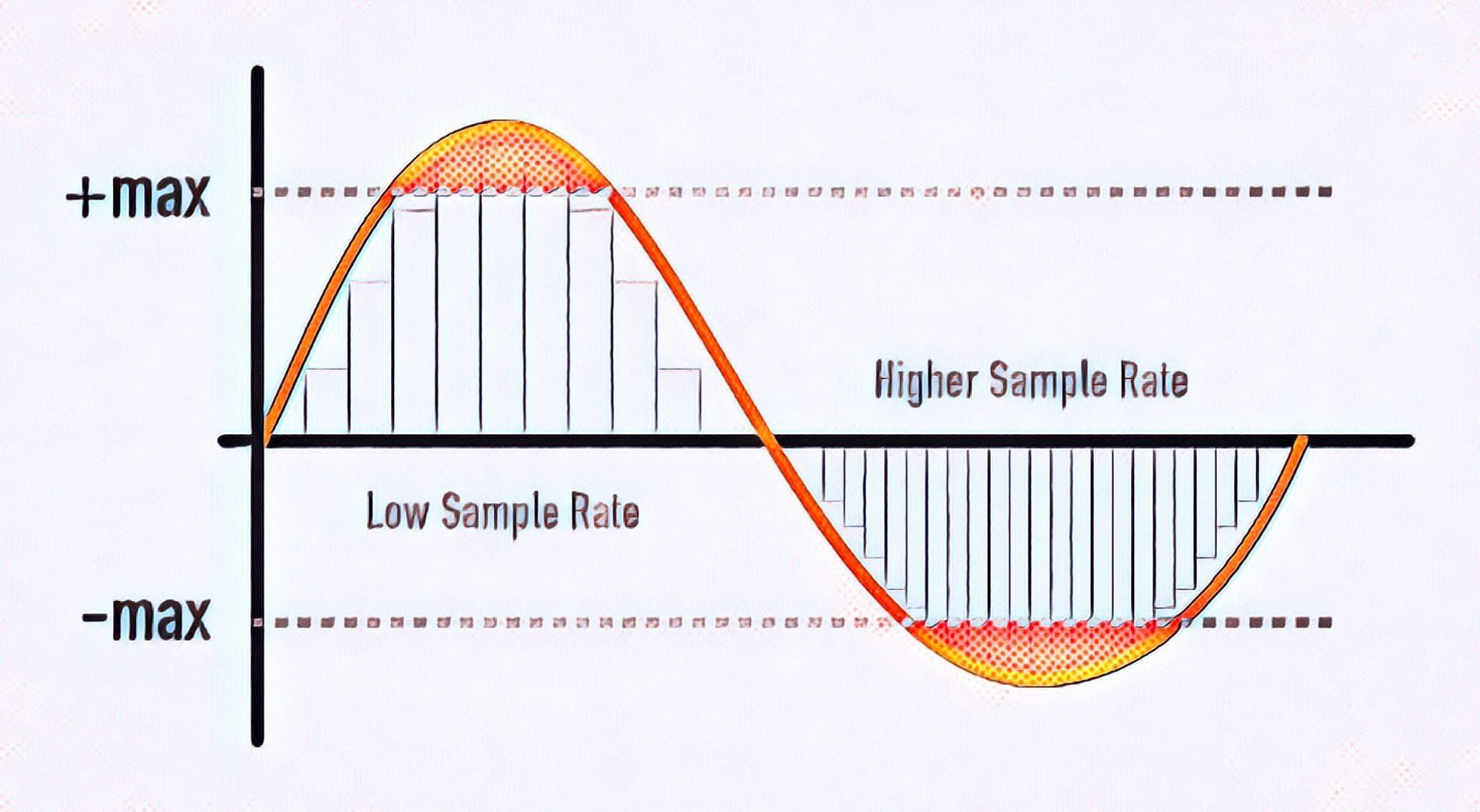
Bitness is dynamic range, that is, the oscillation of your audio up and down (in terms of volume, power, so to speak), the nuances of performance.

The higher the audio bit rate, the more space the audio will occupy on your hard drive (on your computer); keep in mind.

For projects that are important to you, I advise you to use 24 bits and a sample rate of 48000 Hz. THIS IS A STANDARD. Then, for CD output, it will be possible to downgrade the data to 16 bits and 44.1 kHz.

But some people prefer to work on 24/96 (24 Bits – bit depth, 96 KHz – sample rate) or 24 / 88.2. The taste and the color …

For most projects, 16 / 44.1 is adequate (16 bit – bit depth, 44100 Hz is equivalent to 44.1 KHz – sample rate).

The sample rate and bit depth go directly next to each other and never go alone. That is their destiny.


Free Download Mp4Gain
picture


Mp4Gain Main Window
picture


Mp4Gain Features
picture


Free Download Mp4Gain
picture

Why is 44,100 used as the high quality sample rate?

Why is 44,100 used as the high quality sample rate?

Sample Rate

Why did we choose 44.1 kHz as the recording sample rate?

Sample Rates

People’s ears hear a sound whose frequency varies between 20 Hz and 20 kHz. By Nyquist’s theorem, the recording speed must be at least 40 kHz. Is this the reason for choosing 44.1 kHz?

Explain in more detail, the sample rate means how many “frames” should be recorded per second to have high quality audio.
According to the famous theorem created by a famous scientist named Nyquist, the sampling frequency must be at least twice the maximum frequency that we will record … then, as the human ear can hear approximately 20 kHz at most, twice that would be 40,000 per which was proposed 44,100 as a standard sampling frequency for high fidelity audio.

It is true that, like any convention, the choice of 44.1 kHz is something of a historical accident. There are several other historical reasons.

Of course, the sample rate must be higher than 40 kHz if you want high-quality audio with a 20 kHz bandwidth.

How to make 48.0 kHz was discussed (this matched well with 24fps and supposedly 30fps movies on North American television), but given the physical size of 120mm, there was a limit to the amount of CD data that could be stored and what an error detection and correction scheme is needed that requires some data redundancy, the amount of logical data that a CD can store (about 700MB) is about half of the physical data. With all of this in mind, at 48 kHz, we were told that it cannot hold all of Beethoven’s 9s, but that it can hold all of 9 on one record at a slightly slower speed. So 48 kHz is not.

However, why 44.1 and not 44.0 or 45.0 kHz or some nice round number?

Then in the late 1970s, there was a product called the Sony F1, designed to record digital audio onto readily available videotape (Betamax, not VHS). It was at 44.1 kHz (or more precisely 44.056 kHz). Thus, it will facilitate the transfer of recordings without oversampling and interpolation from F1 to CD or in the other direction.

My understanding of how this turns out is that the horizontal scan speed of the NTSC TV was 15,750 kHz and 44.1 kHz is exactly 2.8 times. I’m not entirely sure, but I think this means you can have three pairs of stereo samples per horizontal line, and for every 5 lines where you would normally have 15 samples, there are 14 samples plus an extra sample for some checking. for parity or redundancy in F1. 14 samples for 5 lines is the same as 2.8 samples per horizontal line and 15,750 lines per second, which is 44,100 samples per second.

With the transition to digital formats, audio was stored in the form of pseudo-video, which could be viewed as black or white (representing a binary format).

The frequency and field structure used by the television standard is as follows for 60 Hz video: 245 lines per field (excluding the first 35 skipped lines). With three samples per line, that is 60 x 245 x 3 = 44100 = 44.1 kHz.

This convention was later used for the CD format due to hardware compatibility issues (the first computer used to make master CDs used for CD replication was video-based).

Now, with the advent of color television, they’ve had to slow the horizontal line speed a bit to 15,734 lines per second. This setting results in 44,056 samples per second on the Sony F1.

Sampling frequency.

Sampling frequency.

Sample Rate

What is its importance for sound recording?

Sample Rate

Time sampling is a process that is directly related to the conversion of an analog signal to digital. Along with it, the data is quantized in amplitude. Time sampling means measuring a signal at the time of its entire transmission.

A sample is taken as a unit. If in words this is not entirely clear, then in an example it seems more convincing. Let’s say the sample rate is 44100 Hz, the same as that used on audio CDs.

This means that the signal is measured 44100 times in one second.

An analog signal is always higher in saturation than a digital one. And its transformation is an inevitable loss of quality.

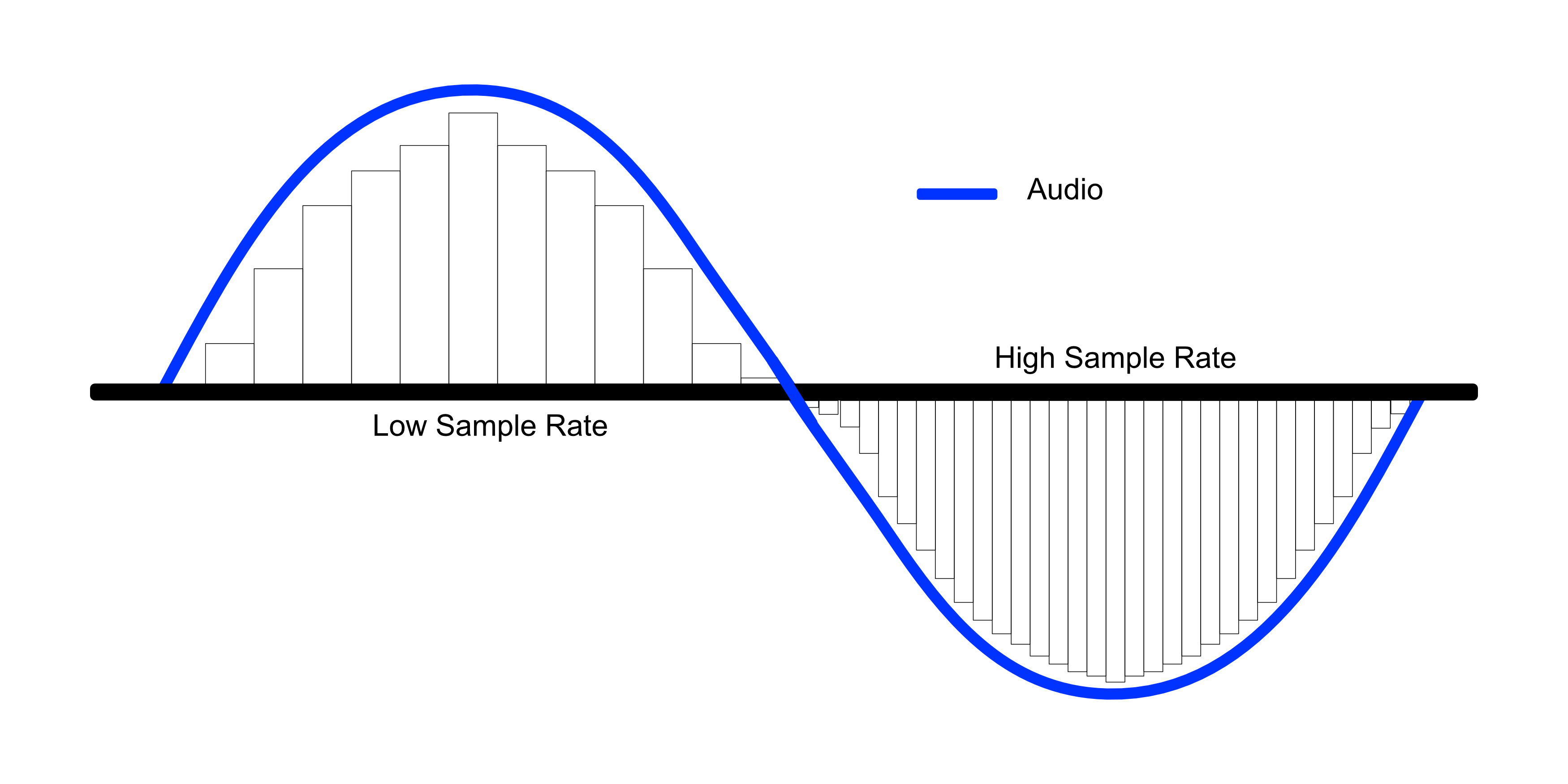
The sample rate serves as a kind of benchmark: the higher it is, the closer the digital sound quality is to analog. This is clearly visible in the list below. Shows which sound frequency is best.

As you study it, you will see a direct relationship between sampling and track quality:

1,8000 Hz. This frequency is typical for telephone conversations and voice recording on a dictaphone with a simple set of functions. It is used in audio converted through the Nellymoser codec.
2. 22050 Hz is used in broadcasting.
3.44100Hz. As mentioned above, this frequency is typical for audio CDs, and this figure has long been identified with the highest quality level. And today the format does not lose its positions.
4.48000 Hz. These are the DAT and DVD formats, which have replaced AUDIO.
5.16000 – DVD-Audio MLP-5.1.
6.2822 400HZ is a high-tech Super Audio SACD format.
Also read 3D Builder Windows 10 what it is
The list clearly indicates which sound frequency is the best. In addition, technologies do not stop and new formats appear.

But before making far-reaching plans, a very significant nuance must be taken into account.

Its essence is simple: the higher the sampling frequency, the more difficult it is to achieve it technologically. This requires:

Provide high intensity transmission of digital streams. And this is not possible on all interfaces. And the more channels are involved in the recording (which is typical for musical ensembles), the more complicated the process will be;
be armed with a processor capable of powerful computing operations. But even with the most advanced examples, the possibilities for ultra-high quality sound are limited;
Use it to record computer equipment with a large amount of RAM.
Considering the above information, it is not surprising that the sound frequency equal to 44100 Hz is still the most in demand today.

It has been meeting even the most demanding quality requirements for decades, and at the same time there are all the technical possibilities to achieve it. This last factor is decisive for both normal users and most recording studios.

Even knowing what the best sound frequency is, to achieve this, it is necessary to take care of the technical equipment.

Sample rate, a clear explanation about what the sample rate is

Let’s proceed in order and start from the sampling frequency, defined as the number of times per second in which our AD converter will measure the electrical signal placed at its input: it is measured in Herz (Hz).

Obviously, the greater the number of “photographs” that we take of our electrical signal in one second, the greater its fidelity to the “original” sound wave. At the same time, obviously, our converter will be obliged to spend a greater amount of “energy” (faster information processing speed, greater storage space, etc.) which therefore translates into a different quality of components and obviously at a higher cost.

La tasa de muestreo

Sampling rate

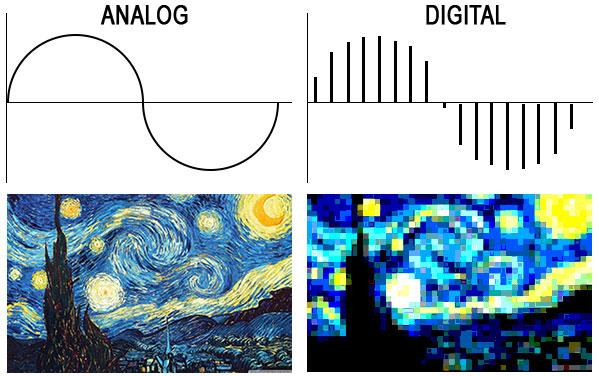
On the left an analog wave (a sine wave) in the time / amplitude domain and an image of Vincent Van Gogh’s “Starry Night” which, for our teaching purposes, we intend to be very high resolution. On the right, a quick reconstruction of the same sampled analog waveform and the same photograph reproduced with a much smaller number of pixels.

Well, if it were that simple, there wouldn’t be a bit of fun. Let’s go back to the diagram of the AD converter at the end of the previous article. Surely you have noticed that the first block through which our signal passes is the so-called “Anti-aliasing filter”, nothing less than a low pass filter.

Coooooooooooosaaaaaaaaaaaaaaaaaa !? Do we want to faithfully reproduce our signal in the digital domain and the first thing we do is pass it through a filter to change its frequency component (remove all components above a certain frequency)?

Yes my dear … you need to share a minimum (but I swear, a minimum) of signal theory to tell you a bit about the “Nyquist-Shannon Sampling Theorem” (for the “fetishists” – no offense, for course …. I am also part of it: of the mathematical treatment, take a look at the related Wikipedia page where you can find a good perspective), based on which, to sample an analog signal without loss of information (that is, to be able to re-enter it – then convert it DA – into the analog domain without “noticeable” differences compared to the original signal) it is necessary that the number of samples taken per second (the sampling frequency) is at least twice the maximum present frequency into the signal to be sampled, Therefore, it is worth introducing frequencies in the digital signal that do not exist in the original analog signal (the calls, and hence the filter name, alias frequencies).
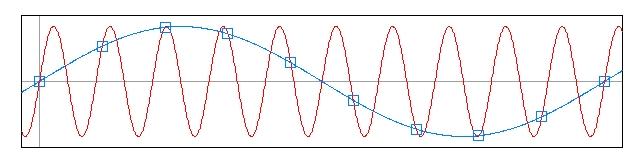
The aliasing phenomenon occurs because we do not have enough samples to describe the trend of the higher frequencies, which are therefore translated into the digital signal as lower frequencies, although nonexistent in the original signal. See this beautiful image always taken from the omniscient Wikipedia. In red the sinusoid sampled at intervals not sufficient to reconstruct it, and in blue the frequency alias (lower) that originates from the points we have taken.

La tasa de muestreo

Sampling rate

As we already know, the human ear is sensitive, at most (at an early age and in good hearing health), to frequencies around 20 KHz; In theory, our anti-aliasing filter should be set at 40,000 Hz and that should be our sample rate, but since it is practically impossible to build a filter with such a steep slope in analog, we opted for a filter with less steep slope and so both leaves the signal to sample frequencies slightly higher than 20,000 Hz (which we don’t hear, but there are), sampling at a slightly higher frequency. Therefore, the minimum sample rate used is equal to 44,100 samples per second.

Obviously, technological development and, nevertheless, the opinion and experience of many professionals (which I personally share very modestly) have in any case led to the awareness that, having set the minimum limit of 44,100 Hz (we will see later, it is the sampling frequency of the files that make up an audio CD), sampling at higher frequencies certainly leads to better results both from the point of view of signal manipulation (passing through a plug-in, the sum of two or more signals within a DAW, etc.) and from a listening point of view.

Later we will return to the topic, we will develop it further and we will begin to understand the logic with which the converter assigns a value in “machine language” to the different samples taken during the sampling phase.