Sample rate and bit rate

The compression ratio of audio encoding is determined by the bit rate at the time of encoding.

Last time I mainly wrote about the original sound bit rate (PCM), but this time I would like to write about the bit rate and compression rate of the encoding.
Specifically, setting a lower bitrate will increase the compression ratio and reduce the size of the file when it is saved. As I wrote last time, the bit rate of the sound source (PCM) before compression is as follows.
PCM bit rate = sample rate (Hz) x number of quantization bits x number of channels
For example, a music CD has the following 44.1 kHz stereo bit rate.
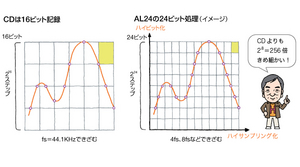
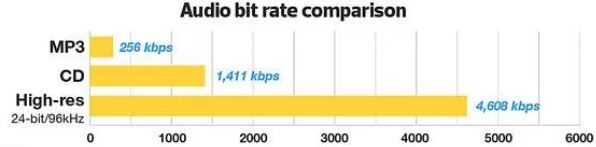
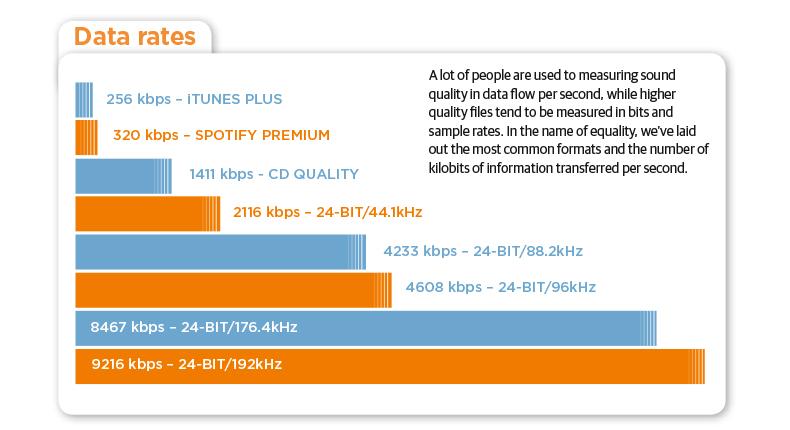
Music CD bit rate: 44100Hz x 16bit x 2ch (stereo) = 1411.2kbps
If it is encoded with MP3, AAC, etc., for example 256 kbps, the compression rate (assuming the original sound is 100%) is approximately 18% and the file size is 1/5 or less.
Encode Music CDs at 256 kbps: 256 kbps / 1,411.2 kbps = approximately 18%
If it’s 4 minutes of music, the file size is as follows.
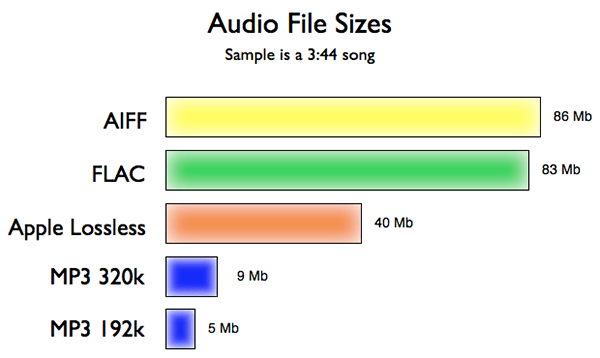
Original sound: 1,411.2 kbps x 240 seconds = approximately 40.4 MB
Encode at 256 kbps: 256 kbps x 240 seconds = approximately 7.3 MB (+ header)
If a song is about 4 minutes long, 16 songs can be saved on CD650MB as original sound, but if it is encoded at 256 kbps as MP3 or AAC, 89 songs can be recorded.
Original sound: CD650MB / 40.4MB = about 16 songs
256 kbps encoded: CD650MB / 7.3MB = approximately 89 songs
If you check the web, you can compare the sound quality due to the difference in the bit rate. I think all the conditions are the same except the bit rate, but first of all there is a difference in the sound quality depending on the sample rate of the original sound source (PCM) and the number of quantization bits (the bit rate of the original sound changes). At the time of analog to digital conversion (ADC), the sound quality is determined by the conditions. No matter how high the bit rate is encoded for a sound source in poor condition, the sound quality is still poor. Even with the same bit rate, the compression rate changes depending on the number of channels (stereo or monaural). Therefore, strictly speaking, the evaluation of the sound quality cannot be judged only by the difference in the bit rate.
For example, when 48 kHz and 44.1 kHz 16-bit PCM is encoded at 32 kbps to 320 kbps, the compression ratio is as follows.
16-bit PCM compression ratio (when original sound is 100%)
Encoded bit rate 48 kHz stereo (1,536 kbps) 48 kHz monaural (768 kbps) 44.1 kHz stereo (1,411.2 kbps) 44.1 kHz monaural (705.6 kbps)
320 kbps 320/1536 = about 21% About 42% 320 / 1,411.2 = about 23% About 45%
256 kbps 256/1536 = about 17% About 33% 256 / 1,411.2 = about 18% About 36%
192 kbps 192/1536 = about 13% About 25% 192 / 1,411.2 = about 14% About 27%
160 kbps 160/1536 = about 10% About 21% 160 / 1,411.2 = about 11% About 23%
128 kbps 128/1536 = about 8% About 17% 128 / 1,411.2 = about 9% About 18%
64 kbps 64/1536 = about 4% About 8% 64 / 1,411.2 = about 5% About 9%
32 kbps 32/1536 = about 2% About 4% 32 / 1,411.2 = about 2% About 5%
Comparison with the original sound
It’s a bit of a twisted idea, but for example, which one is closer to the original sound, stereo or monaural in the above conditions?
Considering the compression ratio, it is the latter. Of course, stereo is superior to monaural in terms of expression, like expressing the depth of sound, so it makes sense to compare this and evaluate the sound quality, but in encoding, compression is done efficiently using stereo. Since there are algorithms (Stereo M / S and Stereo Intensity), the quality is not half that of monaural and the stereo is compressed efficiently.