
PCM conversion flow
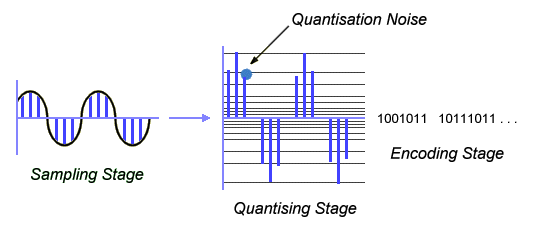
Let’s summarize how analog music signals are digitized in PCM and burned to CD. PCM is an abbreviation for pulse code modulation. In Japanese, it translates to pulse code modulation method.
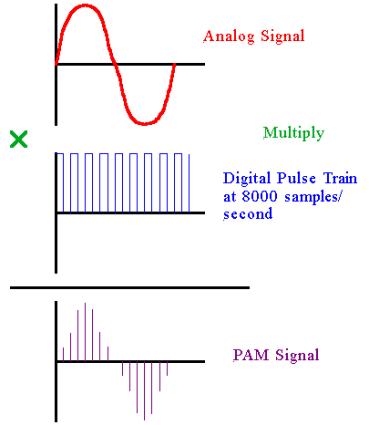
The music signal is originally a continuous analog signal. A continuous waveform that ripples like a wave will not fit in the hole of a CD as is, so test it first. What part of the rippling wave should be used as a sample? Of course, it is necessary to have regular intervals, and in the case of CD, it is decided to sample at 44.1 kHz. kHz is a unit of frequency and is the number of repetitions per second. We’re going to sample at a tremendous rate of 44,100 times per second. The job of sampling is sampling, and it does not mean that the waves are crushed separately.
After sampling in the direction of the time axis in this way, the next step is how to read the discrete data (points) with what precision. This is the quantification. It’s not used often, but in English it’s called quantizing. Since the vertical axis of the graph is the signal level, that is, the magnitude, the precision point is how many steps to read to the highest point of the wave. The unit is the number of bits.
The bits are a binary number in the digital count. Binary numbers are a game, and as the number of bits increases, the number that can be expressed at an accelerated rate increases (number of steps = sampling precision). The calculation is “2 raised to the power of the bits.” For example, 3 bits would have 2 x 2 x 2 = 8 steps, but 5 bits would have 2 x 2 x 2 x 2 x 2 = 32 steps. It seems that it will be incredible if we continue like this. Yes, 16 bits is 2 to the power of 16, so multiply 2 16 times to get 65536 steps. Remember the “65,000 steps”.
Still, it’s not analog per se, but if you play it on a CD player it will play the original continuous analog wave, which is why digital is Erai. Actually, after quantization, the encoding work is done and a 16-bit PCM digital signal is obtained as “010011 … 10”.
Digital is strict and, in fact, there are some rules. It is often said that “CD has a frequency range of 20 kHz and a dynamic range of 96 dB”. This is determined solely by the format. To put it bluntly, the 20 kHz high-frequency range comes from the sample rate, while the 16-bit quantization defines the D range as 96 dB.
It’s kind of logical, but it’s called “Shannon’s Sampling Theorem (Erai scholar)”, and it can record high frequencies up to almost half the sampling frequency (fs). For quantization, there is a guideline of 6 decibels per bit, which is 6 x 16 = 96 decibels.


