Psychoacoustics – highlights
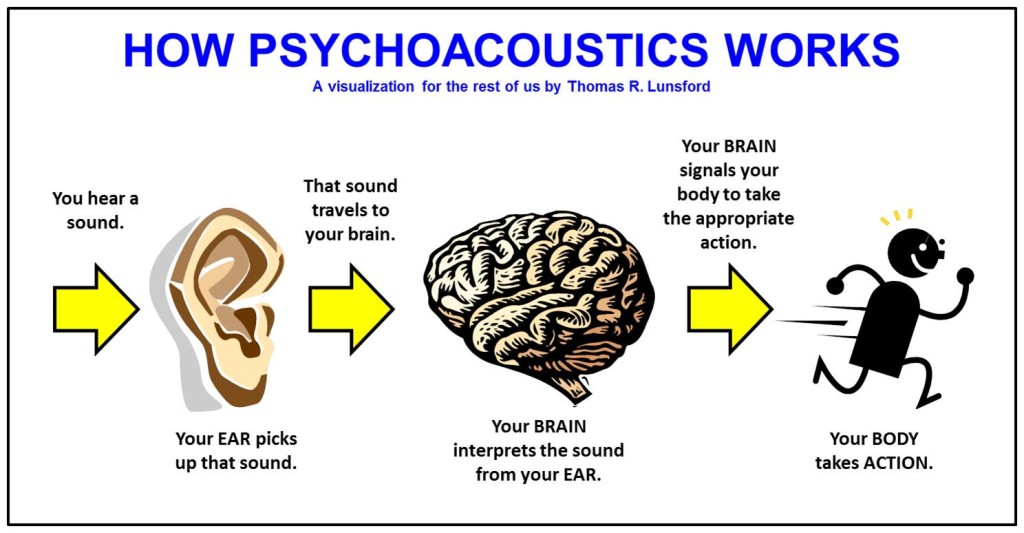
Psychoacoustics deals with the study of the mechanisms of perception of auditory information and its interpretation by the human brain.
The results obtained in the framework of various studies in this area served as the basis for the development of numerous technologies that have changed our lives in many ways. Among the most striking examples are several audio codecs, such as the well-known MP3. Internet telephony (Skype) and even mobile communications also owe their wide dissemination to research in the field of psychoacoustics.
DF Mechanism
To locate sound sources in space, using exclusively the auditory system, the human brain applies several basic principles that provide it with enough information to draw certain conclusions and make a certain decision. The main condition for this is the presence of two separate discrete receivers, which are the listener’s ears.
mechanisms of psychoacoustics
To more clearly illustrate how this works, imagine a situation where the sound source is to the left of the listener.
Time factor – ITD (interaural time difference)
The acoustic signal from the sound source will reach the right ear somewhat later than the left, since the latter is closer to the sound source. This distance (12-17 cm, depending on the size of the head) is sufficient for the brain to record the resulting time delay between two discrete receptors.
Intensity factor – IID (Interaural Intensity Difference)
The sound pressure directly on the eardrum of the left and right ear is slightly different, depending on which is closer to the sound source. The sound pressure at the eardrum of the left ear will be slightly higher than that of the right. This difference indicates the direction of the sound source.
Spectral factor
The spectral component of the acoustic signal reaching the left and right ears also differs depending on the location of the sound source. Especially high frequencies, due to the short wavelength, are shaded by the head and lose energy. In situation A, the acoustic signal reaching the listener’s right ear will contain slightly less energy in the high frequency range than that reaching the left.
The combination of the above principles allows us to orient ourselves in the ear space and plays an important role in the ability to locate sound sources in space. Every time we hear something, our brain involuntarily performs an analysis and we easily and without even thinking determine the direction from which the sound is coming.
For more information on this topic, I recommend watching the YourSoundPath video series dedicated specifically to this topic.
The mechanism for determining the distance from the sound source and the characteristics of the room.
To determine the distance from the sound source, the auditory system uses other methods. The main thing here is to determine the relationship between the fraction of the direct signal energy and the fraction of the reflected energy. The more reflections that reach the listener’s ears in the acoustic signal, the further away the sound source is. In this case, when reaching a certain radius, beyond which the ratio of reflections prevails over the energy of the direct signal, this method is no longer effective.
By analyzing the time interval between the direct signal and its reflections, the brain can draw conclusions about the distance from a reflective surface, for example, a wall, and its acoustic properties, for example, the material (concrete, glass, carpet) and the surface structure (smooth, non-uniform), etc. This is also facilitated by spectral analysis of the reflections and their density. The more diffuse they are, the more heterogeneous should be the reflective surface from which they are reflected.