What is the difference between 128k and 320k music? Part 2


Free Download Mp4Gain
picture

What is the difference between 128k and 320k music? Part 2

DJs: Understanding Bitrate & Audio Quality - On The Rise DJ Academy

Bit Rate, Sample Rate, Lossless, MP3, FLAC, APE, 320kb, 192kb, 128kb, 44.1khz, CBR, VBR. Does this bunch of various names make you both familiar and unknown?
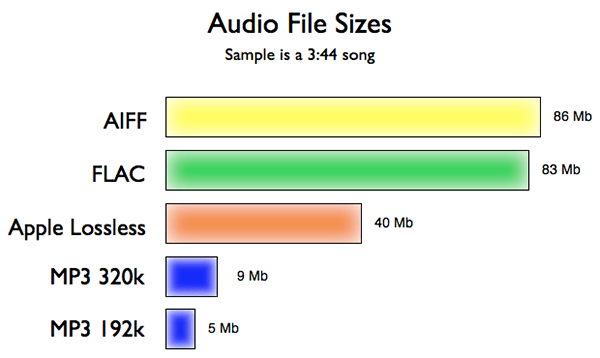
Audio File Sizes
Audio File Sizes

The higher the bitrate, the better the sound quality. Lossless music is the highest sound quality, right? So, let’s start with the sound collection.

【Audio composition】

Nowadays, when we talk about audio, everything is digital audio. Digital audio consists of three parts: sample rate, sample precision, and number of sound channels.

Sample Rate: Both the sample rate, which refers to the number of samples per second when recording the sound, expressed in Hertz (Hz).

Sampling Precision: Refers to the dynamic range of the recorded sound, measured in bits (Bit).

Sound channel: the number of channels (1-8).


In simple terms, we can think of a sound wave as a curve. We know that the curve is made up of points, and the sampling rate is the number of points in the middle of the length per second (the horizontal axis in the figure above). Sampling precision is the number of points in the dynamic range (upper vertical axis). The finer the positioning of these two dimensions, the greater the true sound restoration and the better the sound quality. Of course, the larger the audio file will be. The customer mentioned by the above colleague said that the latest Hi-Res Audio format released by SONY is a 6-channel 192kHz/24-bit recorded audio file. The size of the lossless format, of course, will be more than 200 megabytes.

The sampling frequency is approximately the following depending on the type of use (k is the thousand-bit symbol, 1khz=1000hz):

8khz – used for phones etc, is enough to record human voices.

22.05khz: transmission use frequency.

44.1kb: Audio CD.

48khz: used in DVD and digital TV.

96khz-192khz: used for DVD-Audio, Blu-ray HD, etc.

The common range of sample precision is 8 bits to 32 bits, with 16 bits generally used on CD.

Having said that, my friends are starting to get confused. It’s not the bitrate that determines the sound quality, so why is everyone saying that 320kb sound quality is better than 128kb?


Free Download Mp4Gain
picture


Mp4Gain Main Window
picture


Mp4Gain Features
picture


Free Download Mp4Gain
picture

What is the difference between 128k and 320k music?

What is the difference between 128k and 320k music?

Mp3 Bit Rate
Mp3 Bit Rate

192k is a turning point. Below 192K, the sound quality is relatively damaged, especially the high-frequency part above 16Khz will be cut off.

Mp3 Bit Rate
Mp3 Bit Rate

In short, mp3 above 192k, ordinary home equipment can no longer hear the difference in CD sound quality, except for golden ears and hi-fi equipment. Of course, these data are not 100% reliable. There are always people on the internet sharing fake mp3 above 192K. In fact, they are converting low bitrate music to high bitrate through software, but the sound quality will not improve. Windows Media Player compresses the resulting mp3 is absolutely wonderful. No matter how high the compressed bitrate is, it will cut perfectly at around 16K, so if you want to compress MP3 yourself, don’t use Windows Media Player.


Well, in fact, the bit rate should be said to be another dimension, it is a compression of audio files.

Nowadays, most of the audio formats that we use regularly are based on the original “WAV” file of the audio CD (44.1khz sampling rate, 16bit sampling precision, 2ch). The original recorded sound data is stored in an array, which is in PCM format, while WAV format is an encoding format developed by Microsoft, and its function is to play the PCM format data through encoding.

Since the data in WAV basically completely restores the PCM data, MP3, AAC and other lossless encoding formats are basically recompressed based on the WAV files. Therefore, we can simply think that WAV is the original audio format and other audio formats are compressed formats.

When it comes to compression, storage and transmission are inseparable. The purpose of compression is to improve storage and transmission. Therefore, before we talk about compression, we need to understand the basic units of computers.

We all know that the computer is a binary number system, and the files stored by the computer are made up of two numbers, 0 and 1. Therefore, the computer’s transmission is based on each number, and each number is called 1 ” bit”. For example, for an audio piece, its basic data is “0,1,1,1,0,1, 1 ,0”, and when transmitting, these numbers are transmitted one by one. The sampling precision mentioned above is this unit.

Why are MP3 bitrates often multiples of 32? Part 2

Why are MP3 bitrates often multiples of 32? Part 2

MP3 bitrate
MP3 bitrate


Technically, there is nothing to limit the MP3 bitrate to a multiple of 2, as variable bitrate encoding can be used, or a custom bitrate can be achieved using some flags not used in the MPEG specification (although it must be implemented manually).

MP3 bitrate
MP3 bitrate


For MP3 to be MPEG-compliant, and therefore compatible with most MP3 decoders, it must have a bitrate defined by the specification, so all CBR-encoded MP3 files must have a bitrate that is a multiple of two.

Depending on the resource, VBR can be encoded by changing the bitrate between a fixed rate above each frame, or it can be encoded by sharing the available bits in adjacent frames (effectively generating a non-standard bitrate for the two frames combined). The length of a given frame depends on the sampling rate, there are 1152 samples per frame. There is nothing to limit the size of the frame itself, nor is there any limit to making the frame size base 2 (i.e. a 128 kbit/s MP3 with a 44.1 kHz sample rate would have a frame size of 417 bytes).

In the end, a file encoded at 126 kbps sounds worse than a file encoded at 128 kbps, and likewise a file encoded at 131 kbps sounds better. However, MP3s are encoded for compression according to the psychoacoustic model of a specific encoder. The amount by which a file sounds “better” or “worse” at a given bitrate depends largely on the algorithm used to implement the model; however, in general, higher bit rates can hold more data, likely reproducing Build a more accurate raw stream audio signal

I strongly suspect that the reason the MPEG standard specifies multiples of 2 is because binary computers can often optimize math involving both themselves and programmers.
This is a begging question. Don’t you think there is a mathematical/arithmetic reason for the chosen bitrate value? Or doesn’t the mere presence of VBR justify any limits on possible bitrates?
@slhck I’ve just updated my answer to provide more relevant details, please let me know if this answers all questions.
MPEG 1 Layer-III (mp3) files are streams of frames.

This web page details the data structure of the framework.

As you can see, only 4 bits are allocated to determine the bitrate. When designing a format for live streaming, you don’t want to waste more space than describing the stream.

I’m not sure exactly why 4 bits was determined to be a good compromise between space footprint and “bitrate resolution” – for the particular bitrate chosen, they were probably chosen based on the lowest and highest quality range that the engineer considered acceptable. mp3 algorithm.

Probably most MP3 players read one frame at a time, probably trying to “early” buffer at least one frame when decoding/playing the current frame.

The size of the frame and possibly the RAM allocated to it is as follows:

FrameSize = 144 * BitRate / SampleRate when the padding bit is cleared.
FrameSize = (144 * BitRate / SampleRate) + 1When the padding bit is set.
Higher bit rate/sample rate = more RAM required.

128 Kbps is probably popular as it is the default setting for many encoders.

Also, a colleague gave me insight into the discussion: 128 Kbps also roughly translates to “minutes in a minute” (unverified though), probably has something to do with that as well.

When “raw” data is logged, that data is buffered in chunks. These blocks will obviously be powers of two. It’s conceptually easier if you have an integer number of blocks per second.

Why are MP3 bitrates often multiples of 32?

Why are MP3 bitrates often multiples of 32?

MP3 bitrate
MP3 bitrate

I understand why multiples of 2 are often found on computers due to their binary nature, but I can’t figure out that the most common mp3 bitrates (64kbps, 128kbps, 160kbps, 192kbps, 256kbps, 320 kbps, etc.) also tend to follow this rule.

MP3 bitrate
MP3 bitrate

Since MP3 is just a sequential encoding of sound waves, why does it matter that each second is represented by thousands of digits per second that are divisible by 2?
Do music players like iTunes continue to read the file and play the encoded sound regardless of where the second limit is, or will they read the file every second?
In the latter case, reading a 256kbps file requires slightly fewer memory pages than reading a 257kbps file, but the player can always read 256kbit chunks, regardless of their bitrate, and process them incrementally , it is right?
Is MP3 popular at 128kbps because it’s a generally accepted bitrate, or does it really have some advantages over 126kbps and 131kbps files? Very slight difference in quality/file size?


For constant bit rate (CBR) encoding, the MPEG-1 Audio Layer III standard specifies standard bit rates of 32, 40, 48, 56, 64, 80, 96, 112, 128, 160, 192, 224, 256 and 320 kbit/s. There are other definitions in the MPEG-2 standard, but they’re also all multiples of 2 (actually all multiples of 8 are in the range 8 to 160 – see the table called “Bitrate Index” at the link above ).