How digital compression works. Part 3


Free Download Mp4Gain
picture

How digital compression works. Part 3

DIGITAL COMPRESSION

In most cases, there is another pin, Master Clock (MCLK or MCK), which is used to synchronize the transmitter and receiver from the same clock to reduce the transmission error rate.

DIGITAL COMPRESSION

For the external synchronization of the MCLK, two clock generators are used: with a frequency of 22 579 kHz and 24 576 kHz. The first, 22,579 kHz, is for frequencies that are multiples of 44.1 kHz (88.2, 176.4, 352.8 kHz), and the second, 24,576 kHz, is for frequencies that are multiples of 48 kHz (96, 192, 384 kHz). There may also be generators at 45,158.4 kHz and 49,152 kHz; You’ve probably already noticed how in the digital sound world they like to multiply everything by two.

Frame or I2S frame
Frame or I2S frame
In I2S, three contacts are necessarily used: SCK, WS, SD; the rest of the contacts are optional.

Synchronization pulses are transmitted through the SCK channel, under which the frames are synchronized.

The length of the “word” is transmitted over the WS channel and logical states are also used. If the WS pin is a logical unit, then the right channel data is transmitted, if it is zero, the left channel data is transmitted.

The data bits are transmitted via SD: the values ​​of the amplitude of the audio signal during quantization, the same 16, 24 or 32 bits. No checksums or service channels are provided on the I2S bus. If data is lost in transit, there is no way to get it back.

Expensive DACs often have external connectors to connect to the I2S. The use of such connectors and cables can have a bad effect on the sound, even the appearance of “artifacts” and stuttering, everything will depend on the quality and length of the cable. Still, I2S is a hard-wired connector and the length of the wires from the transmitter to the receiver should tend to zero.

Let’s see how the PCM data stream is transmitted through the I2S bus. For example, when transmitting PCM 44.1 kHz at 16 bits, the length of the word on the SD channel will be these sixteen bits and the length of the frame will be 32 bits (right + left). But most of the time, the transmitters use a 24-bit word length.

When playing PCM 44.1×16, the most significant bits are simply ignored as they are filled with zeros or, in the case of older multi-bit DACs, they can go to the next frame. The length of the “word” (WS) may also depend on the player through which the music is played, as well as the driver for the playback device.

An alternative to PCM and I2S would be to record the audio signal in DSD. This format was developed in parallel with PCM, although Kotelnikov’s theorem also played a role here. To improve sound quality compared to CDDA, the emphasis was not on increasing the quantization bit, as in the DVD Audio format, but on increasing the sample rate.

DSD
DSD stands for Direct Stream Digital. It originates from Sony and Philips labs, however, just like the other formats discussed in this article.

SACD
DSD first saw the light of day on Super Audio CDs in 2002.

At the time, SACD seemed like a masterpiece of engineering, it applied a completely new way of recording and playback, very close to analog devices. The implementation was simple and elegant at the same time.

The media was even equipped with copy protection, although without it, no pirate was afraid. Under the Sony and Philips brands, they began to produce “closed” devices exclusively for playback, with no possibility of copying discs. Manufacturers sold recording equipment to studios, but kept control over the SACD launch.

Who knows, perhaps the SACD format could gain popularity comparable to Audio CD, if it weren’t for the cost of the playback devices. By unreasonably selling out player prices, Sony and Philips’ own leaders hampered the popularity of their format. And the next mistake completely put an end to the sale of specialized devices. To promote Sony’s PlayStation, Sony engineers have added the ability to listen to SACD on it. Hackers immediately hacked the set-top box and began copying SACD discs into ISO images that can be burned to a regular DVD and played on any competing player; others simply ripped out tracks to play on a computer.


Free Download Mp4Gain
picture


Mp4Gain Main Window
picture


Mp4Gain Features
picture


Free Download Mp4Gain
picture

How digital compression works. Part 2

How digital compression works. Part 2

digital compression

The next after CDDA in 1987 appeared the DAT format – Digital Audio Tape.

digital compression

The sample rate was 48 kHz, the quantization bit did not change. And although the format failed, the 48 kHz sample rate took hold in recording studios, as they say, due to the convenience of digital processing.

In 1999, the DVD-Audio format was released, which made it possible to record on a disc six stereo tracks with a sampling frequency of 96 kHz and a 24-bit bit depth, or two stereo tracks with a frequency of 192 kHz, 24 bits.

In the same year, the SACD – Super Audio CD format was introduced, but the discs began to be produced only three years later. I will tell you more about this format in the DSD section.

These are the main formats that are considered the standard for digital audio recordings on media. Now let’s see how data is transmitted on a digital audio path.

The structure of the digital audio path.
When playing music, something like the following happens: the player, using a codec created in the form of a device or program, decompresses the file into a specific format (FLAC, MP3 and others) or reads data from a CD, DVD-Audio or disc SACD, receiving a standard PCM data stream … This stream is then transferred via USB, LAN, S / PDIF, PCI, etc., to the I2S converter. In turn, the converter converts the received data into so-called I2S data interface frames (not to be confused with I2C!)

I2S
I2S is a digital audio transmission serial bus. Now I2S is a standard for connecting a signal source (computer, turntable) to a digital-to-analog converter. It is through it that the vast majority of the DAC connects directly or indirectly. There are other digital audio transmission standards, but they are much less common.

I2S output (input) on PCB
Other articles in this issue:
Xakep # 256. Fight Linux
Broadcast content
Subscription to “Hacker”
The I2S bus can consist of three, four, or even five pins:

continuous serial clock (SCK) – bit sync clock (can be called BCK or BCLK);
word selection (WS) – frame sync clock (may be called LRCK or FSYNC);
Serial data (SD): transmitted data signal (can be called DATA, SDOUT, or SDATA). As a general rule, data is transmitted from a transmitter to a receiver, but there are devices that can act as a receiver and transmitter at the same time. In this case, another contact may be present;
Serial data in (SDIN): On this pin, data moves in the receive direction, not the transmit direction.
SD or SDOUT is used to connect a D / A converter, and SDIN is used to connect an A / D converter to the I2S bus.

How digital compression works.

How digital compression works.

Digital Compression

Have you ever wondered how sound is reproduced on digital devices?

Digital Compression

How is a sound signal formed from a combination of ones and zeros? I’m sure I was thinking, since I started reading! But often, even professionals only have a general idea of ​​the modern sound route. In this article, you will learn how the different formats appeared, what a digital-to-analog converter is, what types of DACs exist, and what determines the quality of sound reproduction.

PCM
As you know, in digital audio, almost any format, with rare exceptions, is recorded using a pulse code stream or a PCM stream – pulse code modulation. FLAC, MP3, WAV, Audio CD, DVD-Audio and other formats are just ways to package, “preserve” a PCM stream.

How it all began
The theoretical foundations of digital sound transmission were developed at the dawn of the 20th century, when scientists tried to transmit an audio signal over a long distance, but not by telephone, but in a rather strange way for that time.

By dividing the sound wave into small parts, it could be sent to the receiver in some kind of mathematical representation. The recipient, in turn, could restore the original waveform and listen to the recording. In addition, scientists were faced with the task of increasing the bandwidth of the “ether”.

In 1933, the theorem of V.A. Kotelnikov. In Western sources, it is called the Nyquist-Shannon theorem. Yes, Harry Nyquist was the first to raise this issue: in 1927 he calculated the minimum sampling frequency to transmit a waveform, which later got his name “Nyquist frequency”, but Kotelnikov’s theorem was published 16 years ago before.

The essence of the theorem is simple: a continuous signal can be represented as an interpolation series consisting of discrete reports, from which the signal can be reconstructed. In order to roughly restore the original state of the signal, the sampling frequency must be at least twice the upper cutoff frequency of this signal.

For many years, the theorem was not in demand, until the advent of the digital age. It was then that it found a use. In particular, the theorem was useful when developing the CDDA (Compact Disc Digital Audio) format, in common people it is called Audio CD or Red Book. The format was released by engineers at Philips and Sony in 1980 and became the standard for audio CDs.

Format characteristics:

sampling frequency – 44.1 kHz;
quantization capacity – 16 bits.

INFO
The sampling rate is the number of signal samples taken during your sampling. Measured in Hertz.
Quantization bit: the number of binary bits that express the amplitude of the signal. Measured in bits.
The 44.1 kHz sampling frequency was calculated from Kotelnikov’s theorem. It is believed that the hearing of the average person cannot pick up sound beyond 19-22 kHz. The frequency was probably 22 kHz and was chosen as the upper limit.

22,000 × 2 = 44,000 + 100 = 44,100 Hertz

Where does 100 Hertz come from? There is a version that this is a small margin in case of errors or oversampling. In fact, Sony chose this frequency for its compatibility with the PAL transmission standard.

The bit depth of the CDDA format is 16 bits, or 65,536 samples, which equates to a dynamic range of approximately 96 dB. Such a large number of samples were not chosen by chance. Firstly, due to the strong influence of quantization noise, and secondly, to provide a formal dynamic range superior to that of the main competitors at the time – cassette records and vinyl records. I’ll cover this in more detail in the section on digital to analog converters.

The development of PCM continued on the principle of multiplying by two. Other sample rates appeared: first, the 48 kHz sample rate was added, and then the frequencies based on it were 96, 192, and 384 kHz. The 44.1 kHz frequency was also doubled to 88.2, 176.4, and 352.8 kHz. Bit depth increased from 16 to 24 and then to 32 bits.

Audio encoding: secrets revealed

Audio encoding: secrets revealed

Digital Audio

Audio settings for video capture and transmission.

Digital Audio

As people directly related to the AV sphere, we constantly talk about audio coding and audio codecs, but what is it? An audio codec is essentially a device or algorithm that can encode and decode a digital audio signal.

In practice, the audio waves that travel through the air are continuous analog signals. The signals are converted to digital form by a device called an analog-to-digital converter (ADC), and the reverse converter is called a digital-to-analog converter (DAC). The codec lies between these two functions and it is he who allows you to adjust some important parameters for the successful capture, recording and transmission of an audio signal: the codec algorithm, the sampling frequency, the bit width and the speed of the audio signal. data.

The three most popular audio codecs are Pulse-Code Modulation (PCM), MP3, and Advanced Audio Coding (AAC). The choice of codec determines the compression rate and the recording quality. PCM is a codec used by computers, CDs, digital phones, and sometimes SACD. The PCM signal source is sampled at regular intervals, and each sample is the digital amplitude of the analog signal. PCM is the simplest option for digitizing an analog signal.

With the correct parameters, this digitized signal can be fully converted to analog without any loss. But this codec, which provides almost complete identity with the original audio, is unfortunately not very cheap, which results in large files, and these files are not suitable for streaming. We recommend using PCM to record digital images for your sources or when doing audio post-processing.

Fortunately, we always have the option of choosing a different codec that can compress digital data (versus PCM) based on some helpful observations on the behavior of sound waves. But in this case, you have to make a compromise: all alternative algorithms are associated with “losses”, since it is impossible to completely restore the original signal, but nevertheless the result is still so good that most users will not be able to to catch the difference.

MP3 is an audio encoding format that uses a digital data compression algorithm that allows you to save the audio signal in smaller files. The MP3 codec is the most used by users to record and store music files. We recommend using MP3 to stream audio content as it requires less network bandwidth.

AAC is a newer audio encoding algorithm that is the successor to MP3. AAC has become the standard for MPEG-2 and MPEG-4 formats. In fact, this is also a digital data compression codec, but with less quality loss than MP3 when encoded with the same bit rate. We recommend using this codec for online streaming.

Sampling frequency (kHz, kHz)
Sample rate (or sample rate): the frequency with which the signal is digitized, stored, processed or converted from analog to digital. Time sampling means that the signal is represented by several of its samples (samples) taken at regular intervals.

Measured in hertz (Hz, Hz) or kilohertz (kHz, kHz,) 1 kHz equals 1000 Hz. For example, 44,100 samples per second can be labeled 44,100 Hz or 44.1 kHz. The selected sample rate will determine the maximum playback frequency and, as follows from Kotelnikov’s theorem, to fully restore the original signal, the sample rate must be twice the highest frequency in the signal spectrum.

As you know, the human ear is capable of picking up frequencies between 20 Hz and 20 kHz. Given these parameters and the values ​​shown in the following table, you can understand why 44.1 kHz was chosen as the sampling frequency for CD and is still considered a very good frequency for recording.

What are the problems with digital audio?

What are the problems with digital audio?

digital audio

As with many areas of technology, there is no single standard for digital audio.

DIGITAL AUDIO

It can be presented in various standards: AES / EBU 110 Ohm, AES-ID3 75 Ohm, S / PDIF 75 Ohm, Optical Toslink, among others. The sampling frequency can be from 32 kHz to 192 kHz with different bit depths. To work with all the variety of standards in a serious studio, you need to have an interface unit, better a digital audio converter or a sample rate converter.

What are the problems with digital video?
Digital video (SDI) is similar in some respects to analog video. In it, the quality of the cables and connectors is also important for normal operation, the loss of high frequencies of the signal in them also affects the quality of the signal. Due to many factors that affect the analog signal, fluctuations can appear in digital systems, at a certain level of which there is a complete blockage of the image (clipping effect *). A little lost in digital video can have far more serious consequences than a pixel lost in analog. When working with digital video, restoration of signal quality (equalization of the frequency spectrum and restoration of clock frequency) is often required. The format (“language”) of a digital signal is very important for its correct transmission, since the transmission protocols are very specific.
Level incompatibility is a rare problem in analog technology. Digital signals, however, can have different and incompatible levels: TTL, ECL or others. Another problem with digital signals is the adaptation of the load capacity of the digital inputs and outputs, which must also be addressed.

What is the easiest way to input a digital video signal into a computer?
The easiest and cheapest way is to use a DV video source and a Firewire® card on your computer (or the built-in interface on many modern computers). The entry procedure is simple and fast. For analog video, you can use an analog video capture card or an external analog video to DV converter connected to the Firewire® card.

Why do I sometimes have difficulties with the DV format?
The digital video format that uses a DV or mini-DV cassette and Firewire® technology has a very high bit rate, which limits the length of the connecting cable. Attempting to use long cables will cause many bit stream problems, such as clipping effect * when the image is completely lost. Another problem is a consequence of two-way communication between devices connected via Firewire® and manifests itself when trying to randomly connect multiple DV devices.

What is a device for embedding (extracting) digital audio into an SDI signal?
The total digital stream of digital serial video can include multiple channels of digital audio. An SDI embedder is used to insert digital audio into an SDI signal, and an SDI embedder is used to extract digital audio from a mixed stream.

Audio. Digital and analog audio

Audio. Digital and analog audio

Digital Audio

Although we assimilate most of the external information with the help of our eyes, sound images are no less important to us and often even more.

Digital Audio

Try watching a movie with the sound turned off; in 2-3 minutes you will lose the thread of the plot and the interest in what is happening, no matter how big the screen and the high quality image. Therefore, a pianist played off-screen in silent movies. If you remove the picture and leave the sound, the movie can be “heard” like a fascinating radio show.

Hearing gives us information about what we do not see, since the sector of visual perception is limited, and the ear captures the sounds that come from everywhere, complementing the visual images.

Hearing gives us information about what we do not see, since the visual perception sector is limited, and the ear captures sounds from all directions, complementing visual images. At the same time, our hearing with great precision can locate an invisible sound source in direction, distance, speed of movement.

They learned to convert sound into electrical vibrations long before images. This was preceded by a mechanical recording of sound vibrations, whose history dates back to the 19th century.

Accelerated progress, including the ability to transmit sound at a distance, was made possible by electricity, with the advent of amplification, acoustic and electroacoustic technology and transducers – microphones, pickups, dynamic heads, and other emitters. Today, audio signals are transmitted not only over cables and over the air, but also over fiber optic communication lines, primarily in digital form.

Acoustic vibrations are converted into an electrical signal, usually by microphones. Any microphone contains a moving element whose vibrations generate a current or voltage in a certain way. The most common type of microphone is the dynamic one, which is a reverse speaker. The vibrations of the air set in motion a membrane that is rigidly connected to a moving coil in a magnetic field. A condenser microphone is, in fact, a condenser, one of whose plates vibrates in time with the sound, and with it the capacitance between the plates changes. Ribbon microphones use the same principle, only one of the plates is freely suspended. Similar to a condenser electret microphone, whose plates, in the process of oscillation, generate by themselves an electric charge proportional to the amplitude of the oscillations. Many models of microphones have a built-in amplifier (the level of the signal directly from the acoustic-electric transducer is very low). Unlike a microphone, the pickup of an electric musical instrument registers vibrations not from air, but from a solid body: a string or the soundboard of an instrument. The cartridge reads the disc slot using a stylus mechanically connected to moving coils in a magnetic field, or magnets if the coils are stationary. Or the vibrations of the needle are transmitted to the piezoelectric element which, under mechanical stress, generates an electrical charge. In magnetic recording, an audio signal is recorded on a magnetic tape and then read with a special head. Finally, in cinematography, optical recording was traditionally adopted: an opaque soundtrack was applied from the edge of the film,

In synthesizers, sound is born directly in the form of electrical vibrations, there is no primary transformation of acoustic waves into an electrical signal.

History of Digital Audio Part 2

History of Digital Audio Part 2

Digital Audio

Different formats use different methods of audio compression, but bit rate still plays a role as a measure of audio quality. The sample rate also plays an important role and the number of hertz shows how many parts per second the file is divided into. The lower limit of the sample rate for audio files is 44.1 kHz (44100 Hz), if it is lower, it is not sufficient.

digital audio

VBR vs CBR

Constant Bit Rate (CBR) and Variable Bit Rate (VBR) are two methods of obtaining Bit Rate. Constant bitrate means that you set a certain bitrate for the entire file, and with a variable bitrate, its value changes throughout the entire music file as needed.

CBR is like packing something in a larger box than necessary, and VBR packs in a box that matches the outline of its contents. People often use an overestimated bit rate of 320 kbps, when this is not necessary, often a VBR of 192 kbps is sufficient. By ear, you are unlikely to feel a difference.

DRM

DRM (Digital Rights Management) is the most terrible invention since the nuclear bomb and is best left untouched. Music stores primarily use DRM protection to protect it from illegal copying and use.

DRM files are not compatible with all players and you may forget to transfer files in MSC / UMS mode with them. DRM-protected music is usually in WMA or AAC formats. In short, the use of DRM only creates additional problems for people.

History of digital audio

History of digital audio

digital audio

By its nature, sound is an oscillatory movement of particles in an elastic medium that propagates in the form of waves. After it became clear that sound represents such vibrations, the idea came up of recording them by repeating the shape on solid material.

DIGITAL AUDIO

So, in 1877, Thomas Edison created a phonograph, a device for the mechanical recording and reproduction of sound. And in 1888, the German E. Berliner invented the gramophone – the era of gramophone records began, which became the first massive carriers of audio information.

Thomas Edison and his phonograph

FIG. Inventor Thomas Edison and His Record Making: The Phonograph

Having studied the laws of electromagnetism, man made successful experiments to convert sound waves into electromagnetic waves and preserve them. This is how magnetic tape appeared, which became widespread in the middle of the 20th century.

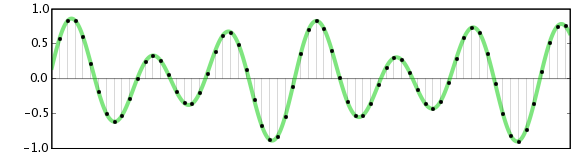
For digital technology to store, process, and reproduce sound, it is converted to digital format by an analog-to-digital converter (ADC), which converts an analog signal into a sequence of numbers. This is called Pulse Code Modulation (PCM).

It happens like this: the ADC measures the amplitude of an analog signal many times per second and outputs the results in the form of numbers. However, the measurement result does not exactly match a continuous electrical signal: it depends on the number of measurements and their precision.

The frequency at which the measurements are taken is called the sample rate, and the precision of the amplitude measurements indicates the number of bits used to indicate the result of the measurement. This parameter is called the bit depth. For example, if the sampling frequency is 44.1 kHz, this means that the signal is measured 44 100 times in one second.

For the analog signal to be accurately reconstructed from its samples, the sample rate must be twice the maximum audio frequency. That is, if the analog signal contains frequency components from 0 Hz to 20 Hz, then the frequency of its sampling must be at least 40 kHz.

Digital audio formats

Of course, for digitized sound to be stored, transmitted, and converted, there must be certain digital sound standards – audio formats. Today, there are many such formats, each of which uses its own sound processing algorithm. They also differ in the information carriers.

The most popular and widespread in the field of home use today are ordinary music CDs – CDs. There are also relatively new recording formats, Super Audio Compact Disk (SACD) and DVD-Audio (or simply DVD-A). In addition, formats that use digital data compression have become widespread.

The most popular among them is MPEG-1/2 / 2.5 Layer 3 (MP3). Microsoft also did not stay away from the sound industry, as it developed its own compression algorithm, WMA, which is also actively promoted in the market.

New audio file formats appear every year, but no player on the market supports the playback of all formats.

In fact, the term MP3 player is only correct for players that support the MP3 format. Let’s see what’s what in audio formats.

Before looking at the various audio file formats (codecs), let’s take a look at a few terms.

Bitrate

Bit rate is the space required for 1 second of music. With a bit rate of 128 kbps (kilobits per second) = 16 kbps (kilobytes per second), approximately 5 megabytes are needed for 5 minutes of music.

The higher the bit rate, the higher the quality of the music. But this as long as the bit rate of the original format is higher than the bit rate of the encoded format. By compressing a CD to MP3 at 320 kbps, you get better sound quality than 128 kbps, but converting from 128 kbps to 320 kbps will not improve the quality and may even degrade it.

Often times a 128kbps bit rate masquerades as CD quality, but this is not actually the case. If you have enough high-quality equipment, you will hear it immediately. Manufacturers like to give an estimate of the number of songs that go into a player at a very low bit rate, and many consumers are unaware that audio files vary in size. Therefore, you should not rely on the numbers in the advertisements, in fact, much less the songs in your collection can fit in the player.

Compression

Uncompressed audio takes up a lot of space. To reduce the size of audio files in formats such as MP3, programs cut off the part of the frequency range that the human ear cannot hear.

Hardware for processing digital audio – Part 4

Hardware for processing digital audio – Part 4

digital audio processing

As a practical example of a MIDI device, consider a conventional MIDI keyboard.

DIGITAL AUDIO PROCESSING MAC

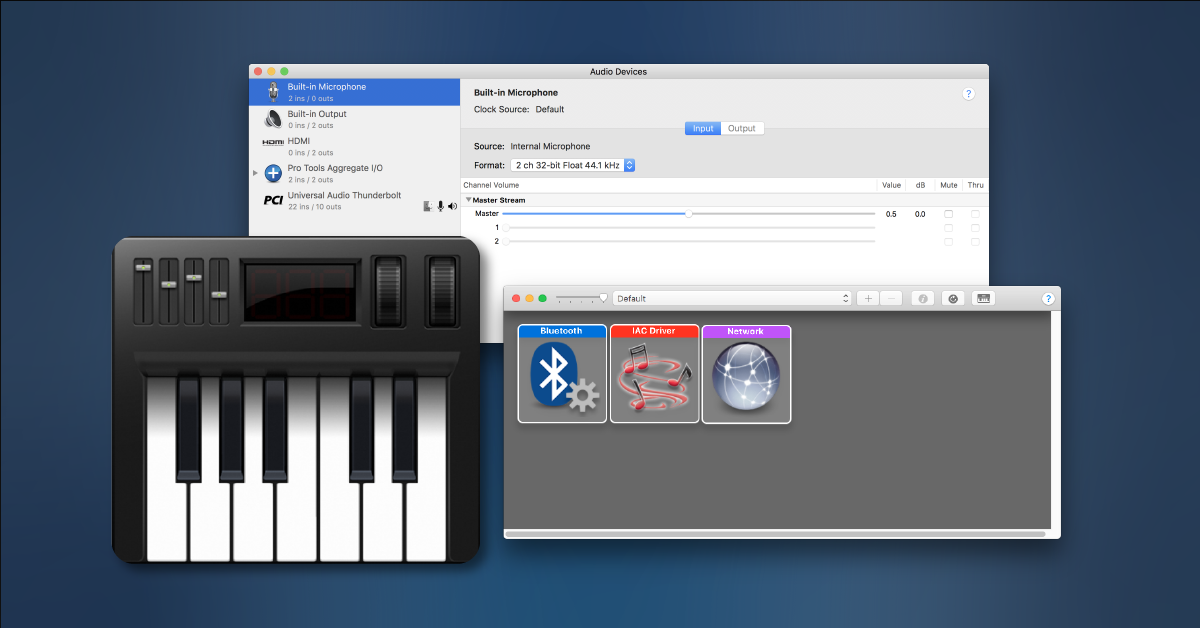
Simplified, a MIDI keyboard is a shortened grand piano keyboard in a housing that contains a MIDI interface that allows you to connect it to other MIDI devices, such as a MIDI synthesizer, that is installed on your computer’s sound card. With special software (for example, a MIDI sequencer), you can turn a MIDI synthesizer into play mode, for example, on a grand piano, and by pressing the keys on a MIDI keyboard, you can hear the sounds of a piano from line. Naturally, the matter is not limited to the grand piano: in the GM standard there are 128 melodic instruments and 46 percussion instruments. Additionally, using a MIDI sequencer, you can record notes played on a MIDI keyboard on a computer for further editing and arrangement, or simply to print notes.

It should be noted that since MIDI data is a set of commands, music written using MIDI is also recorded using synthesizer commands. In other words, a MIDI score is a sequence of commands: what note to play, what instrument to use, how much and how much it will sound, etc. Familiar MIDI files (.MID) are more than just a collection of such commands. Naturally, since there are a large number of MIDI synthesizer manufacturers, the same file can sound differently on different synthesizers (because the instruments themselves are not stored in the file, there are only instructions to the synthesizer on which instruments to play. while the differences synths may sound different).

Let’s go back to the consideration of sound cards. As we have already clarified what MIDI is, we cannot ignore the characteristics of the hardware synthesizer built into the sound card. A modern synthesizer, most often, is based on the so-called “wave table” – WaveTable (in short, the principle of operation of such a synthesizer is that the sound in it is synthesized from a set of recorded sounds dynamically superimposing them and change of sound parameters), before the main synthesis type was FM (Frequency modulation: sound synthesis generating simple sinusoidal oscillations and mixing them). The main characteristics of a WT synthesizer are: the number of instruments in the ROM and their volume, the presence of RAM and its maximum volume, the number of possible signal processing effects, as well as the possibility of channel-by-channel effect processing. . (of course, in the case of an effects processor), the number of oscillators that determines the maximum number of voices in polyphonic mode (polyphonic) and, perhaps most importantly, the standard by which the synthesizer is manufactured (GM , GS or XG). By the way, the amount of memory of the synthesizer is not always a fixed value. The thing is that recently synthesizers have stopped having their own ROM, but use the main RAM of the computer: in this case, all the sounds used by the synthesizer are stored in a file on disk and, if necessary, are they read into RAM.

Hardware for processing digital audio – Part 3

Hardware for processing digital audio – Part 3

digital audio processing

A MIDI synthesizer is a synthesizer that meets the requirements of the standard that we will now talk about. MIDI is a generally accepted specification related to the organization of a digital interface for musical devices, which includes a standard for hardware and software.

Digital Audio Processing

This specification is intended to organize a local area network of electronic instruments (Fig. 7). MIDI devices include a variety of musical instruments and hardware that meet MIDI requirements. Therefore, a MIDI synthesizer is a musical instrument, generally intended to synthesize sound and music, and also conforming to the MIDI specification. Let’s briefly see why there is a separate class of devices called MIDI.

The fact is that the implementation of sound processing software is often associated with drawbacks due to various technical characteristics of this process. Even leaving sound processing operations on a sound card or any other equipment, many different problems remain. First, it is often desirable to use hardware synthesis of musical instrument sounds (at least because a computer is too general an instrument, often only a hardware sound and music synthesizer is needed, nothing more). Second, software sound processing is often accompanied by time delays, while concerted work requires instantaneous reception of the processed signal. For these and other reasons, they resort to the use of special equipment for processing, and not computers with special programs. However, when using equipment, there is a need for a single standard that allows devices to connect to each other and combine. It was these prerequisites that led several leading companies in the musical equipment field to approve the first MIDI standard in 1982, which was subsequently continued and continues to this day. What, ultimately, is a MIDI interface and the devices included in it from a personal computer’s point of view?

Hardware: These are installed on the sound card: a synthesizer of various sounds and musical instruments, a microprocessor that controls and controls the operation of MIDI devices, as well as several standardized connectors and cables for connecting additional devices.
Programmatics is a MIDI protocol, which is a set of messages (commands) that describe various functions of the MIDI system and with which communication (information exchange) between MIDI devices takes place. The messages can be considered as a means of remote control.
The scope of this article does not allow us to delve into the description of MIDI in particular, it should be noted, however, that with respect to sound synthesizers, MIDI sets strict requirements for their capabilities, the sound synthesis methods used in them. , as well as for the synthesis control parameters. Furthermore, in order for music created on one synthesizer to be easily transferred and played successfully on another, several standards have been established for the matching of instruments (voices) and their parameters on various synthesizers: the General MIDI (GM) standard, General Synth (GS) and eXtended General (XG). The basic standard is GM, the other two are its logical extensions and extensions.