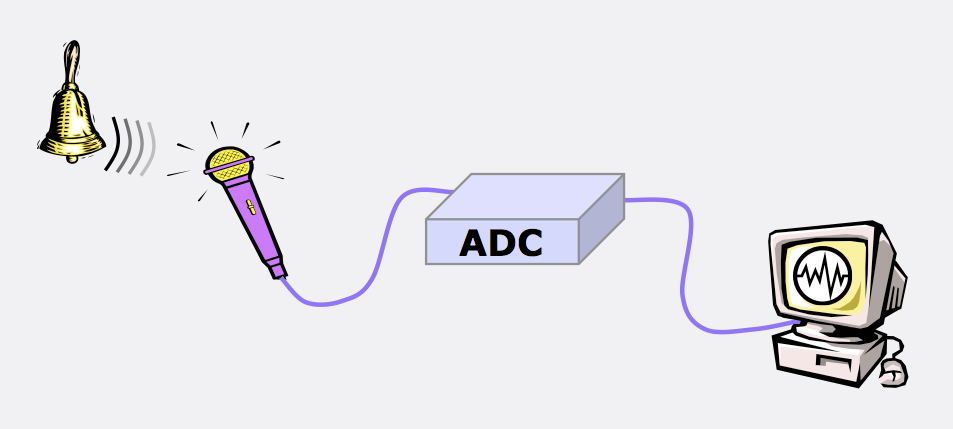
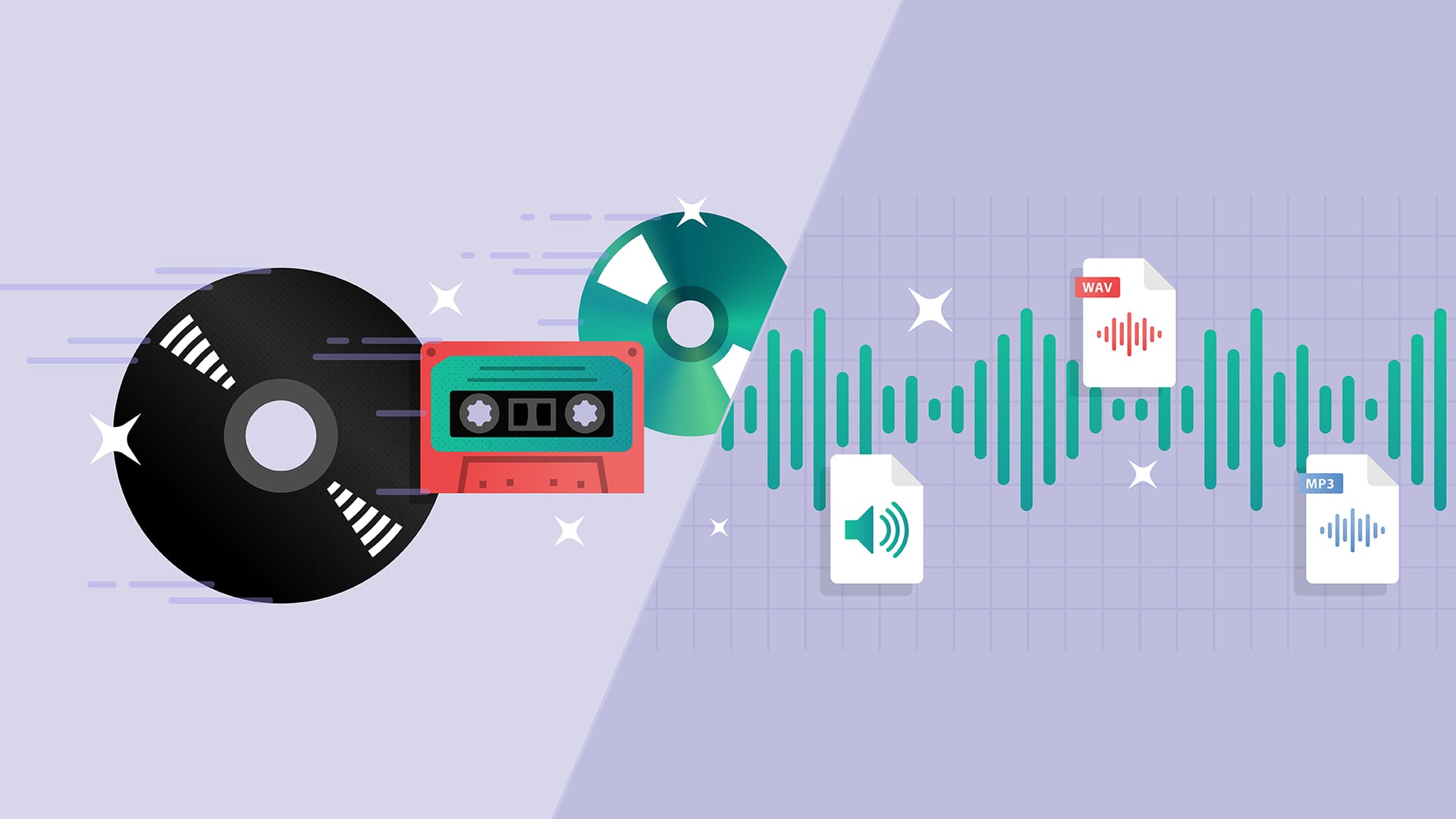
Audio is the electronic information that represents sound, or rather, having sound of a temporary nature is the flow of information that represents it.
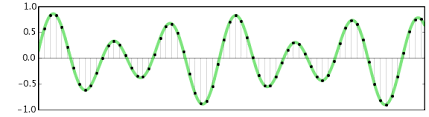
Sound is made up of pressure waves traveling in space, therefore it is represented by a sinusoidal.
The characteristics of a sound are:
Amplitude: Measured in Hertz (Hz) and determined by the frequency of a sound, the higher the frequency, the louder the sound, the lower it is, the lower the sound.
Intensity: it is measured in decibels (db) and is determined by the power of a sound, the more intense a sound is, the greater its volume.
Duration: It is measured in seconds (s) and dermal how long a sound lasts over time.
Timbre: It is not directly measurable, but it is that sound parameter that allows us to distinguish a trumpet from a drum. It constitutes the trace of a sound and is characterized by harmonics.

ANALOGUE AND DIGITAL
There are two different ways of representing sound as electronic, analog and digital information.
Analog audio was the first, in chronological order, to be developed.
The information varies similarly to the information it represents and can (in theory) assume any value.
If we greatly expand the sine wave that describes an analog sound, we would see that it is a continuous line without interruptions.
Instead, digital audio is encoded with a number system, which allows discretization (transition from analog to digital), during this step information is lost, but once the sound is written as a series of numbers (digital information) it is possible to reproduce it. , transmit and modify it without losing anything in terms of quality, which is impossible with analog information.
If we greatly expand the sine wave that represents a digital sound, we would realize that it is not a continuous line as in the previous case, but a series of points very close to each other.
The amount of these points in one second of information will define the “sampling frequency”.
The amount of information that each point can contain is called “bit depth”.
THE CHARACTERISTICS OF DIGITAL SOUND
Sampling rate
Determine the number of samples contained in one second of information.
It is expressed in hertz (Hz) and generally assumes the following values in the musical field: 22050Hz, 44100Hz, 96000Hz.
According to Nyquist’s theorem, each sampling frequency can record and reproduce sounds that have a maximum frequency equal to half of the chosen sampling frequency, this means that a piece sampled at 44Mhz can assume values of up to 22Mhz only
Bit depth
Determine the amount of information contained in each sample.
It is expressed in Bit (bit) and generally assumes the following values in the musical field 8Bit, 16Bit and 24Bit.
Above all, this is the parameter that depends on the quality of a sound.
Transmission rate (bit rate)
It is a characteristic of codecs, that is, of the “machine language” used to describe a sound.
Sets the total amount of information needed to play a second of a sound.
It is expressed in Bit / s.
AUDIO PROCESSING
Whether you’re talking about studio recording or live performances, the audio signal is never sent directly from the microphone to the speakers / recording medium, but is always processed first, through tools that allow you to perform different interventions. in the sound
These instruments can be analog, therefore they have the instrument physically in the studio (which is usually inserted inside a shelf), which must be connected between the microphone and the mixer or between the mixer and the speakers / recording medium.
Or you can simulate them through some plugins for your computer.
It is necessary to have a Daw (Digital Audio Workstation), which is the workspace in which all editing operations are performed. (Ableton, Cubase, Fruitloops, Logic, Reaper).
Within this software it is possible to install smaller ones, called VST (Virtual Studio Technology) that simulate the circuits of the studio equipment, emulating the effect.
(There are also other proprietary plugins with extensions other than the classic VST like .component or .au).
Some tools are essential and are used in all audio recordings, others are used only in particular situations or to obtain / avoid certain effects.
The main ones are:
Equalizer, is used to emphasize or attenuate some frequencies, this way you get a cleaner sound and a less “mixed” mix where all the instruments occupy only the correct frequencies, without overlapping.
The compressor, as the name suggests, serves to compress the dynamic range, so that the sound is more consistent and less dispersive.
Amp, wavering of different kinds, is used to increase the intensity of a sound.
Limiter works in a similar way to the compressor, but instead of compressing all frequencies, it attenuates those that exceed a predetermined threshold (threshold), avoids entering faults.
Reverb adds a slight reverb that makes a sound recorded in a soundproof studio much more natural than it would be too “dry”.
Filters (high / low cut) allow you to cut some useless and sumptuous frequencies too low or too high. (They are just 1 band parametric equalizers).