
From mp3 format to H.265 and VP9 codecs, these are the most widely used audio and video compression formats.
The videos we watch on YouTube, the music we listen to through Spotify and iTunes, the photos taken with the digital camera. The multimedia content that we process daily is the result of a compression process that allows you to enjoy them without major headaches. Due to the weight of the files, the need arose to reduce their size so that they take up less disk space and can be exchanged faster on the network.
Over the years, two different compression techniques have been developed: one involving loss of information and one involving loss of information. This has led to the emergence of various codecs and formats, such as MPEG, MP3, MPEG-H and many others.
Without loss and without loss
Media compression can occur in two ways: lossy (translated with “lossless”) and lossless (translated with “lossless”). In the first case, encoding audio and video files involves loss of some information that is considered “useless” or non-essential. The files obtained through this process will have a lower quality than the original files, but the human eye or ear should not notice major differences. In an mp3 file, for example, the ultrasound is removed; In the case of a Jpeg file, groups of adjacent pixels and the like can be chromatically grouped into larger blocks and lose a certain amount of detail depending on the amount of compression performed.
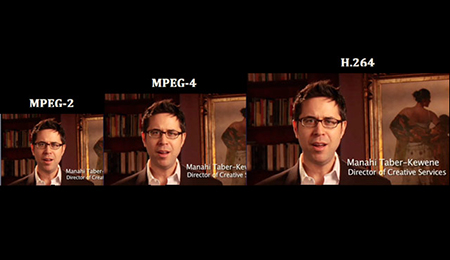
Comparison of MPEG formats
Losses without compression ensure that no loss of information is lost in the coding process. This is possible by using certain algorithms that eliminate redundant information by replacing it with some sort of “placeholder”. For example, the LLE (Run Length Encoding) algorithm identifies the usual repetition in the bitstream files and replaces them with a single symbol and the number of repetitions.
Video compression formats
DivX, Xvid. They belong to one of the first generations of the era of online multimedia content. In essence, these are two “twin” codecs: DivX was born as the proprietary format of the homonymous software house; XviD as a free and open source alternative with similar, if not identical, functionalities. They achieved great success and widespread popularity thanks to their ability to compress long clips (even full-length movies) into small files while maintaining a good quality level.
Comparing formats to the Internet.
– Google code. Google is increasingly engaged in the multimedia sector and is increasingly committed to investing in technologies that can minimize the impact on users’ bandwidth consumption. An example of this is the set of codecs and video compression formats developed in recent years. The latest addition is the VP9 codec, which is compliant with the 4K standard and is capable of guaranteeing a high reproduction quality associated with small files.
–H.264. Among the most widely used video compression formats to create and distribute movies and videos of all sizes and resolutions, the H.264 codec (also known as MPEG-4 Part 10 AVC) is also known to be one of the Blue Disks-ray encoding standards . It is capable of guaranteeing excellent video quality at low bitrate levels (ie smaller files) and is widely used by web video streaming services (Vimeo, iTunes) and video playback software (Adobe Flashplayer and Microsoft Silverlight)
–H.265. The inheritance of the H.264 codec (officially released only in April 2013) theoretically guarantees a double compression compared to its predecessor: therefore, for the same video quality, a video file compressed with the H.265 codec will weigh approximately half of that movie compressed with the H.264 codec. It is compatible with the 8K standard, which guarantees viewing videos with a resolution up to 8,192×4,320 pixels


