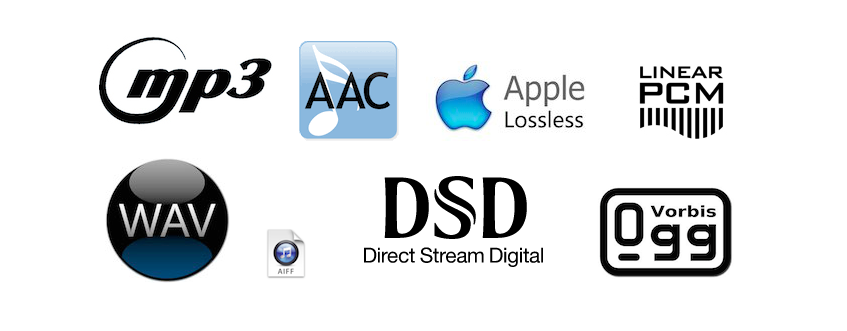
DIGITAL AUDIO FORMATS
Currently, thanks to digital audio formats, we can store and listen to our music on numerous devices, such as mobile phones, tablets, computers and music players.
What are digital audio formats?
Digital audio formats are basically containers. And the differences between them are fundamentally in:
Whether or not they are compressed.
If they are compressed, in the quality of compression.
The type of labeling they can support.
Digital audio formats
MP3
It is the best known, popular and most used. They are known by their extension “.mp3”.
It was developed by Moving Picture Experts Group, to be part of the well-known MPEG-1 and MPEG-2 standards.
Its fundamental characteristic lies in the fact that the technology behind it compresses the sound sequence, resulting in a really small file, which normally occupies half of the original file. To achieve this, it is necessary to lose certain sounds, which supposedly cannot be heard by the human ear.
Audio formats
WAV
Developed by the companies Microsoft and IBM, this format, whose name comes from the acronym WAVE (Waveform Aujdio File Format), is currently one of the audio formats that have no compression in the data, so they have excellent quality.
They are known for their “.wav” extension.
On the other hand, this format has the particularity that it includes support for almost all current audio codecs. This makes the WAV one of the most used formats in the field of professional sound, since the sound is captured with parameters of 44100 Hz and at 16 bits, the same quality can be obtained as on a CD.
On the contrary, one of the disadvantages of this format is that it has a limitation in recording, since it can only capture a maximum of 6.6 hours at maximum quality in the same file.
Audio formats
AIFF
The AIFF (Audio Interchange File Format) format is very similar to WAV. It was born as an answer from Apple to the Microsoft WAV, being initially only compatible with MAC computers. Currently it can also be used on Windows.
Due to its characteristics, AIFF, together with FLAC and WAV, are usually the most used formats in the professional field of audio.
Wma
The WMA (Windows Media Audio) format is a format of music files created by Microsoft.
One of its main features is that those files that have been compressed in WMA format occupy less space than MP3s, which also means reducing their quality. Therefore, it is a lossy audio compression format.
OGG
OGG audio formats are compressed audio files, which means that they have a size that allows them to be transmitted via WIFI, but at the same time avoid the damage that is usually generated in the compression process.
For example, Spotify uses these OGG formats.
Audio formats
OPUS
Opus is a new codec that use the Ogg container. It was developed by the same creators of FLAC, with the help of Mozilla and Skype.
This new format stands out for its low latency, being ideal for online audio transmissions.
FLAC
When we talk about the FLAC (Free Lossless Audio Codec) format, we are referring to an audio compression free codec without loss of quality.
Emerged within the community responsible for the OGG project, FLAC has become one of the strongest competitors of the WAV format, due to its advantages in terms of its sound quality.
Its objective is to reduce the size of the original file, eliminating data that are usually known as “waste”, without causing loss of quality.
This is the format used by the Tidal platform, the best service for high quality audio transmissions.
Audio formats
A THE C
The Alac (Apple Lossless Audio Codec) format is basically Apple’s alternative to FLAC. It is the format used by Itunes and for Apple Music broadcasts.