Digital audio encoding

PC-based audio coding is based on the process of converting air vibrations into electrical current fluctuations and the subsequent sampling of an analog electrical signal.

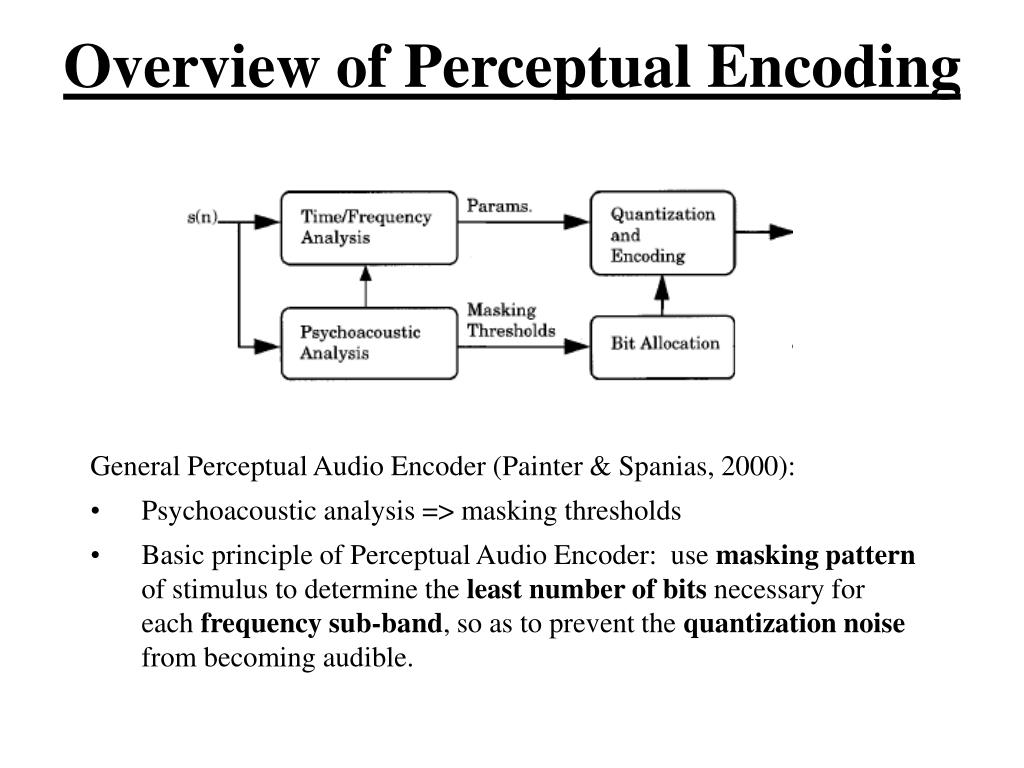
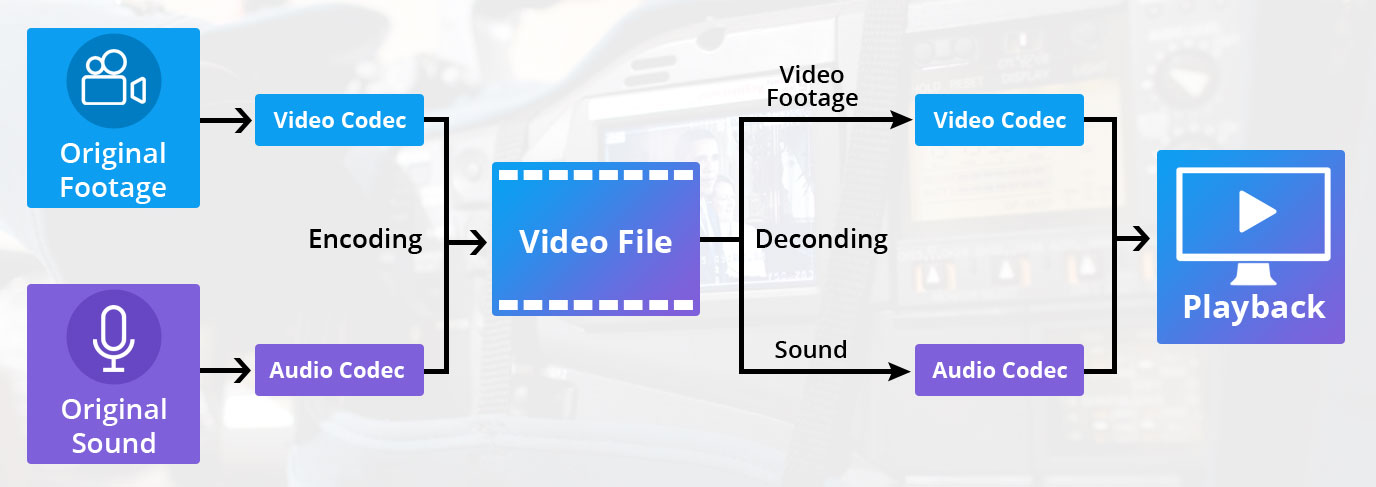
The encoding and reproduction of audio information is carried out using special programs. The quality of reproduction of the encoded sound depends on the sampling frequency and its resolution (sound encoding depth – the number of levels).
Digital audio is an analog audio signal represented by discrete numerical values of its amplitude.
Sound digitization is a technology with a divided time step and subsequent recording of the values obtained in numerical form. Another name for digitizing audio is analog to digital audio conversion, which includes the following operations:
Bandwidth limiting is done by using a low pass filter to suppress spectral components that are more than half the sample rate.
Time sampling, that is, replacing a continuous analog signal with a sequence of its values at discrete moments of time: samples.
Level quantization is the replacement of the signal’s reference value with the closest value of a set of fixed values: quantization levels.
Encoding or digitization, as a result of which the value of each quantized sample is represented as a number corresponding to the ordinal number of the quantization level.
This is done as follows: a continuous analog signal is “cut” into sections with a sample rate, a discrete digital signal is obtained, which goes through the quantization process with a certain bit depth, and is then encoded, that is, it is replaced by a sequence of code symbols. To record sound in a 20-20,000 Hz frequency band, a sampling frequency of 44.1 and higher is required (today there are ADCs and DACs with a sampling frequency of 192 and even 384 kHz). To obtain a high-quality recording, 16-bit is sufficient, however, to expand the dynamic range and improve the quality of the sound recording, 24 (less often 32) bits are used.
Sound coding methods (of course an electrical signal coming from a microphone) are based on the fact that, theoretically, any complex sound can be decomposed into a sequence of simpler harmonic signals of different frequencies, each of which it is a sinusoid, called the spectrum of the original signal. The task of encoding sound, like any other analog signal, is to represent it in the form of another analog or digital signal, which is more convenient for its transmission or storage in each specific case. Real sound sources have a limited spectrum width, therefore, for encoding, transformation methods are used that transform the original signal into one, the spectrum of which is more suitable for transmission on the selected channel. Representing an analog signal as another analog signal is commonly referred to as modulation and digitally as encoding. This division is very arbitrary. An analog signal can be represented as a harmonic signal (that is, a sinusoid), the parameters of which change depending on the value of the original signal. In the event that the amplitude of the sinusoid changes with a change in the original signal, it is amplitude modulation (AM). If, depending on the value of the original signal, the frequency or phase of the sinusoid changes, we are dealing with frequency modulation (FM) or phase modulation (PM). Amplitude and frequency modulation, for example, is widely used to transmit sound by radio. These types of modulation, of course, are not the decomposition of the original signal into harmonics. The development of digital technology and the use of computer processing and information storage has led to the widespread use of pulse encoding or modulation methods. Such types of modulation are, for example, pulse code modulation, in which the value of the original signal at regular intervals is represented in code form. The vast majority of “computer sound” is precisely the recording of the binary code of the received signal in short equal time intervals, determined by the sampling frequency. For storage and transmission through communication channels, this signal is usually compressed (reducing the volume by discarding unnecessary or insignificant information). In addition to pulse code modulation, other types of digital modulation (pulse width, pulse frequency, etc.) are also used to encode sound.