What do you like more, analog sound or digital sound? Part 3


Free Download Mp4Gain
picture

What do you like more, analog sound or digital sound? Part 3
 

DIGITAL SOUND


Difference between digital and analog
digital recording

The sound is analog. And sound is the vibration of the air. How is this sound vibration transmitted?
For example, when a stone is thrown onto a surface of calm water, the ripples spread around it, but if
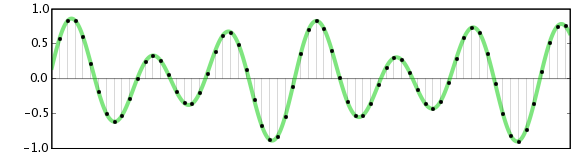
Cut in the direction of the waves and look at the cut, the waveform is as shown in Fig.1.

Air waves spread from the point where sound is emitted even in air. Although invisible to the eye, it has a
similar waveform. This is the analog waveform of sound.

Therefore, although it is digital, when such a sound waveform is recorded or communicated by phone or wirelessly, as
shown in Fig. 2, the change in the analog waveform is electrically replaced with a series of numerical values ​​according to a certain promise. ..

When recording or communicating, if you handle it as analog, it is easy for noise to enter and the sound quality to deteriorate, but when trying
the waveform of the sound as digital = numerical data, you can eliminate that worry and
maintain a certain quality. You can do various processing while maintaining it.

(2) What is convenient when it is digital?

Digital audio signals are convenient because they can be recorded and edited using a personal computer, for example.

In addition, 74 minutes of music can be recorded on a CD with a diameter of only 12 cm, and through digital compression processing
, music of the same length can be recorded on an MD with a smaller diameter.

Since digital signals can be compressed in this way, it is also convenient for storing large amounts of information.
Not only sound, but also more informative video signals can be recorded and communicated at high speed by using compression technology.

Especially in communication, a two-way digital multiplex communication can be realized communicating multiple pieces of information with a single wire.
In addition to electrical signals, laser optical communication is also possible, so communication is possible at extremely high speeds.

(3) What is the sampling frequency?

Digital signals are processed at predetermined fixed time intervals.
The sample rate (sample rate) indicates how many times a second is processed and is expressed as Fs or fs.

The sampling frequency unit is Hz (Hertz), and the
44.1 kHz (kilohertz) sampling rate means 44,100 pieces of data are processed per second.
(K represents 1000 times)

AD conversion converts a continuous analog signal into a digital signal,
measures the size of the signal at each moment determined by the sampling frequency (sampling) and converts
the result in a binary number (quantization).

On the contrary, DA conversion consists of converting a digital signal into an analog signal,
and the digital signal is read in the time interval of the sample rate and connects smoothly.

Since digital signals can be reproduced up to half the sampling frequency, how much
The higher the sample rate, the higher the playable frequency and the better the sound quality.
In familiar places, 44.1 kHz is adopted for CD and 48 kHz for DAT and mode B of satellite transmission.

Also, recent professional equipment uses high sampling frequencies (high sampling), such as 88.2 kHz and 96 kHz, and is
designed to faithfully reproduce even higher frequency sounds to improve sound quality.

(4) What is bit?

bit is an abbreviation for binary digits.
16 bit and 24 bit in catalogs, etc. they represent the number of digits of binary * that computers handle.

In digital audio, analog sound is converted to a digital signal,
but the number of bits determines how accurately the amplitude value is converted when it is converted to a binary number (quantization) after sampling.
In the case of 1 bit, only 1 or 0 can be judged, but in 8 bit (10001001), 2 raised to the eighth power, that is, 256 steps can be judged in detail.

Currently, the 16-bit mainstream has 65,536 steps and the 24-bit mainstream has 16,777,216 steps.
Now,
there is a part that does not match the actual waveform (analog waveform) and the quantized and sampled digital waveform. This is called quantization noise.
This noise is especially noticeable when the number of bits is small.

So simply increasing the F’s and the number of bits will improve the sound (closer to the original sound)
, but it will consume a lot of memory. Furthermore, in the case of digital recording, it is
It is very important to control the input level to bring out the high quality of the sound.


Free Download Mp4Gain
picture


Mp4Gain Main Window
picture


Mp4Gain Features
picture


Free Download Mp4Gain
picture

What do you like more, analog sound or digital sound? Part 2

What do you like more, analog sound or digital sound? Part 2

Digital Audio

The development of the Internet has fueled the boom by increasing the amount of information and facilitating the search for the product you are looking for.

digital audi music

Repairs are not as difficult as they used to be, and the variety of repair parts has made it easier to use than in the past.
It is true that vintages are difficult to obtain and maintain, but the market is well established.

At Audioland, we also focus on vintage shopping!
We have experienced repair personnel, so feel free to contact us for repairs.

On the other hand, the audio industry is experiencing a boom in high resolution.
Music Download Image Photo
The revolution in audio technology is the advent of CDs, but the push to push it away is “high resolution.”
Adobe has released Photoshop, an image correction and processing software, and the word “resolution” in the manual is abbreviated as “resolution.”
“Is this image sufficient for resolution?” “Low resolution” and so on.
The high resolution etymology is “high resolution printing”.

The power of high resolution is a sound source that has more than three times the amount of information as a CD and several dozen times more information than a compressed sound source such as MP3 or AAC.
It is possible to express this difference or the richness of the sound more than a CD.
By definition, if you have information specifications higher than CD, you can call yourself high resolution.
High-resolution sound sources have been around for some time, but they were not widely used because they required quite expensive equipment to reproduce them.
The widespread use of high-resolution audio is largely due to the improved infrastructure of the Internet environment.

It’s often thought that you need to buy a compatible high-resolution device to enjoy high-resolution audio sources, but you can fully enjoy it with today’s amplifiers and speakers.
There is also information that tube and high resolution amplifiers are surprisingly compatible.
At least you need to prepare a player with hard disk, network player or USB-DAC.
Of course, if it is a compatible high resolution device, it will show the maximum performance, but even if it is not, you can feel the difference between CD and high resolution.

How to hear high-resolution sound better? Aiming at the height of the clear sound …
Recently, the number of high-resolution audio devices has increased and tuning knowledge has also emerged.
It’s digital so you can let it go! It’s boring and boring! That is not the case.
It is up to the listener to save or remove the high-spec sound source.

Use an audio LAN cable
The data size of high-resolution audio sources is 3 to 7 times larger than that of CDs.
Since it contains many tiny electrical signals, the noise and vibration are more severe than ever and there is no loss.
Even if you prepare a good network player, it will be difficult to highlight the true value of high resolution if the surrounding environment such as NAS, router and personal computer is not good.
In particular, the noise suppression of cables is as important as conventional audio.

Clean the power supply
It is a fact that the waveform of the AC power supply for home use is altered.
Since routers and personal computers were not originally made as audio equipment, protection against noise is excellent.
You do not need to be qualified for electrical work to change the power supply.
Replacing the output board with audio will reduce high-frequency noise and increase the feeling of silence.
Power boxes and power cables are also available from various companies, such as Saek and Luxman.

Increase the importance of the existence of boards and insulation.
Common to audio is the vibration of the floor of the speakers. This shakes the CD players and amplifiers.
In the case of high resolution, the network player and DAC are mechanical, but the NAS has rotational vibration due to the HDD, and the personal computer also has fan noise to dissipate heat.
Put compact items like routers, NAS, and USB-DAC together on the board and use another board or insulator for large items.

Enrich the range with super tweeters and subwoofers

Super tweeter sales seem to be strong due to the hi-res boom.
It seems that the super high range above 20 kHz, which is cut off on CD, also contains harmonic components that stimulate brain waves, although it is not audible.

What do you like more, analog sound or digital sound?

What do you like more, analog sound or digital sound?

Digital Audio

The appeal of audio that cannot be talked about with technique alone

Digital Audio

“I like the irresistible sound that flows from the gramophone”, “that listening to play in front of how to listen to the sound of the album has been fulfilled so far you also with the clients that”.
It goes without saying that the sound quality is inferior to that of modern playback equipment, but it feels more attractive than that.
I will try to blur the worldview and the allure of audio that won’t change even if technology evolves.

Table of Contents

The reality is concentrated in the technical limitations of the 1 SP registers
2 History repeats itself! Is the record boom these days real?
3 exciting vintage market
4 On the other hand, the audio industry is experiencing a boom in high resolution
5 How to hear high-resolution sound better? Aiming at the height of the clear sound …
5.1 Use a LAN cable for audio
5.2 Cleaning the power supply
5.3 Improving the importance of the existence of boards and insulation
5.4 Enriching the range with super tweeters and subwoofers
6 5 masterpieces you want to hear and compare between digital (Hi-Res / CD) and analog (recording)
6.1 Piano Concerto No. Rachmaninov # 2 [classic] / Nobuyuki Tsujii x Yutaka Sado
6.2 [Jazz] I don’t know why / Norah Jones
6.3 [Rock] Eagles / Hotel California
6.4 [Soul] Stand By Me / Ben E. King
6.5 [Fusion] Palladíum / Weather report
7 Even if the sound quality and audio equipment change, there are things that do not change.
The reality is concentrated in the technical restrictions of the SP registers
Gramophone photo
Speaking of the latest in analog, is it an SP record?
SP is an abbreviation for “standard playback”.
Discs made from the second half of 1890 were not produced in Japan in 1962 at the end.
The playback time is 10 inches and there is a limit of about 4 minutes on one side, and it is a record for a gramophone that rotates at a high speed of 78 rotations per minute.
By the way, the LP record has 33 rotations per minute, which has a wider range and less noise than the SP.
The record makes a sound due to the friction between the stylus and the board, so it wears out.
In particular, the treble fades every time it is played, and it takes time and effort to change the needle each time to enjoy it for a long time.
Recording was done using the “direct cut method” which presses the sound picked up by the microphone directly onto the recording board.
It’s a one-time recording where the performers gather in front of the mic and pick up the sound, so it’s important how to play deeply in no time.
That live feeling is a huge draw that digital doesn’t have.
Since the sound produced is recorded on the disc as is, the atmosphere of the place is recorded realistically.
In a sense, it has a more vivid and realistic view of the world than modern processed sound sources, and I think the noise and sound quality restrictions make the listener’s imagination work.
Listening to music from that era the way you enjoy it will make it even more interesting.
Modern digital audio equipment is an honor student, while analog is a naughty and badass kid.
However, the album has a very human character that analog is more attractive.

History repeats itself! Is the record boom these days real?
record image
Records have fallen since the advent of CDs, but in recent years the production of LP records has surpassed one million in Europe and one million in the United States.
The number of records produced is also gradually increasing in Japan.
Many reprints and new songs have been released regardless of genre, such as rock, jazz, and classical music.
The number of major record stores, such as the HMV record store, is gradually increasing and is a great success.
Also, the only record press factory in Asia, “Toyo Kasei”, has decided to print LPs and singles for a few years, and is said to be fully operational.
The return of the active Atalog generation, mainly in their 60s, is driving the record boom.
It will also feel cool and fresh to young people.
It’s not uncommon for teens to download music these days, and even if they hear it as a “recommended masterpiece,” it doesn’t come to mind.

A booming vintage market

The image of vintage = antiques is an old story, and now I feel that more and more people are enjoying the classic instruments of yesteryear.
In the old days, it was the talkies era like Western Electric, but Marantz 7, McIntosh MC275, JBL Paragon, Tannoy autograph, gems that couldn’t be bought at the time are on the move.

How digital compression works. Part 4

How digital compression works. Part 4

AUDIO COMPRESSION

Record labels are good too: contrary to what music lovers expected, they didn’t take full advantage of the new high-definition format. The studios did not record music from the master tape in DSD, instead taking a digital recording in PCM, remixing and processing everything in a row: limiters, compressors, noise-shaping dithering, and various digital filters. The result was a sound so sterile and dry that even CD Audio could have sounded much better. In this way, listeners’ trust in SACD and, at the same time, in new formats in general was undermined.

DIGITAL COMPRESSION

INFO
Unfortunately, with vinyl records, this vicious practice continues to this day: studios print vinyl from a digital recording, even if they have the recording on the master tape. So on modern vinyl it can easily be 44.1 x 16.

DSD
What is DSD? This is a one-bit stream with a very high sample rate compared to PCM. Also, DSD uses a different type of modulation, PDM (Pulse Density Modulation) – pulse density modulation. Sound recording in this format is done by a one-bit analog-to-digital converter, now these ADCs based on sigma-delta modulation are used everywhere. The recording process looks like this: while the amplitude of the wave increases, the ADC output is a logical unit, when the amplitude decreases, the output is a logical zero, there can be no average value. It is compared with the previous value of the wave amplitude.

DSD achieves significant advantages over PCM:

more precisely, draw a wave;
greater immunity to noise;
an easier way to switch and transmit a digital stream;
In theory, it is possible to reduce the cost by simplifying the DAC circuit, but due to backward compatibility, manufacturers are unlikely to accept it.
Originally, SACDs used the DSD x64 format with a sample rate of 2822.4 kHz. The 44.1 kHz audio CD sample rate was taken as the basis, increased 64 times, hence the name x64. The following DSDs are currently in use:

x64 = 2822.4 kHz;
x128 = 5644.8 kHz;
x256 = 11 289.6 kHz;
x512 = 22,579.2 kHz;
declared DSD x1024.

DXD
There is a certain intermediate format between PCM and DSD called DXD – Digital eXtreme Definition. This is, in fact, high definition PCM: 352.8 kHz or 384 kHz with 24 or 32 bit quantization. It is used in studies for the processing and subsequent mixing of materials.

But this approach is flawed: first, it doesn’t allow you to use all the benefits of DSD, and second, the file size is larger than DSD. Currently, flagship DACs on the I2S input accept a PCM data stream with a sample rate of up to 768 kHz and a bit depth of up to 32 bits. It’s scary to even consider how much hard drive space an album will take up at this resolution.

DSD has practically separated from SACD. Now, the DSD format can often be found packaged in files with the DSF and DFF extensions. Many turntables have been released with the ability to record in DSF and DFF, lovers of good sound are increasingly digitizing vinyl records in DSD format. But in recording studios, nobody wants to invest in unpopular formats, so they continue to rivet the sound with minimum wages: 44.1 × 16.

DSD switching and data transmission
To transfer a digital stream to DSD, a three-pin connection scheme is used:

DSD clock pin (DCLK) – sync;
Data input pin DSD Lch (DSDL) – left channel data;
Data input pin DSD Rch (DSDR): right channel data.

Unlike I2S, DSD data transmission is extremely simplified. DCLK sets the clock rate of the bit sync, and the left and right channel data is transmitted sequentially through the DSDL and DSDR pins, respectively. Here there are no adjustments, recording and playback in DSD is done little by little. This approach provides the closest approximation to the analog signal, and due to the high frequency, quantization noise is reduced and reproduction precision is increased by an order of magnitude.

PDO
DoP is often used to carry DSD data streams, so it is worth mentioning. DoP is an open standard for transferring DSD data over PCM frames (DSD over PCM). The standard was created to pass a stream through controllers and devices that do not support direct DSD streaming (not DSD native).

The principle of operation is as follows: in a 24-bit PCM frame, the upper 8 bits are padded with ones; this means that DSD data is currently being transmitted. The remaining 16 bits are sequentially filled with DSD data bits.

How digital compression works. Part 3

How digital compression works. Part 3

DIGITAL COMPRESSION

In most cases, there is another pin, Master Clock (MCLK or MCK), which is used to synchronize the transmitter and receiver from the same clock to reduce the transmission error rate.

DIGITAL COMPRESSION

For the external synchronization of the MCLK, two clock generators are used: with a frequency of 22 579 kHz and 24 576 kHz. The first, 22,579 kHz, is for frequencies that are multiples of 44.1 kHz (88.2, 176.4, 352.8 kHz), and the second, 24,576 kHz, is for frequencies that are multiples of 48 kHz (96, 192, 384 kHz). There may also be generators at 45,158.4 kHz and 49,152 kHz; You’ve probably already noticed how in the digital sound world they like to multiply everything by two.

Frame or I2S frame
Frame or I2S frame
In I2S, three contacts are necessarily used: SCK, WS, SD; the rest of the contacts are optional.

Synchronization pulses are transmitted through the SCK channel, under which the frames are synchronized.

The length of the “word” is transmitted over the WS channel and logical states are also used. If the WS pin is a logical unit, then the right channel data is transmitted, if it is zero, the left channel data is transmitted.

The data bits are transmitted via SD: the values ​​of the amplitude of the audio signal during quantization, the same 16, 24 or 32 bits. No checksums or service channels are provided on the I2S bus. If data is lost in transit, there is no way to get it back.

Expensive DACs often have external connectors to connect to the I2S. The use of such connectors and cables can have a bad effect on the sound, even the appearance of “artifacts” and stuttering, everything will depend on the quality and length of the cable. Still, I2S is a hard-wired connector and the length of the wires from the transmitter to the receiver should tend to zero.

Let’s see how the PCM data stream is transmitted through the I2S bus. For example, when transmitting PCM 44.1 kHz at 16 bits, the length of the word on the SD channel will be these sixteen bits and the length of the frame will be 32 bits (right + left). But most of the time, the transmitters use a 24-bit word length.

When playing PCM 44.1×16, the most significant bits are simply ignored as they are filled with zeros or, in the case of older multi-bit DACs, they can go to the next frame. The length of the “word” (WS) may also depend on the player through which the music is played, as well as the driver for the playback device.

An alternative to PCM and I2S would be to record the audio signal in DSD. This format was developed in parallel with PCM, although Kotelnikov’s theorem also played a role here. To improve sound quality compared to CDDA, the emphasis was not on increasing the quantization bit, as in the DVD Audio format, but on increasing the sample rate.

DSD
DSD stands for Direct Stream Digital. It originates from Sony and Philips labs, however, just like the other formats discussed in this article.

SACD
DSD first saw the light of day on Super Audio CDs in 2002.

At the time, SACD seemed like a masterpiece of engineering, it applied a completely new way of recording and playback, very close to analog devices. The implementation was simple and elegant at the same time.

The media was even equipped with copy protection, although without it, no pirate was afraid. Under the Sony and Philips brands, they began to produce “closed” devices exclusively for playback, with no possibility of copying discs. Manufacturers sold recording equipment to studios, but kept control over the SACD launch.

Who knows, perhaps the SACD format could gain popularity comparable to Audio CD, if it weren’t for the cost of the playback devices. By unreasonably selling out player prices, Sony and Philips’ own leaders hampered the popularity of their format. And the next mistake completely put an end to the sale of specialized devices. To promote Sony’s PlayStation, Sony engineers have added the ability to listen to SACD on it. Hackers immediately hacked the set-top box and began copying SACD discs into ISO images that can be burned to a regular DVD and played on any competing player; others simply ripped out tracks to play on a computer.

How digital compression works. Part 2

How digital compression works. Part 2

digital compression

The next after CDDA in 1987 appeared the DAT format – Digital Audio Tape.

digital compression

The sample rate was 48 kHz, the quantization bit did not change. And although the format failed, the 48 kHz sample rate took hold in recording studios, as they say, due to the convenience of digital processing.

In 1999, the DVD-Audio format was released, which made it possible to record on a disc six stereo tracks with a sampling frequency of 96 kHz and a 24-bit bit depth, or two stereo tracks with a frequency of 192 kHz, 24 bits.

In the same year, the SACD – Super Audio CD format was introduced, but the discs began to be produced only three years later. I will tell you more about this format in the DSD section.

These are the main formats that are considered the standard for digital audio recordings on media. Now let’s see how data is transmitted on a digital audio path.

The structure of the digital audio path.
When playing music, something like the following happens: the player, using a codec created in the form of a device or program, decompresses the file into a specific format (FLAC, MP3 and others) or reads data from a CD, DVD-Audio or disc SACD, receiving a standard PCM data stream … This stream is then transferred via USB, LAN, S / PDIF, PCI, etc., to the I2S converter. In turn, the converter converts the received data into so-called I2S data interface frames (not to be confused with I2C!)

I2S
I2S is a digital audio transmission serial bus. Now I2S is a standard for connecting a signal source (computer, turntable) to a digital-to-analog converter. It is through it that the vast majority of the DAC connects directly or indirectly. There are other digital audio transmission standards, but they are much less common.

I2S output (input) on PCB
Other articles in this issue:
Xakep # 256. Fight Linux
Broadcast content
Subscription to “Hacker”
The I2S bus can consist of three, four, or even five pins:

continuous serial clock (SCK) – bit sync clock (can be called BCK or BCLK);
word selection (WS) – frame sync clock (may be called LRCK or FSYNC);
Serial data (SD): transmitted data signal (can be called DATA, SDOUT, or SDATA). As a general rule, data is transmitted from a transmitter to a receiver, but there are devices that can act as a receiver and transmitter at the same time. In this case, another contact may be present;
Serial data in (SDIN): On this pin, data moves in the receive direction, not the transmit direction.
SD or SDOUT is used to connect a D / A converter, and SDIN is used to connect an A / D converter to the I2S bus.

How digital compression works.

How digital compression works.

Digital Compression

Have you ever wondered how sound is reproduced on digital devices?

Digital Compression

How is a sound signal formed from a combination of ones and zeros? I’m sure I was thinking, since I started reading! But often, even professionals only have a general idea of ​​the modern sound route. In this article, you will learn how the different formats appeared, what a digital-to-analog converter is, what types of DACs exist, and what determines the quality of sound reproduction.

PCM
As you know, in digital audio, almost any format, with rare exceptions, is recorded using a pulse code stream or a PCM stream – pulse code modulation. FLAC, MP3, WAV, Audio CD, DVD-Audio and other formats are just ways to package, “preserve” a PCM stream.

How it all began
The theoretical foundations of digital sound transmission were developed at the dawn of the 20th century, when scientists tried to transmit an audio signal over a long distance, but not by telephone, but in a rather strange way for that time.

By dividing the sound wave into small parts, it could be sent to the receiver in some kind of mathematical representation. The recipient, in turn, could restore the original waveform and listen to the recording. In addition, scientists were faced with the task of increasing the bandwidth of the “ether”.

In 1933, the theorem of V.A. Kotelnikov. In Western sources, it is called the Nyquist-Shannon theorem. Yes, Harry Nyquist was the first to raise this issue: in 1927 he calculated the minimum sampling frequency to transmit a waveform, which later got his name “Nyquist frequency”, but Kotelnikov’s theorem was published 16 years ago before.

The essence of the theorem is simple: a continuous signal can be represented as an interpolation series consisting of discrete reports, from which the signal can be reconstructed. In order to roughly restore the original state of the signal, the sampling frequency must be at least twice the upper cutoff frequency of this signal.

For many years, the theorem was not in demand, until the advent of the digital age. It was then that it found a use. In particular, the theorem was useful when developing the CDDA (Compact Disc Digital Audio) format, in common people it is called Audio CD or Red Book. The format was released by engineers at Philips and Sony in 1980 and became the standard for audio CDs.

Format characteristics:

sampling frequency – 44.1 kHz;
quantization capacity – 16 bits.

INFO
The sampling rate is the number of signal samples taken during your sampling. Measured in Hertz.
Quantization bit: the number of binary bits that express the amplitude of the signal. Measured in bits.
The 44.1 kHz sampling frequency was calculated from Kotelnikov’s theorem. It is believed that the hearing of the average person cannot pick up sound beyond 19-22 kHz. The frequency was probably 22 kHz and was chosen as the upper limit.

22,000 × 2 = 44,000 + 100 = 44,100 Hertz

Where does 100 Hertz come from? There is a version that this is a small margin in case of errors or oversampling. In fact, Sony chose this frequency for its compatibility with the PAL transmission standard.

The bit depth of the CDDA format is 16 bits, or 65,536 samples, which equates to a dynamic range of approximately 96 dB. Such a large number of samples were not chosen by chance. Firstly, due to the strong influence of quantization noise, and secondly, to provide a formal dynamic range superior to that of the main competitors at the time – cassette records and vinyl records. I’ll cover this in more detail in the section on digital to analog converters.

The development of PCM continued on the principle of multiplying by two. Other sample rates appeared: first, the 48 kHz sample rate was added, and then the frequencies based on it were 96, 192, and 384 kHz. The 44.1 kHz frequency was also doubled to 88.2, 176.4, and 352.8 kHz. Bit depth increased from 16 to 24 and then to 32 bits.

Audio encoding: secrets revealed

Audio encoding: secrets revealed

Digital Audio

Audio settings for video capture and transmission.

Digital Audio

As people directly related to the AV sphere, we constantly talk about audio coding and audio codecs, but what is it? An audio codec is essentially a device or algorithm that can encode and decode a digital audio signal.

In practice, the audio waves that travel through the air are continuous analog signals. The signals are converted to digital form by a device called an analog-to-digital converter (ADC), and the reverse converter is called a digital-to-analog converter (DAC). The codec lies between these two functions and it is he who allows you to adjust some important parameters for the successful capture, recording and transmission of an audio signal: the codec algorithm, the sampling frequency, the bit width and the speed of the audio signal. data.

The three most popular audio codecs are Pulse-Code Modulation (PCM), MP3, and Advanced Audio Coding (AAC). The choice of codec determines the compression rate and the recording quality. PCM is a codec used by computers, CDs, digital phones, and sometimes SACD. The PCM signal source is sampled at regular intervals, and each sample is the digital amplitude of the analog signal. PCM is the simplest option for digitizing an analog signal.

With the correct parameters, this digitized signal can be fully converted to analog without any loss. But this codec, which provides almost complete identity with the original audio, is unfortunately not very cheap, which results in large files, and these files are not suitable for streaming. We recommend using PCM to record digital images for your sources or when doing audio post-processing.

Fortunately, we always have the option of choosing a different codec that can compress digital data (versus PCM) based on some helpful observations on the behavior of sound waves. But in this case, you have to make a compromise: all alternative algorithms are associated with “losses”, since it is impossible to completely restore the original signal, but nevertheless the result is still so good that most users will not be able to to catch the difference.

MP3 is an audio encoding format that uses a digital data compression algorithm that allows you to save the audio signal in smaller files. The MP3 codec is the most used by users to record and store music files. We recommend using MP3 to stream audio content as it requires less network bandwidth.

AAC is a newer audio encoding algorithm that is the successor to MP3. AAC has become the standard for MPEG-2 and MPEG-4 formats. In fact, this is also a digital data compression codec, but with less quality loss than MP3 when encoded with the same bit rate. We recommend using this codec for online streaming.

Sampling frequency (kHz, kHz)
Sample rate (or sample rate): the frequency with which the signal is digitized, stored, processed or converted from analog to digital. Time sampling means that the signal is represented by several of its samples (samples) taken at regular intervals.

Measured in hertz (Hz, Hz) or kilohertz (kHz, kHz,) 1 kHz equals 1000 Hz. For example, 44,100 samples per second can be labeled 44,100 Hz or 44.1 kHz. The selected sample rate will determine the maximum playback frequency and, as follows from Kotelnikov’s theorem, to fully restore the original signal, the sample rate must be twice the highest frequency in the signal spectrum.

As you know, the human ear is capable of picking up frequencies between 20 Hz and 20 kHz. Given these parameters and the values ​​shown in the following table, you can understand why 44.1 kHz was chosen as the sampling frequency for CD and is still considered a very good frequency for recording.

What are the problems with digital audio?

What are the problems with digital audio?

digital audio

As with many areas of technology, there is no single standard for digital audio.

DIGITAL AUDIO

It can be presented in various standards: AES / EBU 110 Ohm, AES-ID3 75 Ohm, S / PDIF 75 Ohm, Optical Toslink, among others. The sampling frequency can be from 32 kHz to 192 kHz with different bit depths. To work with all the variety of standards in a serious studio, you need to have an interface unit, better a digital audio converter or a sample rate converter.

What are the problems with digital video?
Digital video (SDI) is similar in some respects to analog video. In it, the quality of the cables and connectors is also important for normal operation, the loss of high frequencies of the signal in them also affects the quality of the signal. Due to many factors that affect the analog signal, fluctuations can appear in digital systems, at a certain level of which there is a complete blockage of the image (clipping effect *). A little lost in digital video can have far more serious consequences than a pixel lost in analog. When working with digital video, restoration of signal quality (equalization of the frequency spectrum and restoration of clock frequency) is often required. The format (“language”) of a digital signal is very important for its correct transmission, since the transmission protocols are very specific.
Level incompatibility is a rare problem in analog technology. Digital signals, however, can have different and incompatible levels: TTL, ECL or others. Another problem with digital signals is the adaptation of the load capacity of the digital inputs and outputs, which must also be addressed.

What is the easiest way to input a digital video signal into a computer?
The easiest and cheapest way is to use a DV video source and a Firewire® card on your computer (or the built-in interface on many modern computers). The entry procedure is simple and fast. For analog video, you can use an analog video capture card or an external analog video to DV converter connected to the Firewire® card.

Why do I sometimes have difficulties with the DV format?
The digital video format that uses a DV or mini-DV cassette and Firewire® technology has a very high bit rate, which limits the length of the connecting cable. Attempting to use long cables will cause many bit stream problems, such as clipping effect * when the image is completely lost. Another problem is a consequence of two-way communication between devices connected via Firewire® and manifests itself when trying to randomly connect multiple DV devices.

What is a device for embedding (extracting) digital audio into an SDI signal?
The total digital stream of digital serial video can include multiple channels of digital audio. An SDI embedder is used to insert digital audio into an SDI signal, and an SDI embedder is used to extract digital audio from a mixed stream.

Audio. Digital and Analog Audio Part 6

Audio. Digital and Analog Audio Part 6

Digital Audio

ANALOG AUDIO PROCESSING

digital audio

Any processing of an analog audio signal is accompanied by a certain loss of its quality (frequency, phase, non-linear distortions occur), but it is necessary. The main types of processing are as follows:

amplification of the signal to the level required for transmission, recording or playback through the speaker: having sent the signal from the microphone to the speaker, we will not hear anything: it is necessary to pre-amplify it in terms of level and power, while providing the ability to adjust the volume.

frequency filtering: infrasound, which is harmful to health at certain frequencies, and ultrasounds are cut off from the useful sound range (20 Hz – 20 kHz). In many cases, the range is deliberately reduced (the voice phone channel has a band from 300 Hz to 3400 Hz, the frequency band of metered radio stations is significantly limited). For loudspeaker systems, which usually have 2-3 bands, separation is also necessary, which is usually carried out in the crossover filters already at the level of the amplified (powerful) signal.

frequency correction (equalization): tone control, compensation for uneven recoil due to acoustic properties of the room, compensation for losses in transmission lines, studio processing to achieve the desired “color” of sound, suppression of feedback parasitic acoustics (“whistle”), etc., etc.

Noise suppression: there are special dynamic noise reduction schemes that analyze the signal and reduce the bandwidth in proportion to the level and frequency of the RF components (“denoisers”, “dehissers”). In this case, the noise that is above the bandwidth of the signal is cut off and the remaining noise is more or less masked by the signal itself. Such schemes always lead to a very noticeable degradation of the signal, but in some cases their use is appropriate (for example, when working with a recorded speech or on intercom radio stations). For analog sound recording equipment, compressor / expander-based noise cancellers (“compander” eg Dolby B, dbx systems) are also used, the work of which is less perceptible to the ear.
Impact on dynamic range: In order to make the playback of music programs in ordinary home systems, including car radio, rich and expressive enough, the dynamic range is compressed, making the sound of quiet sounds more strong. Otherwise, in addition to the occasional bursts of fortissimo (in classical music), you will have to listen to the silence from the speakers, especially given the noisy environment. For this, devices called compressors are used. In some cases, on the contrary, it is required to expand the dynamic range, then expanders are used. And to exclude exceeding the maximum level, which will lead to clipping (limiting the signal from above, accompanied by very high non-linear distortions, perceived as wheezing), limiters are used in studies.

special effects for studios, EMP, etc.: available to sound engineers and musicians there is a large number of special equipment to give the sound the desired color or to obtain a specific effect. These are various distorters (the sound of an electric guitar becomes hoarse, grainy), wah-wah prefixes (amplitude modulation that causes a characteristic “croaking” effect), enhancers, and exciters (devices that affect the color of the sound, in In particular, it can give the sound a “tube” tint); flangers, choruses, etc.

sound mixing, echo / reverb: recording in studios is usually done in multi-channel form, then, using mixers, the phonogram is reduced to the required number of channels (usually 2 or 6). In this case, the sound engineer can “push forward” one or another solo instrument recorded on a separate track, changing the loudness ratio of different tracks. Sometimes multiple copies of a lower level are superimposed on the signal with a certain time shift, thus simulating natural reverb (echo). Currently, similar and other effects are mainly achieved using signal processors that process digital signals.