WAV File Compression: Finding the Balance


Free Download Mp4Gain
picture

WAV File Compression: Finding the Balance

WAV File Compression: Finding the Balance

WAV File Compression: Finding the Balance

Let’s talk about WAV Files

In the realm of digital audio, WAV files stand as a cornerstone. Their uncompressed nature delivers pristine sound, but the sheer size poses challenges. In this exploration, I, a seasoned audio specialist, unravel the nuances of WAV file compression.

Latest words on WAV Compression

Today, amidst a sea of audio compression methods, understanding the delicate dance between lossless and lossy WAV compression is crucial. Each approach has its…

The Battle: Lossless vs. Lossy

When it comes to WAV compression, the battle between lossless and lossy is central. Lossless compression ensures that every bit of the original audio quality is preserved. Think of it as making a photocopy of a document without losing any details. However, the trade-off is larger file sizes.

Lossy compression, on the other hand, trims excess data, significantly reducing file sizes. Imagine compressing that document but sacrificing some finer print. The result is a smaller file, but there’s a subtle loss in quality.

Choosing the Right Approach

  • Consider the purpose: Lossless for critical listening, lossy for storage efficiency.
  • Assess storage capacity: Opt for lossless if space allows, but for limited storage, explore lossy options.
  • Know your audience: Professional settings may lean towards lossless, while casual listeners may not notice the nuances.

Behind the Scenes: My Personal Insights

Having navigated the intricate world of audio for years, I’ve witnessed the evolving landscape of WAV compression. I recall a studio session where the choice between lossless and lossy…

Unveiling Lesser-Known Compression Techniques

Delving deeper, let’s shed light on some lesser-known WAV compression techniques. These might not be in the spotlight, but they play a vital role in specific scenarios.

Technique 1: Adaptive Differential Pulse Code Modulation (ADPCM)

ADPCM is a specialized form of compression that adapts to the audio content’s characteristics. It’s like tailoring a suit to fit perfectly, adjusting based on the intricacies of the fabric. This technique…

Technique 2: Wavelet-based Compression

Wavelet-based compression is akin to breaking down an image into its fundamental components. Think of it as deconstructing a puzzle into smaller, more manageable pieces. This approach…

Real-world Applications

Let’s bring this technical exploration into real-world scenarios. Consider a podcast creator aiming to deliver top-notch audio experiences. The choice between lossless and lossy compression…

Striking the Right Chord: My Closing Thoughts

As we conclude this journey through WAV file compression, remember that there’s no one-size-fits-all solution. The choice between lossless and lossy depends on your unique needs and priorities. Embrace the power…

Let’s Hear Your Thoughts

What’s your experience with WAV compression? Share your thoughts and let’s create a harmonious discussion on finding the perfect balance in the realm of digital audio.

Comments:

Comment: This article really helped me grasp the complexities of WAV compression. Kudos!

Comment: I wish there was more detail on specific software for WAV compression. Any recommendations?


Free Download Mp4Gain
picture


Mp4Gain Main Window
picture


Mp4Gain Features
picture


Free Download Mp4Gain
picture

Pulse Code Modulation

Digital Audio: Pulse Code Modulation (PCM) Variants

Pulse Code Modulation

Pulse Code Modulation


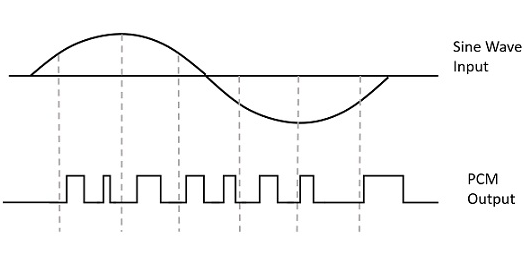
Pulse-code modulation (PCM) is a method of representing an analog signal as a sequence of numbers. It is the most common method of storing and transmitting digital audio.

PCM works by sampling the analog signal at a regular interval. The amplitude of the signal at each sample is then converted to a number. The number of samples per second is called the sampling rate. The higher the sampling rate, the more accurately the analog signal can be represented.

Once the analog signal has been sampled, it can be stored or transmitted as a digital signal. The digital signal can then be converted back to an analog signal by a process called decoding.

There are many different variants of PCM. Some of the most common variants include:

  • Linear PCM (LPCM): This is the most basic form of PCM. In LPCM, the numbers that represent the samples are stored in a linear fashion.
  • Differential PCM (DPCM): In DPCM, the numbers that represent the samples are stored in a differential fashion. This means that only the difference between the current sample and the previous sample is stored.
  • Adaptive delta modulation (ADM): ADM is a type of DPCM that uses a feedback loop to adjust the quantization step size. This allows ADM to achieve better noise performance than DPCM.
  • Pulse-density modulation (PDM): PDM is a type of PCM that uses pulses to represent the samples. PDM is often used in digital audio applications where low power consumption is important.

PCM is a versatile and efficient method of representing digital audio. It is the most common method of storing and transmitting digital audio, and it is used in a wide variety of applications, including CD players, MP3 players, and digital audio workstations.

Here are some additional details about the different variants of PCM:

Linear PCM (LPCM)

LPCM is the most basic form of PCM. In LPCM, the numbers that represent the samples are stored in a linear fashion. This means that the number for each sample is stored directly, without any compression.

LPCM is the most accurate form of PCM, but it is also the most bandwidth-intensive. This is because each sample must be stored as a separate number.

Differential PCM (DPCM)

DPCM is a type of PCM that uses a differential encoding scheme. In DPCM, only the difference between the current sample and the previous sample is stored. This allows DPCM to achieve better compression than LPCM, at the expense of some accuracy.

DPCM is often used in applications where bandwidth is limited, such as voice communications.

Adaptive delta modulation (ADM)

ADM is a type of DPCM that uses a feedback loop to adjust the quantization step size. This allows ADM to achieve better noise performance than DPCM.

ADM is often used in applications where high-quality audio is required, such as music production.

Pulse-density modulation (PDM)

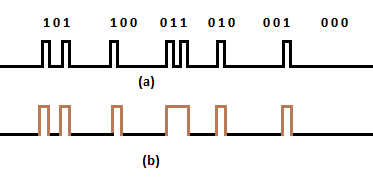
PDM is a type of PCM that uses pulses to represent the samples. In PDM, the amplitude of the signal is represented by the width of the pulses.

PDM is often used in digital audio applications where low power consumption is important. This is because PDM can be implemented using very simple circuitry.